
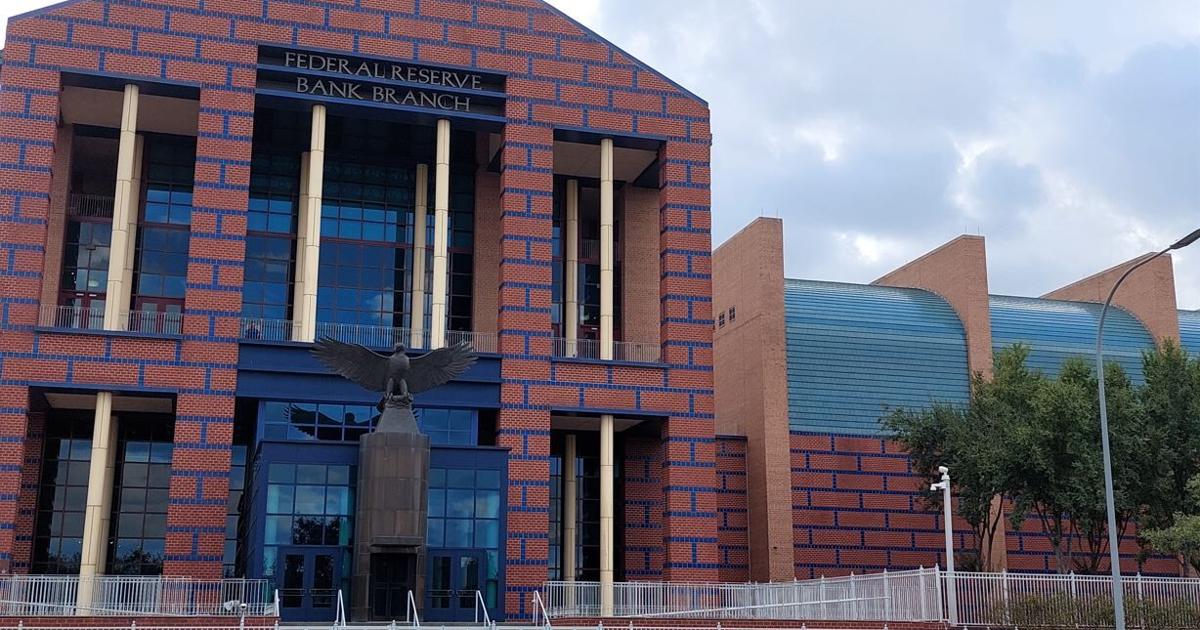
Federal Reserve Banks have been around since 1914 and are empowered to estimate currency demand, distribute, and regulate according to policy. There are 12 primary Federal Reserve banks across the U.S.
The Dallas Fed represents and supports the 11th Federal District. The district is comprised of all of Texas, northern Louisiana, and southern New Mexico. Additionally, the Dallas Fed has branches located in Houston, San Antonio and El Paso to assist in the endeavor.
The Houston Branch was originally located downtown. In late 2005, they moved into the iconic structure at 1801 Allen Parkway, between south Heights and downtown. The 280,000-square-foot building occupies 9 acres, previously the site of Jefferson Davis Hospital. As with all reserve bank buildings, it was self-funded and constructed at a cost of $95 million and no taxpayer dollars were used to build the facility.
The Dallas Fed introduced its Global Perspectives series nearly a decade ago, as a way to promote a better understanding of the economic landscape. The series is a platform that educates and connects the community, by sharing moderated conversations with significant thought leaders in the areas of local and national policy, academia and business. These live events were alternated between different cities in the district until the pandemic upended plans, schedules, and delivery mediums. Forums moved to virtual platforms. Notable past speakers, including Janet Yellen, Jerome Powell and Alan Greenspan merit live participation and interaction. Fortunately, the live conversations returned in 2025 and the latest Houston event did not disappoint.

On Nov. 18, President and CEO of the Greater Houston Partnership and Chair Gretchen Watkins shared their perspectives on the state of the community. (Photo by Stephanie Shirley)
Stephanie Shirley
On Nov. 18, the Houston Branch of the Dallas Fed hosted an event sharing the state of our community’s economic condition. The occasion featured Gretchen Watkins, former president of Shell USA. Her extensive energy and economic industry experience, both nationally and internationally, brought a unique perspective. She is currently the chair of the Greater Houston Partnership (GHP).
Moderating the conversation was Steve Kean, President and CEO of the GHP. He opened by saying, “The Greater Houston Partnership is non-partisan, so that’s enabled us to bring people together from all of our leading institutions in the city to work on big problems, big challenges, big opportunities.” The biggest challenge is connecting people and opportunity, he said. Their other big focus is in resilience and he said he’s proudly works alongside Watkins on both of these issues.
“I’m an engineer. I started as a facilities engineer working in New Orleans,” Watkins said. “The first five years of my career, I spent quite a bit of time offshore in the Gulf of Mexico. I’m absolutely dating myself by saying this was pre-deep water, so this was all the shallow shelf stuff, but it was a great way to start a career. I learned a ton and I really fell in love with an industry that I feel is really one that does great things for the world in many ways. And so it’s been a real honor to have worked for some absolutely great and amazing companies, to work with outstanding people. It’s been a delight to be involved in the Energy Advisory Council with the Fed and in many other ways in the city of Houston and beyond.”
Kean asked Watkins how, from her perspective as GHP Chair, she felt the city was doing. Without hesitation, her response was resoundingly positive.
Watkins shared her perspectives with more than 100 attendees. (Photo by Stephanie Shirley)
Stephanie Shirley
“The Houston metro is the youngest metro of the ten largest in this country and we have about 25% of our population under the age of 20-25,” she said. “So, we have a really young community here and that says a lot for the future of the city. We’ve also grown that population by about 4% over the last few years, while we’ve seen other cities actually contract. For example, in Chicago, we’ve seen the young demographic contract. We’re the second strongest job growth market, second only to Dallas. Two big Texas cities are responsible for creating the most jobs. We’re also the top export region in the whole country. Last year, we exported $181 billion worth of goods through the Port of Houston. And if you add up the amount of export from New York and LA, we have done more here than those two combined. And New York and LA are numbers two and number three.”
Watkins said the county has continued securing major investments in recent months, including what he described as the most significant one: a $6.5 billion commitment from Lilly Pharmaceuticals to build a new manufacturing plant. Eli Lilly is also partnering with Nvidia to build the most powerful Artificial Intelligence (AI) ‘supercomputer’ and Apple and Foxconn will be partnering on the facilities.
Apple, Nvidia, and Foxconn are key technology companies with strong, interconnected relationships between manufacturing and the AI supply chains, with Foxconn serving as the primary production partner for both. Watkins said that this will bring a wealth of opportunity and money into the city and county. She is convinced it’s positioning the community for long-term success.
Left to right: Steve Kean and Gretchen Watkins of the GHP with Lorie Logan, President and CEO of the Dallas FRB. (Photo by Stephanie Shirley)
Stephanie Shirley
“I love the fact that we’re not just talking about workforce development, but we’re also talking about how developing our workforce and developing our talent actually enables economic mobility. It enables people to move up the economic value chain in their life,” Watkins said, adding, “We have data that shows that after six years, of the kids graduating from Houston public schools, 20% or less are making a living wage. If that’s not a burning platform, I don’t know what is.”
The partnership is leading, but needs the business community to help connect the dots between the things kids are learning in high school and the educational opportunities afterwards, whether certification or higher education and how it leads to a healthy job market, where skills will be utilized. GHP’s launching a Connectivity Project, bringing together whole communities; academics, students and businesses to provide pathways between training and opportunity.
As an example, Kean shared that with power demand, including that of AI, the country won’t have enough electricians. It is estimated that 400,000 new electricians will be needed in the U.S. by 2031 and supply won’t meet demand. Even though the electrical workers may not get a four-year degree, the Connectivity Project will help promote training, providing for time and grade, as electrical services increase in demand. Wages will increase and new businesses will be started, as result of that pathway.
To learn more about the Global Perspectives Series or the GHP, visit dallasfed.org/research/perspectives or houston.org.