
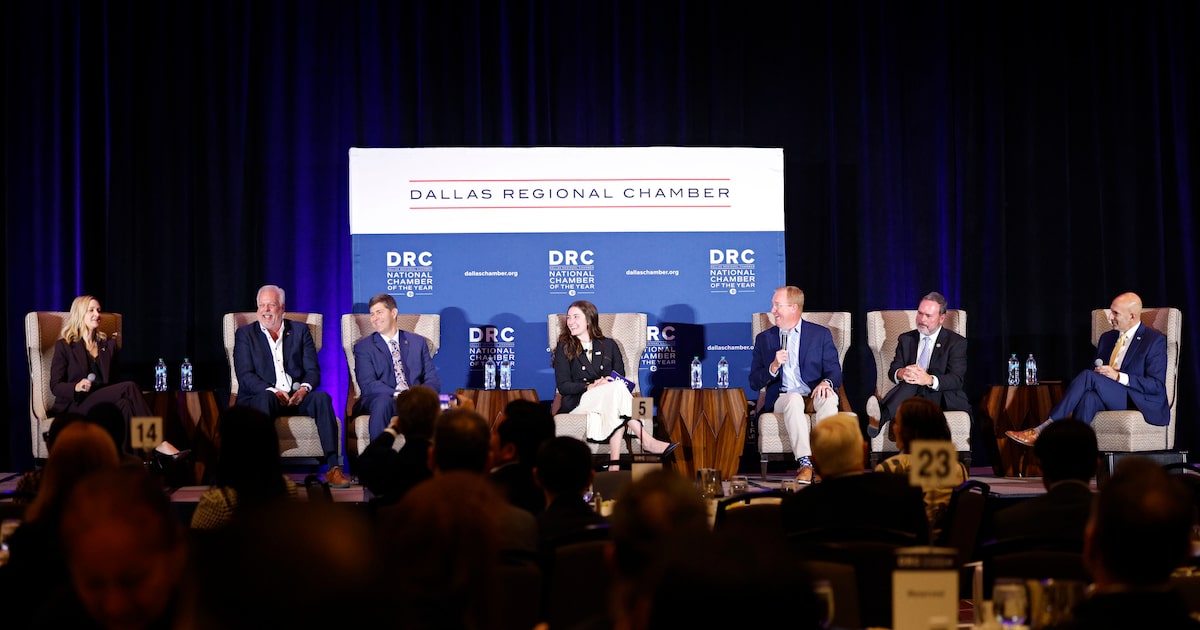
As North Texas grows in population and power, six mayors of some of the region’s largest cities called for collaboration and continued emphasis on economic development at the Dallas Regional Chamber’s State of the Region address.
The mayors of Fort Worth, Arlington, Garland, Frisco, McKinney and Richardson spoke in Richardson Wednesday about the importance of attracting businesses to the region, how state legislation has wrestled with cities for local control and why working cooperatively has given North Texas a regional advantage.
“When we work together, we win together,” said Dale Petroskey, president of the Dallas Regional Chamber, at the start of the address.
Leaders emphasized the need to work together at a pivotal period for North Texas amid booming economic and population growth, regional flashpoints in changing transportation and resource needs, and a shifting center of gravity outside of Dallas.
Breaking News
Related

“Our power is really regional,” said Fort Worth Mayor Mattie Parker in her remarks. “And now soon to be the third largest metro region in the entire country … all of us working together really reflects the success of the Dallas-Fort Worth region. And the sky’s the limit.”
In the next 10 years, the region is projected to grow to 10 million, surpassing Chicago, the third-largest U.S. metro area, according to the Texas Demographic Center.
Leaders of other cities were also invited to speak at the address, including the mayors of Dallas and Plano, but they declined to attend due to conflicts, according to Dana Jennings, the DRC’s executive vice president.
‘The greener grass’
Petroskey has led the chamber for nearly 12 years and said since 2014, the region has seen more than 800 significant corporate relocations and expansions and more than 300 headquarters have moved to the area — including Caterpillar, Charles Schwab and Toyota’s North American headquarters.
For many businesses looking to relocate to North Texas, it’s not a matter of if they’ll come to D-FW, but a question of where, Arlington Mayor Jim Ross said on the panel.
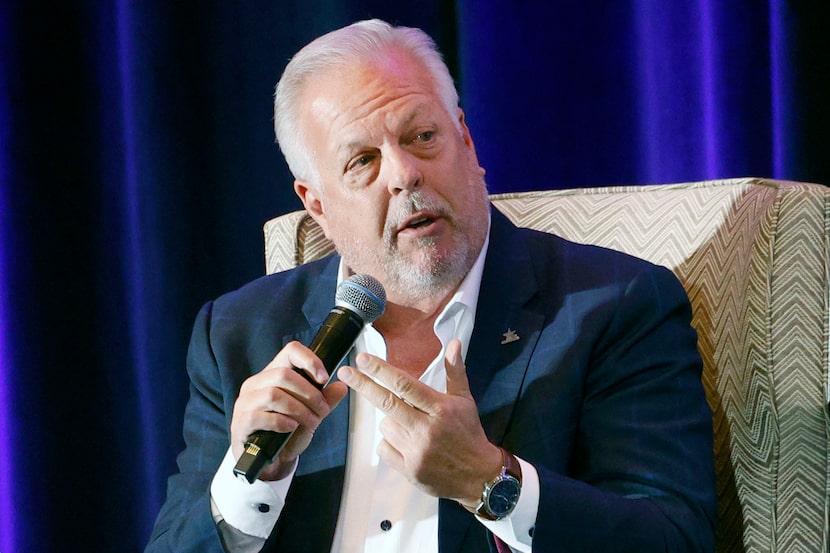
Arlington Mayor Jim Ross speaks during a breakfast meeting for the Dallas Regional Chamber’s State of the Region, Wednesday, Dec. 3, 2025, in Richardson.
Chitose Suzuki / Staff Photographer
“They just haven’t decided what part of North Texas they’re coming to yet, and that gives us the edge on so many communities around the country,” he said.
In the “Texas triangle” of D-FW, Houston, Austin and San Antonio, North Texas is the region’s “economic heart,” said Mike Rosa, Senior Vice President of Economic Development at the Dallas Regional Chamber.
“We are the greener grass,” he said.
Rosa lauded innovative sectors like artificial intelligence, life sciences, data centers and autonomous mobility in D-FW, and other leaders spoke to the industries that help cities balance cooperation and competition.
“We do this nice, friendly ‘cooper-tition,’” Frisco Mayor Jeff Cheney said. “But having your own niche and brand really helps [us] stand out. And I think all the cities in the D-FW have done that, and that’s a big part of the story, as far as why [we’ve] become a powerhouse.”
Related
For Frisco and Arlington, sports and tourism dominate local economic development projects. In Fort Worth, Parker spoke to film and television production’s impact on the local economy. But local leaders underscored that a rising tide lifts all ships when it comes to the region’s economic development goals.
“We all compete against each other for businesses,” Ross said. “But the bottom line, I know that the better Richardson does, the better we do, the better Frisco does, the better we do.”
Conflict in Austin
The six mayors were unified in their concern about state legislation that has taken over local control — including a new law that allows more apartments and mixed-use residential buildings without city approval.
In the most recent legislative session, lawmakers also passed new rules that slashed some homeowners’ property taxes. The Texas Regulatory Consistency Act, passed in 2023, bars local governments in Texas from creating or enforcing local rules that go beyond state law.
Related

“It seems like it’s an all-out attack every two years on cities,” Cheney said. “All the tools that we have in place that have [contributed] to our success are being taken away from us every single session.”
Leaders emphasized how local governance is harder with blanket rules on development and politicized agendas that muddy local efforts.
“I know my neighborhood better than someone who’s in Austin, and I sure as hell know better than someone who’s in Washington,” Garland Mayor Dylan Hedrick said.
DART and regional transit’s future
As several cities seek an exit from the Dallas Area Rapid Transit system, the future of regional transit has come into question. At least four cities will hold elections next year to withdraw from DART, the state’s largest public transportation agency.
“I think it would be an awful thing if we end up losing any of the cities,” Richardson Mayor Amir Omar told The Dallas Morning News following the address. “Frankly, I think the better thing for the entire region is for more cities to join.”
Related

Omar said leaders of DART’s 13 member cities meet regularly to work toward a solution, and he believes it’s possible Plano, Irving, Farmers Branch and Highland Park will call off their withdrawal elections and come to an agreement with the agency.
But regional connectivity extends northward as the D-FW center of gravity moves north. Cheney said communities like Celina are now living Frisco’s story of growth 20 years later.
“The northern part of D-FW is going to continue to grow, and so we’re already collaborating as a region in McKinney, Plano, Frisco,” he said. “We’re thinking about that as a region from a transportation perspective, from an amenity perspective.”
Email tips on all things Collin County to lilly.kersh@dallasnews.com.