
Angelica Ruiz, the temple’s director of libraries and archives, says one of the things the congregation is particularly proud of is the temple’s involvement in the Civil Rights Movement. The rabbi at the time, Rabbi Levi Olan, was one of the first white clergymen to march with Black clergymen in the fight for civil rights.
In the 1920s, Olan’s predecessor Rabbi David Lefkowitz opposed the rise of the Ku Klux Klan.
Ruiz also points to members of the congregation that were part of the push for the desegregation of Dallas schools, including prominent members like the Marcus family of Neiman Marcus.
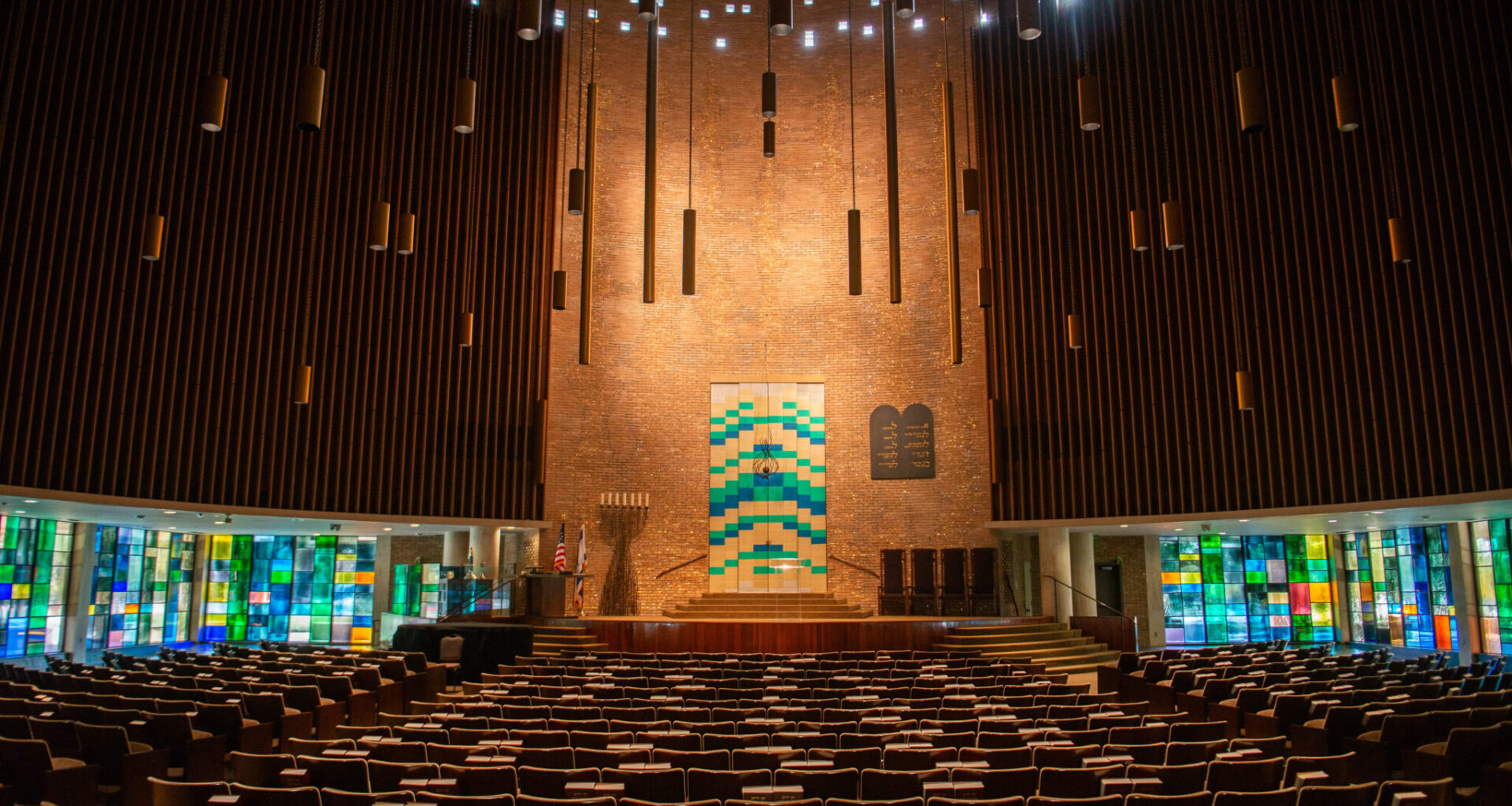
Natural light floods the space from the windows placed throughout the building. Stern, who serves as senior rabbi, references a sixth century teaching from the Talmud, which says synagogues should have windows. He says this teaching has many interpretations, one of which is that windows allow you to look outside to see the beauty of creation and nature.
“Especially for us as a Reform synagogue, we do not believe in a kind of fortress of Judaism, a kind of drawing the wagons into a circle and facing inward,” Stern says. “It’s always been our ethical commitment to be able to see beyond your own walls, so that’s what the windows represent to us.”
Walking through the synagogue, one can find a digital impact map, which shows all the nonprofits, schools, universities and social service agencies that members of the congregation have led or heavily contributed to.
The temple has grown rapidly since its founding, now becoming one of the largest Jewish congregations in the South with around 2,500 member households from across the city. As a result, Stern says the congregation’s demographic has gotten more diverse.
Another major change he has seen over the years is a return to Jewish tradition, which mirrors changes in the Reform movement as a whole. Compared to 30 years ago, Stern says there is now more Hebrew used in worship along with more rituals and traditional practices.
“We still maintain our emphasis on social justice, and yet now deepen that with a richer sense of attachment to tradition and ritual and practice,” Stern says. “And to me, they sort of sustain each other in a very beautiful and powerful way.”
Stern says that despite the congregation’s size, members are still able to connect with each other due to the clergy and congregation’s emphasis on forming relationships.
“Not every rabbi is privileged to lead a congregation that they would want to belong to, and I feel that sense of privilege,” he says.
Congregation Shearith Israel