
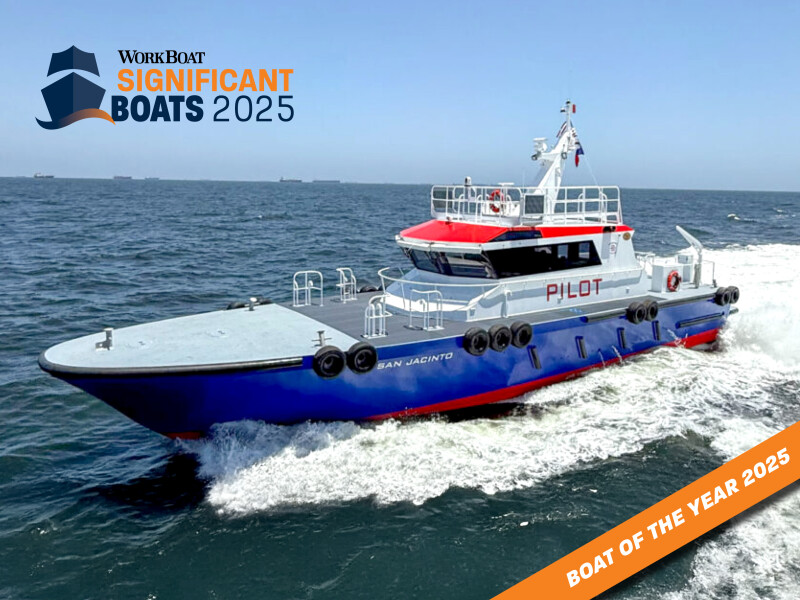
This year’s Boat of the Year marks the third consecutive time that sisterships have taken home the International WorkBoat Show’s top award. The honor went to the Houston Pilots’ two new high-speed launches built by Breaux’s Bay Craft, Loreauville, La.
This year’s Boat of the Year marks the third consecutive time that sisterships have taken home the International WorkBoat Show’s top award. “It seems if you want to win the Boat of the Year, just build two of them,” WorkBoat’s Ben Hayden said during the ceremony. The honor went to the Houston Pilots’ two new high-speed launches built by Breaux’s Bay Craft, Loreauville, La.
WorkBoat’s Top 10 Significant Boats list covered a wide functional range this year, including pilot boats, three ferries, an Alaska patrol boat, two research vessels, an inland towboat, a tractor tug, and a rebuilt offshore service vessel converted into a space-capsule launch platform.
The 80’×21′ San Jacinto, delivered in May, and its sister vessel Juan Seguin, scheduled for delivery later this year are each powered by three MAN D2862 LE438 Tier 4 engines, rated at 1,200 hp apiece and paired with Twin Disc MGX 5204 SC gears and HamiltonJet HTX47 waterjets.
 Representatives accept the 2025 Boat of the Year award at the International WorkBoat Show, recognizing the Houston Pilots’ twin high-speed launches built by Breaux’s Bay Craft. Doug Stewart photo.
Capt. Billy Kern, third executive officer, said the group selected MAN engines to maintain consistency with its station boats. “We wanted continuity for our maintenance and repairs,” he said. “We’re trying to streamline our maintenance process. And we wanted fuel efficiency, of course.”
The boats are among the first EPA Tier 4 pilot boats in the U.S. and the first using a three-engine MAN configuration. Kern said the group initially debated the setup, “we figured out that running those three engines, but not running them at full power, has given us about four knots faster than our old boat, but burning less fuel.”
The contract required 30 knots at roughly 80% load. With an inverted deep-V hull designed by ECS Marine, the San Jacinto exceeds that mark, cruising at 32.5 knots at 1,950 rpm with a 37.5-knot top speed. Fuel burn is 43 gph per engine, with 2,200 gals. fuel capacity.
The main engines are fitted with water-cooled exhaust systems and Soundown-built SCR units mounted overhead. Three 145-gal. stainless steel DEF tanks support the emissions system.
A fixed CO₂ system with dual 100-lb. bottles, auto engine shutdown, and vent closures was supplied by Total Safety and installed by Burner Fire Control.
To improve comfort during low-speed or idle periods offshore, the San Jacinto carries a Seakeeper 40. “A lot of times, the boat’s moving slow or waiting for a pilot,” Kern said. “That Seakeeper just keeps the boat so stable.”
The pilot boats use HamiltonJet AVX controls, an update from the pilots’ older jet boats. “There’s a mouse pad now with kind of a docking mode,” Kern said. “You just move this mouse wherever you want the boat to go, and it does it.”
The NorSap 1700 captain’s chair is fitted with a left-arm joystick. “[A helmsman] can sit back and control the steering with their left hand and then control the buckets with their right hand, so they don’t even really have to leave the chair,” he said.
Additional seating includes nine NorSap 1600 reclining seats. The cabin features aluminum framing, marine-grade acoustic plywood, and PlasTEAK flooring. Ceilings are marine plywood with black vinyl. Sleeping space is provided for four.
Kern said the pilots chose functional finishes over yacht-style interiors. “We decided to go minimal, which did cut down on some weight… They can have everything apart with just a screwdriver.”
Ship’s power comes from two Northern Lights M944T3FG 38-kW generators. HVAC includes dual four-ton Dometic variable-speed chillers with titanium coils and five air-handling units. EEG Marine provided insulation. Centek Industries supplied mist eliminators and blowers.
Electronics installed by Rio Marine include three Delta19 displays, Furuno 1518 radar, a Furuno FA170 AIS, FE-800 sounder, LH5000 loudhailer, GP170D DGPS, SC-70 sat compass, Dual Cobham SAILOR 6248 VHFs, ACR GlobalFix V5 EPIRB, and FLIR thermal/visible cameras.
Forward and overhead boarding areas were designed for stable transfer operations. The vessel also carries a SeaLift rescue system on the stern.
The pilothouse uses fritted laminated glass with built-in defrosters from B&G Glass. SeaDeck decking from Castaway Customs Texas covers the walk-around areas. Logos and name markings were produced in reflective material by Lipari Sporting.
The San Jacinto is now in service, moving pilots to and from ships entering and departing the Port of Houston.