

This story is a collaboration between The Barbed Wire and the Investigative Reporting Workshop— a nonprofit newsroom at American University that trains student journalists on in-depth reporting.
When she was elected mayor of Houston in 2009, Annise Parker became the first openly gay mayor of a major American city.
In 2014, Houston was one of the few such cities without an anti-discrimination ordinance, so five years into her term, she put one together using wording from the 200 or so existing laws across the country. Parker proposed the Houston Equal Rights Ordinance, or HERO, to ban discrimination over gender identity, sexual orientation, and other federally protected characteristics like race and religion.
Then the public comment period took a turn.
Opponents focused on a single paragraph in the 34-page ordinance — which would allow people to use restrooms fitting their gender identity — claiming it would open the door to sexual assault by men pretending to be women in women’s only facilities.
“At first I laughed,” Parker said in an interview in 2023, and echoed to The Barbed Wire this week. “The sexual predators language, men in women’s bathrooms, goes way back.”
Over the last century, every time a marginalized group has demanded equitable access to public services and facilities, conservatives have responded with messaging about threats to public safety, with little — if any —evidence to back the claims. In that way, restrooms have long been a barometer for the state of civil rights in the U.S., and as Politico reported, the fight to separate transgender individuals has parroted the rhetoric of segregationists.
Nowhere more so than Texas.
What Parker witnessed in Houston in 2014 was an opening salvo in what would become a raging national war over what protections are afforded to transgender Americans — with Texas at the epicenter of a 10-year battle over laws to control who is allowed in what restroom all over the country.
On Thursday, Texas’ first law dictating what facilities transgender and gender non-conforming Texans can use went into effect — the first of 19 attempts to have successfully made it to the governor’s desk, and only after the governor called for a second special legislative session.
The legislation has left many confused about how the law will be implemented, since it is limited to bathrooms in public schools and state government buildings, enforced with a vigilante component and state investigations, and can result in fines on noncompliant public entities (not individual bathroom users).
But its clumsiness as a policy belies the fact that it is the culmination of a herculean, decade-long push by legislators to limit the facilities used by transgender individuals.
Nationally, many Americans associate bathroom bills with North Carolina — where House Bill 2 was the first to become law. Yet, the movement got its start in earnest in Texas, buoyed by the defeat of HERO.
Though the Houston City Council voted in favor of HERO in 2014, it was short-lived. Within weeks, a group of pastors with the backing of prominent social conservative groups started a campaign to overturn it, running ads and distributing signs with the slogan: “No Men In Women’s Bathrooms.” A bruising legal battle led to a Texas Supreme Court ruling that put the ordinance on a ballot, where it was voted down.
Over the next year, Republican state legislators in Texas proposed at least nine separate bills restricting the rights of LGBTQ residents, including four that would make it illegal for people to enter restrooms that didn’t match their sex at birth.
None made it into law for more than a decade. That is, until September, when Gov. Greg Abbott signed Senate Bill 8, which carries the highest financial penalty of any existing bathroom bill in the nation.
The Barbed Wire has reconstructed the law’s evolution — from objections over a city ordinance to a new strategy that weaponized the issue of women’s safety to fight a broader, ever-sprawling culture war — to better understand why Texas politicians have spent more than a decade obsessing over the bathroom rights of roughly 1% of the population.
Reporting showed no problem to be solved: There’s no evidence of a public safety threat to women or children by allowing trans individuals to use the bathroom of their preference. There is, however, substantive research that these bills negatively impact trans individuals, leading to medical complications from restroom avoidance, harassment, and even assault.
Work for this story began in 2023 as part of a project by the Investigative Reporting Workshop, a nonprofit newsroom at American University. Journalism students, interns, and editors over the past two years combed through more than 1,600 bills filed across multiple states since 2015 that targeted the rights of transgender Americans. Reporting for the project included interviews with advocates, academics, politicians, and activists on all sides of the measures.
The Workshop’s reporting showed that, in the decade since it became commonplace for anti-discrimination ordinances to include gender identity, there’s been a sustained backlash of proposed laws eroding the rights of transgender and gender non-conforming people. In the last five years, the country has seen thousands of bills restricting everything from who can play on which high school sports teams and what healthcare trans teens can receive to how teachers can interact with students who prefer gender neutral pronouns — with more than 1,000 filed in 2025 alone.
Behind many of them is messaging that the Workshop and The Barbed Wire have traced back to the 2014 HERO battle. Our findings indicate that conservatives’ 2014 win became a blueprint for right-wing groups, religious organizations, and Republican politicians trying to outdo primary opponents.
“This is not communities spontaneously rising up against protecting trans folks,” said Parker in 2023, noting that “the messaging piece, the legislative piece that has come since then… has been from the right wing think tanks that have poll-tested and created language and shared it with legislators.”
“They are trying to pump it out,” she said.
Houston Was a Case Study
After the public comment period in 2014, Parker pulled the restroom section of HERO.
It wasn’t enough for some opponents like Dave Welch, who spoke with the Investigative Reporting Workshop in 2023 before his death earlier this year.
Welch first entered the public policy arena in 2003 with the launch of the Houston Area Pastors Council, and later the U.S. Pastors Council, a coalition of like-minded religious leaders who Welch said believe in civic engagement to advance a Biblical worldview.
He had concerns over the 2014 Houston Equal Rights Ordinance from the start.
“The reality is that it was one of the progressing steps forward of what we now know as the LGBTQIA+ movement to deconstruct the traditional order of male and female marriage, as well as a direct assault on personal freedom and religious liberty,” Welch said. “It demanded that we speak to the issue.”
To understand the strategy used to pass these types of legislation across the country requires a quick study of the tactics used by Welch and his national counterparts back then.
Welch, along with four other pastors and conservative donors, launched a petition to send the ordinance to voters. The local coalition, called Campaign for Houston, had help from national players.
The Alliance Defending Freedom, an influential Christian legal group behind more than a dozen conservative Supreme Court victories including the overturn of Roe v. Wade, had worked with the Pastors Council in Houston on similar issues over the years, Welch said, and provided a key element in the fight against HERO — supposed cases of violence in bathrooms by transgender individuals. The Alliance Defending Freedom did not reply to the Investigative Reporting Workshops requests for comment in 2023, or The Barbed Wire’s this week.
Behind the scenes, the Alliance turned to the American College of Pediatricians, a small group of conservative doctors considered a hate group by the Southern Poverty Law Center for its use of discredited anti-LGBTQ science. According to a copy of emails left public in a data breach, first reported by WIRED, the Alliance’s senior counsel wrote to the American College of Pediatricians’ executive director asking for white papers — reports conveying expertise often used by policymakers — on pressing LGBTQ+ topics.
At the top of the list: substantiating long-term psychological harm to women and girls “by having
their right to bodily privacy invaded by males.” In essence, the Alliance Defending Freedom asked the American College of Pediatricians for proof of claims the Campaign for Houston was making in marketing that HERO would compromise the safety and privacy of women and girls.
According to a 2015 report by The Daily Beast, the Alliance Defending Freedom and the other national groups also changed the initial campaign slogan from “Unequal Rights” to “No Men in Women’s Bathrooms.”
The city secretary certified that Welch and the others collected enough signatures for a ballot referendum, but a city attorney disagreed, finding many of the signatures invalid. Parker rejected the petition, and the Campaign for Houston sued with firepower from the Family Research Council, another prominent Christian-right advocacy group.
As lower courts ruled in the city and the ordinance’s favor, the Alliance Defending Freedom sent letters to school districts across the country with a recommended policy requiring transgender students to use bathrooms that matched their birth sex, and proposed model legislation with similar restrictions to state assemblies.
Then, in 2015, the Texas Supreme Court ruled the city had to repeal the ordinance or put it to a vote. Proposition 1 made it onto the November ballot and into national headlines, thanks in part to prominent conservatives like former Arkansas Gov. Mike Huckabee
“No Men in Women’s Bathrooms” was printed on yard signs, repeated in radio spots, and in numerous TV ads. In one, former Houston Astros star Lance Berkman, who is related by marriage to Tucker Carlson, referenced his wife and four daughters, before claiming Proposition 1 “would allow troubled men to enter women’s public bathrooms” and “put them in harm’s way.” In another, a young girl was followed by a man into a restroom stall behind text reading “any man any time” and “registered sex offenders.”
The Investigative Reporting Workshop found no evidence of crimes against women in restrooms by men posing as transgender as the result of anti-discrimination policies in the last ten years. One case referenced by conservative activists involved a male student in a skirt sexually assaulting a female student in the girls bathroom of a Virginia high school in 2021, though the assault occurred before a policy allowing transgender students to use the bathroom of their choice was put in place.
The progressive research group MediaMatters contacted experts in a dozen states with such policies, and later school systems, and found no instances of sexual assault. It did find a case of supposed harassment that was debunked. PolitiFact, run by the Poynter Institute, similarly said it could find no instances of criminals convicted of using transgender protections as a cover in the U.S.
Houstonians voted against the ordinance 61% to 39%. It was a crucial win for social conservatives less than five months after the Supreme Court decision legalizing gay marriage.
“That’s really when opponents of LGBTQ rights realized that there was very little they could do to convince the public to restrict the rights of gays and lesbians. That proverbial ship had sailed as America became more accepting of same-sex sexuality,” said Marie-Amelie George, professor of law at Wake Forest University. “But trans rights issues were a really successful wedge issue that could bring people to the polls and lead to restrictions on not just trans rights but also gay, lesbian, bisexual rights.”
The Spread of an Effective Anti-Trans Message
In 2018, Rolling Stone and Type Investigations co-published a story identifying “the secret history of bathroom bills” — diving into the way “a small band of far-right activists in Houston sparked a movement against transgender rights.”
As reporter Sarah Posner wrote: It started in Houston.
A key takeaway from the effective Campaign for Houston was messaging. Opponents had flipped a debate on legal protections to one on the safety of women and girls and resuscitated anxieties dating back to at least the early 19th century.
In the ‘50s and ‘60s, amid the fight for racial desegregation, conservatives spread the false idea that Black men were rapists and Black women were apt to spread venereal disease. In a 1961 court case, the city of Memphis argued public welfare required the city to maintain separate facilities “for reasons of health, sanitation, and related factors.”
Around the same time, police crackdowns on same-sex sexual activity in men’s rooms stoked fears of child predators hiding in toilet stalls. Officials sent out pamphlets and public service announcements warning kids to be on guard for sexual deviants in bathrooms.
In the ‘70s, prominent conservative activist Phyllis Schlafly drew on those lingering fears in her fight against the Equal Rights Amendment, which would have guaranteed legal gender equality, telling the New York Times it would lead to coed bathrooms and “coed everything — whether you like it or not.” The women’s liberation movement, she added, was “an antifamily movement that is trying to make perversion acceptable as an alternative life-style.”
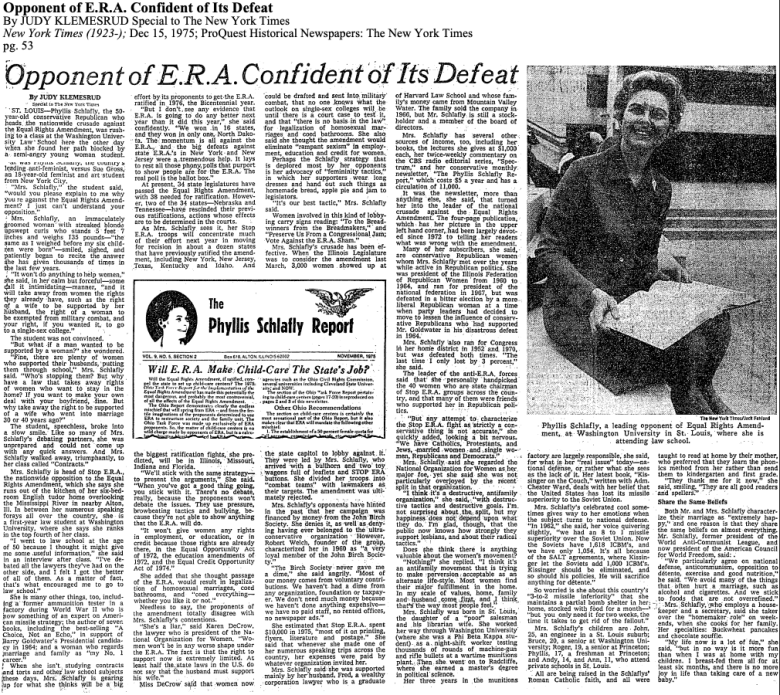
Around the same time, Parker got her start as a gay and lesbian activist in college in the mid-1970s, and she went on to work for the LGBTQ+ Victory Fund, a political action committee. The safety-in-bathrooms messaging was a hallmark of the Schlafly and ERA fight, she remembers now.
“It truly was that the Equal Rights Amendment was going to drop all the barriers and women wouldn’t be safe,” she told The Barbed Wire, pointing out the irony of targeting one marginalized group under the guise of helping another.
“Let’s discriminate by saying, ‘Let’s protect women.’”
In essence, the Campaign for Houston transferred old fears to a small subset within the LGBTQ+ umbrella that many Americans knew little about.
“Fewer than 30% of Americans actually know a trans person,” said Rob Todaro, communications director for the progressive think tank Data for Progress, “so that whole environment was ripe for a lot of fear mongering and misinformation to spread.”
George, the Wake Forest professor who specializes in LGBTQ rights, agreed, noting that “once conservative groups debuted that argument, it really galvanized people and led to a widespread repeal of gender identity protections in cities and towns around the country.”
After the November vote against HERO, standalone bathroom bills, modeled off the Alliance’s legislation — and promoted with messaging that had worked in Houston — began proliferating across state governments from Nevada to Kentucky.
In 2015, the first Texas bathroom bill proposals came from former state Rep. Debbie Riddle (R-Tomball), in which she said that it should be a crime for people to enter a bathroom or locker room that does not match their assigned sex at birth.
Riddle filed two bills that session, and former Rep. Gilbert Peña (R-Pasadena) also filed two in a similar vein, according to the Texas Tribune. One of Peña’s proposed bills would have allowed students to sue their school over sharing bathrooms with transgender students. The four bills were never heard by the legislature, according to the Texas Tribune, and Peña’s bill was removed from the agenda by the chair of the House State Affairs Committee due to its harsh language, according to the Associated Press.
Across the country in 2015, lawmakers from nine states had introduced 17 bathroom bills. That tally jumped in 2016, with 30 bathroom bills proposed across 18 states.
In early 2016, the city of Charlotte, North Carolina, passed an anti-discrimination ordinance with protections for gender identity. Within days, state lawmakers responded with a special session to pass a bill, known as House Bill 2, overriding local anti-discrimination ordinances and requiring all public school and government facilities be restricted to sex assigned at birth. Again, the messaging was about safety. The bill’s full name was “Public Facilities Privacy and Security Act.”
Then-Gov. Pat McCrory signed it the same night it passed. It became the first law in the country prohibiting people from using bathrooms that do not match their assigned sex at birth.
A wave of backlash followed. The NCAA pulled its championship games from the state, companies like Paypal withdrew from expansions planned there, and artists like Bruce Springsteen and Ringo Starr cancelled concerts. Overall, the Associated Press estimated the bill would cost North Carolina $3.76 billion in lost business over a dozen years.
Texas saw significantly less pushback from local artists and independent businesses — but the stances taken in North Carolina helped ensure the version in the Lone Star State failed to pass.
That same year, another proposed bathroom bill in Texas by Sen. Lois Kolkhorst (R-Brenham) failed after backlash both from advocates for transgender rights and for businesses. Lt. Gov. Dan Patrick was a strong proponent of such a bill, but then-House Speaker Joe Straus rallied against it, arguing that it would bring Texas similar economic consequences to the ones faced in North Carolina. Straus’s position was backed by top business executives, according to the Texas Tribune. The bill died quietly after the Senate advanced it but it failed to garner enough House support for a hearing before the legislative session ultimately came to a close.
Still, the bills spread, as did the messaging.
During the race for governor in North Carolina later that year, McCrory faced a heated challenge from Democrat Roy Cooper. A conservative activist group recreated the Campaign for Houston’s ad, frame-by-frame, swapping Houston for Cooper, claiming he’d allow “any man at any time” to enter a women’s bathroom “simply by claiming to be a woman that day.”
Cooper went on to win the governor’s seat and repeal House Bill 2. But other politicians picked up the messaging.
U.S. Sen. Ted Cruz, seeking a way to outpace President Donald Trump in the polls in the 2016 presidential election, seized on what the New York Times called a “once-obscure issue with a proven power to inflame conservatives.” On social media and on campaign stops, he repeated much of the language that came out of the Campaign for Houston.
“In leveraging the issue, Mr. Cruz has raised the specter of sexual predators in women’s restrooms, which conservatives around the country have effectively invoked to defeat anti-discrimination laws — and which gay rights advocates denounce as a myth,” the Times wrote.
A New Norm: 1,000+ Bills Targeting Trans People Per Year
Kyle Riley was in high school in Amarillo in 2017, when another wave of bills on issues targeting transgender Texans hit the 85th Legislature. A group of Republican senators proposed a bill restricting bathrooms to biological sex that cleared the Senate but failed to pass the House.
As a young trans man, Riley said watching the attacks on trans rights from the conservative Panhandle was unsettling.
“Things felt very out of my control and scary,” Riley told The Barbed Wire this week. (Riley is now an ordained minister with the United Church of Christ and a public witness mobilizer for Texas Impact, a political advocacy organization for faith leaders.)
But as conservative groups were galvanizing, so too were trans advocates and progressive lawmakers.
In 2017, then-state senators Sylvia Garcia (D-Houston) and José Rodríguez (D-El Paso) proposed two bills that would allow users to choose the bathroom that matched their gender identity, rather than their biological sex. State House Rep. Gina Hinojosa (D-Austin) filed a similar gender-identity bill in the House, but none of the Democrats’ three measures made it through their respective chambers.
In 2017, the American Civil Liberties Union identified 28 bills involving “single-sex facility restrictions,” and according to MediaMatters, 10 of those contained language resembling the Alliance Defending Freedom’s model legislation.
Even though a small portion of the proposals passed, those championing the movement made it clear their aim was as much about manipulating public sentiment as crafting law.
“For all its recent success, the LGBT alliance is fragile,” Meg Kilgannon, a longtime conservative activist, would explain later, during a 2017 panel discussion featuring other key leaders in the movement to restrict LGBTQ rights. “Trans activists need the gay rights movement to help legitimize them. Gender identity on its own is a bridge too far. Separate the T from the alphabet soup.”
In 2017, 54% of Americans polled by the Pew Research Center said they believed that gender is fixed to what is assigned at birth. By 2022 that had grown to 60%. That same 2022 survey found 43% of Americans — and 70% of Republicans — said societal views on gender identity are changing “too quickly.”
Two years later, during Texas’ 2019 legislative session, Patrick said there was no need to revive the bathroom bill, according to the Texas Tribune.
“Sometimes a bill doesn’t pass, but you win on the issue,” Patrick said at the press conference. “There aren’t any school districts forcing students — as one school district was — to share showers, lockers and bathrooms.”
Despite Patrick’s statements, experts told the Tribune that accommodations were still made for transgender students on a case-by-case basis.
The number of bathroom bills introduced in state houses slowed for several years — but the movement behind anti-trans legislation did not. A record number of bills targeting the rights of transgender people were filed in 2020, extending beyond bathrooms and instead focusing on healthcare, sports, and education. Every year since has seen a new threshold.
The 2021 legislative session in Texas went by without a bathroom bill, but legislation was passed preventing public school students from competing on sports teams that do not match their assigned sex at birth.
Then 2023 hit a fever pitch. Two measures levied against transgender individuals in Texas were passed: a restriction of college sports teams to sex assigned at birth, and a ban on gender-affirming care for minors.
That year, the Investigative Reporting Workshop found hundreds of individual pieces of legislation in all 50 states that would dictate the rights of transgender citizens. The Trans Legislative Tracker identified more than 600. That number grew to 700 in 2024.
The following year, the Tracker identified 59 bathroom bills nationally and more than 1,000 anti-trans bills more broadly. Both numbers shattered all previous tallies.
By the first few days of the 89th Legislature early in 2025, a Texas-based GLAAD representative told The Barbed Wire that GLAAD and Equality Texas, nonpartisan statewide political advocacy organization, counted more than 30 anti-trans bills filed in Texas alone.
By mid-February, Equality Texas had tracked more than 50 anti-LGBTQIA+ bills. The Trans Legislative Tracker ranked Texas as the leader in the country for anti-trans bills this year, with 139 by the end of all of the legislative sessions.

The Barbed Wire reported that 11 variations of a bathroom bill were proposed. Six bills were filed in the regular session, two in the first special session, and three in the second special session. One of those three was Senate Bill 8.
The “Texas Women’s Privacy Act,” or Senate Bill 8, was authored by state Sen. Mayes Middleton (R-Galveston) and sponsored in the House by state Rep. Angelia Orr (R-Itasca) during the 2nd special session. It was passed after hours of debate and protest. It was signed into law by Abbott in September.
The bill says that multiple-occupancy private spaces — such as restrooms, locker rooms, and changing rooms — fall under the new restrictions. State government entities, including school districts and county authorities, must designate these spaces in their buildings as restricted to one sex only, according to the bill. It does not apply to private businesses, and it does not specify how institutions should monitor compliance other than to “take every reasonable step” to ensure only members of the designated sex are using the correct facilities.
The bill provides some exceptions: A member of the opposite sex can enter these spaces for custodial purposes, for a medical or law enforcement emergency, to accompany someone who needs assistance, or if they are a child aged 9 or younger. The bill also does not prohibit institutions from having single occupancy private bathrooms or changing rooms that anyone may use.
Also included is a provision that inmates in correctional facilities be separated by sex, and that domestic violence shelters designated for women may only provide services to those of the female sex and minors in their care.
The bill also states that institutions found in violation of the complaint can be initially charged up to $25,000 and an additional $125,000 for every subsequent day they do not comply with the bill. That means this bill carries the highest financial penalty of any existing bathroom bill across the nation.
Texas’ law brings the total to 19 states — including Wyoming, South Dakota, Arkansas, West Virginia, Idaho, South Carolina, Mississippi, Oklahoma, and Montana — that now have restrictive bathroom bills in effect, according to Stateline.
Many conservative lawmakers said they viewed the bill as a culmination of their previous efforts to restrict gender divisions by biological sex.
“We protected girls’ sports, we protected women’s sports, we passed the bill to define male and female … and now the last piece of this equation is putting the penalties in the law,” said state Sen. Mayes Middleton (R-Galveston) on the legislative floor in August, according to the Texas Tribune.
‘Towards the Far Right Edge’
A lot has changed in the LGBTQ+ rights space, and the country writ large, since the battle over Houston’s bathrooms began in 2014.
Dave Welch, the Houston pastor who helped form the campaign against the Houston rights amendment and pioneer messaging behind bathroom bills, died in June. The Texas Legislature honored him with a resolution for being at “the forefront of interactions between the church and members of government at the city, state, and national levels; many leaders in Texas government, including state senators and the lieutenant governor, worked with Pastor Welch for the better part of two decades, and his commitment to faith, family, and freedom reflected the highest ideals of the Lone Star State.”
Trump has won and lost and won the presidency again. He issued a series of executive orders against trans people, including one “defending women from gender ideology extremism.”
Parker thinks that’s one of the many reasons Texas Republicans were successful in finally getting a bathroom bill passed after failing for the previous five legislative sessions. That and Texas’s march further right as Abbott and other state leaders have pushed out moderate Republicans.
“They primaried folks to really drive the legislature more towards the far right edge. Then you had Trump coming in and suddenly no more trans folks in the military and so forth, legitimizing these efforts,” Parker said. “I think the combination is why it passed. With no care about the pain and the impact on people’s lives.”
A survey by Data for Progress published in March looked at opinions around the policies and their impact. Eighty five percent of transgender adults said anti-LGBTQ+ policies and rhetoric negatively impacted their mental health.
“A lot of people right now especially feel very helpless,” said Kyle Riley, who has now been at Texas Impact for three years. “That was the feeling that I had, and one of the main things that has helped me alleviate that feeling has been being able to do something about it, working towards something.”
Part of that is focusing on creating good public policy. He said it’s become more and more apparent that many proposed laws on gender identity are not, in fact, good policy. As with the new bathroom law, Riley has found many lack the fundamentals: guidelines for implementation, clear outcomes, or ways to collect data or assess effectiveness.
“They’re policy approaches meant to sow fear,” Riley said. “That’s not public policy, that’s a form of violence.”
So, they’re going back to basics, turning heavy feelings into action. Some wars are not fought and won in 10 years.
Parker, for her part, tried to retire. Then Trump was elected, and she got tired of sitting at home. Now she’s running for Harris County Judge.
“I was like, ‘What am I good at? I’m good at this.’ I’m going to run.”
The Investigative Reporting Workshop’s data editor, Aarushi Sahejpal, contributed to this report. As did IRW interns Andy Tallman, Helena Milburn, Daniela Lobo, Mirika Rayaprolu, Hamed Ahmadi, Madison Moore, Hayden Godfrey, and Isabel Del Mastro.
Correction: This story previously, erroneously referred to Democratic North Carolina Gov. Roy Cooper as Roy Moore. It has been corrected in the text. The Barbed Wire regrets the error.
Related