
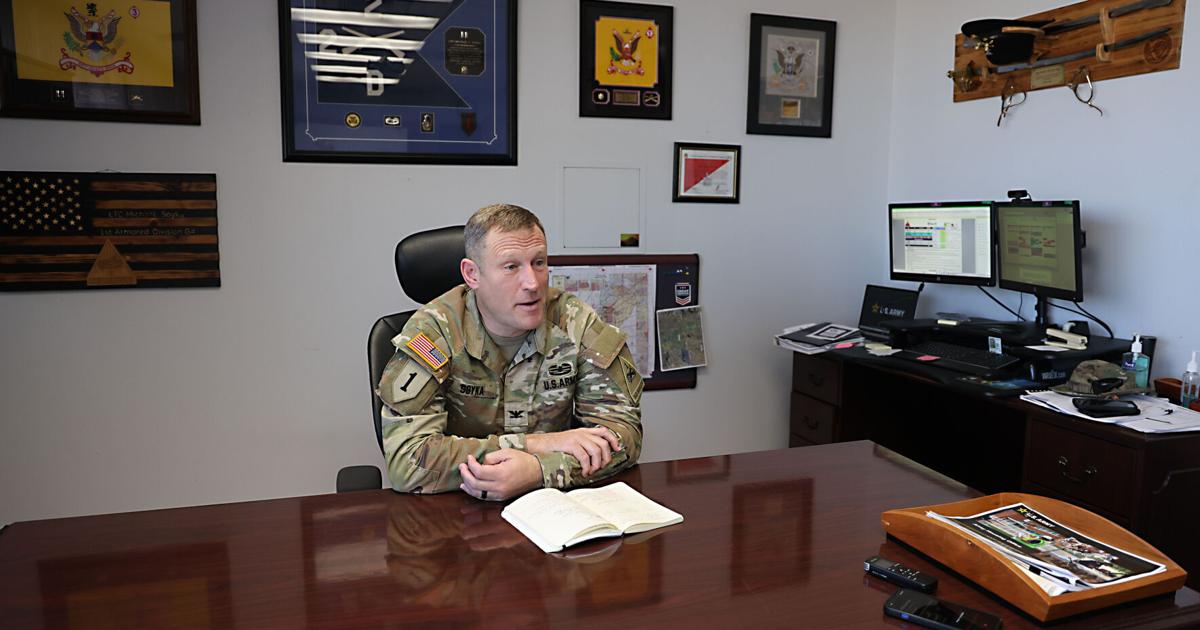
Col. Michael Soyka remembers the scene at ground zero on Sept. 11, 2001, vividly.
Soyka, who was attending the U.S. Military Academy in West Point, N.Y., was there amid the fear and chaos and destruction, handing water to the first responders after terrorists flew planes into the World Trade Center towers.
When he graduated from the Military Academy in 2002, President George W. Bush was the commencement speaker.
“To have the president come to my graduation and tell us that we were going to be the ones who were going to defend against that was powerful,” said Soyka, 46. “To deploy two years to Iraq, a year to Afghanistan and a couple of other years to all kinds of other places, you realize that America, with all its flaws, is still a special place. It’s something worth defending.”
A native of Westlake, Ohio, Soyka assumed command of the Fort Bliss garrison Aug. 6, succeeding Brendan Gallagher, who retired from active duty and is now president for business affairs at the University of Texas at El Paso.
The garrison commander is a role similar to that of a city manager. Soyka is tasked with managing the day-to-day administration and operations of the Army post, which spans more than 1.2 million acres and is home to about 90,000 soldiers and family members. He also helps set up events on Fort Bliss that bring visitors to the post.
Throughout his military career, Soyka has been deployed on missions and operations in many countries, including Iraq, Afghanistan and Egypt. Among his commendations are the Bronze Star, Combat Action Badge, Meritorious Service Medals, Army Achievement Medals and Army Commendation Medals.
Most recently, he was the 1st Armored Division home station mission command chief of staff, overseeing and managing daily operations for the division to ensure mission readiness.
Soyka and his wife, Sarah – who met in the fifth grade – have two sons.
El Paso Inc. sat down with Soyka on Nov. 25 in his office on Fort Bliss. He discussed the impacts of the federal shutdown and the cancellation of the Amigo Airsho and touched on Fort Bliss’ involvement in immigration enforcement.
Q: What has been your approach to addressing needs and issues on Fort Bliss?
It’s a balance. There are things that we need to do on a day-to-day basis to just sustain the place as it is. I have to provide infrastructure sustainment; I have to provide services for the soldiers and their families.
I also have to be a good ancestor. What I mean is that I’ve got to create a sustainable path for this installation over time so that it has what it needs five years from now, 10 years from now.
I have a planning team that’s looking out five to 10 years, working with the county, the city, our congressional representatives and other folks to make sure we’re doing things that make sense for both Fort Bliss and the El Paso community.
I also have feedback mechanisms from the soldiers and the commanders who are on this post to let me know if I’m not doing the right things to get them what they need.
Q: What are the biggest needs on Fort Bliss?
The biggest need, from a quality-of-life perspective, is transportation. I’m working on that.
We’re a very large installation. Even the cantonment area is about 12 miles wide. We have a phenomenal Post Exchange complex over here, but I can’t expect a soldier to walk 12 miles to get to it. I also can’t expect them to spend $35 on an Uber round-trip to do that.
So, we’re working through a series of different transportation initiatives. A couple of those have already come to fruition. We’ve done a geofence for Uber here on post, which means that anytime someone requests an Uber on post, the only people who can pick them up are those who can come get them on post. That used to be a problem.
I’m also working with my team to find volunteers who want to pick people up. If you went out, had a few too many, you could call somebody for free. That’s going to be called Iron Zero.

Photo by Ruben R. Ramirez
Photo by Ruben R. Ramirez
Lastly, we’re working on an intergovernmental service agreement with someone to be able to help us provide the equivalent of a free Uber share for soldiers, family members or civilians on post.
Q: How far are you in that process?
I have an allocation from my higher headquarters. It wasn’t quite as much as I needed to do exactly what I wanted. I’ve got a meeting with the Sun Metro team next week to see what the quality of service would be with the slightly lower amount of money that I got.
My goal was to have it up by January, but with the government shutdown, we weren’t allowed to work on those kinds of activities. It’s delayed me by about a month, but I still want to aim towards February.
Q: How did the federal government shutdown impact those on Fort Bliss?
I will first say, I’m incredibly thankful for all our Department of the Army civilians. From the military side, throughout the shutdown, the soldiers were paid.
The Department and the Army civilians were not paid – thousands of people on this post that are doing the daily work, our policemen, our firefighters, our doctors, people who run our ranges.
They went 43 days without getting paid, and during that time, they had to do a tremendous amount of work that was hard.
That was really hard on our community. Thankfully, the El Paso community stepped up to help us.
We had a resource fair here on post. Banks and other entities offered 0% loans to our Department of the Army civilians. We also did a food drive with help from the El Paso Independent Schools District.
Then, the Armed Services YMCA handed out over 1,000 food baskets for needy families for Thanksgiving. The week before, they did it in conjunction with El Pasoans Fighting Hunger.
I know everyone says El Paso is Fort Bliss, and Fort Bliss is El Paso, but this was from deeds, not just words. This was the El Paso community coming at our time of need. I truly appreciate it.
Q: What else under your command was impacted during the shutdown?
A lot. Every year, we have a plan for infrastructure repair and things of that nature. A lot of those projects were put on hold. We didn’t have the funds to do them.
We also had several contracts expire during that time frame. We had incrementally funded them and were unable to continue.
For a while, we lost our recycling service. We lost animal control services, as well as our grounds maintenance and custodial contracts, all those things.
Instead of training for war, we had soldiers doing custodial work.
Q: Why was the cancellation of the Amigo Airsho, announced by Fort Bliss a day before the event, so last-minute?
First, we had a great meeting with the Amigo Airsho last week. We had the team out here, and we’re already starting the planning for next year.
We’re trying to figure out how we scale it up next year because with the Blue Angels coming to town, we expect that there’s going to be a huge audience. I’m expecting that we will get close to 100,000 folks on this base over the two days.
Whenever you have to deal with a crowd that large, it’s going to be difficult, but I think it’s a very exciting thing.
I am really impressed with the Amigo Airsho team. They went back, and they paid all the vendors, so all the folks that had laid out money to get here for the Airsho were whole.
They also told everybody who bought a ticket that their ticket would be good for next year.
They’re doing right by the community and by the folks that we’re trying to help out. They had a lot of good sponsors that helped them through that, and I’m just glad that their head is still above water.
As to why the cancellation was so late. Just like everybody, we were trying as hard as we could to make sure that it happened.
We didn’t want to shut it off early in the hopes that we were going to be able to get to the place where the government was going to be reopened, and we were going to be able to deal with this.
That was through conversations with the Amigo Airsho team. They said, “We’re willing to push it as late as we can; we just want to hold this.”
Q: Other events on military posts were approved during the shutdown. What was your reaction to those events being approved but not the Amigo Airsho?
I wish I could tell you why. I’m obviously not in the approval authority for any other shows here or any other things across the nation. I can just say that I’m excited to see the Amigo Airsho come back next year.
Q: We published a story in January about the possible closure of the Fort Bliss and Old Ironsides museums. Are there any updates as the Army considers closing them?
We’re still waiting on some guidance from TRADOC (the U.S. Army Training and Doctrine Command) and other higher headquarters.
Right now, nothing has been done to divest anything from the museum. But at the Army level, there were some decisions that were made.
Although we haven’t been told to divest of anything yet, they were going to reduce the number of Army museums, and our museum was one of the ones that was on the list. But then we got some other guidance that said to wait.
So, we’ll see what happens. Either way, there will still be a lot of artifacts that will be used and kept around Fort Bliss. What that looks like in a couple of years, I’m not sure yet.
Q: What would you like to see happen to the museum and its artifacts?
Our heritage is an important part of who we are.
When people join the Army, they join to be part of something bigger than themselves.
My personal view is that one way you tie somebody back to something that’s bigger than themselves is to teach them about the people who have walked before them.
Having a museum that is as dedicated to a division with a history as long and storied as the 1st Armored Division and this post is important. I also understand that there are always constraints.
My personal view: I’ve always been a history buff, and I would love to see not only that history preserved but also out there available for people to see.
Q: How involved has Fort Bliss been in immigration enforcement?
I guess it depends on what you mean by involved. Obviously, there’s the detention facility that’s on our property, but that’s really been a very DHS and ICE-run thing.
Right now, we do have some soldiers from Fort Bliss who are working as part of the Joint Task Force – Southern Border.
Obviously, from a garrison perspective, we’re making sure they’ve got a place to stay and have what they need. But those soldiers are out there helping CBP with the enforcement operations, particularly where areas of the bases have been added along the border.
Q: Have you seen any activity out there?
I haven’t. I mean, it’s not really my lane. I know that there are a lot of folks out there trying to do their best to protect our country.
I haven’t been out there watching every day. I’ve got a lot of things that I need to do here on post.
Q: What inspired you to join the military?
I was a soccer player coming out of high school and didn’t really know what I was going to do with my life. A field force rep came down to try to recruit me to the Military Academy.
I went on a recruiting visit and stayed with my buddy, Matt Adamczyk, who was the first person I met in the Army. I followed him around all day. I was tired as heck.
It was about 11 o’clock at night, and I was lying down trying to get ready to go to sleep. I looked down, and his roommate was doing push-ups on the floor.
I was like, “Man, what are you doing?” He says, “I just want to be better. I want to be better so that when I get the chance to lead, I’ll be as good as I can for my soldiers.” I was 18 years old. I’d never heard somebody say something like that.
I walked around that whole next day, and all I saw were people trying to be better.
The people that I was around every day inspired me – those people who gave everything they had to be better for somebody else. I was hooked.