
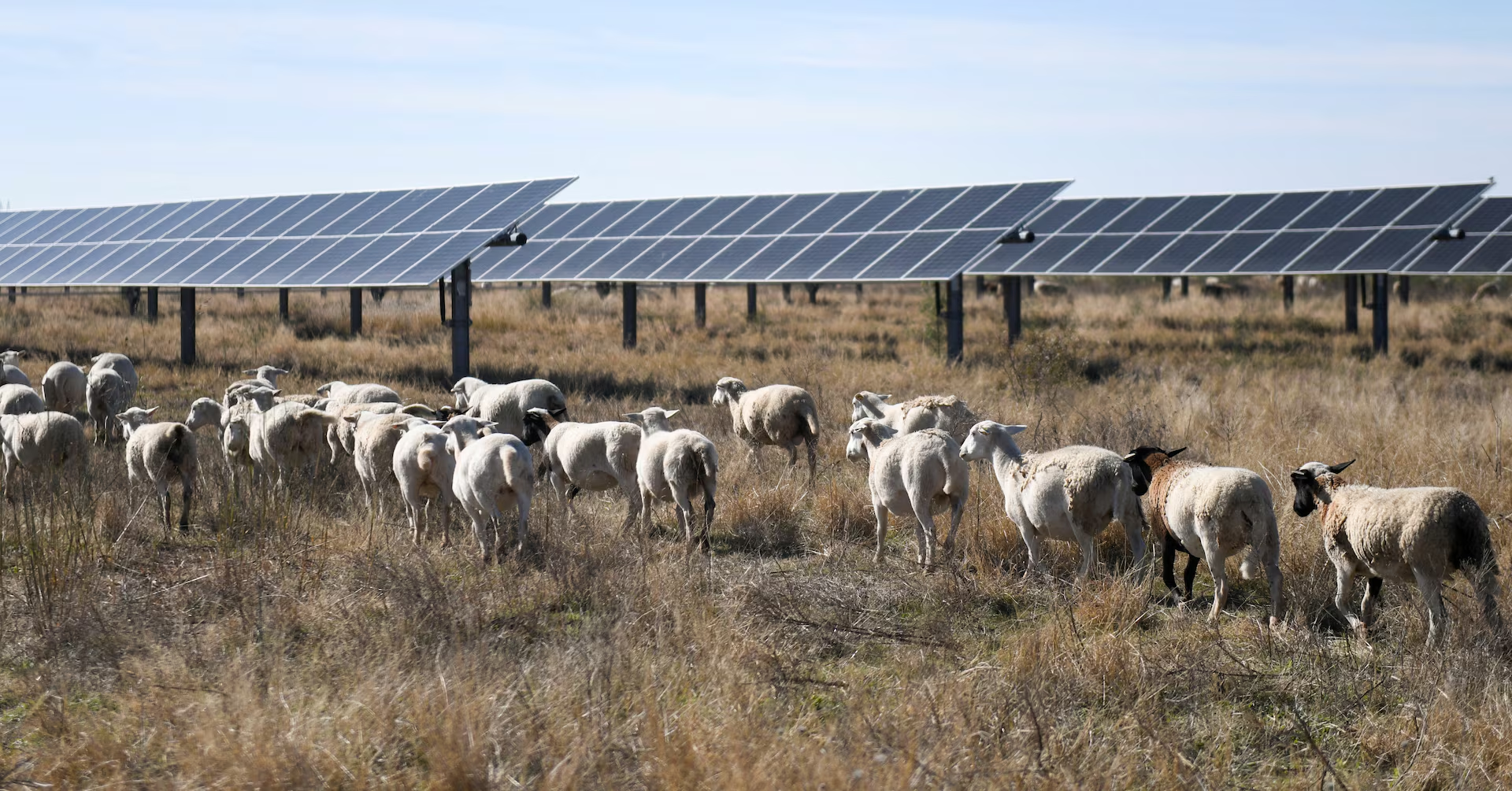
LITTLETON, Colorado, Dec 9 (Reuters) – For the first time, Texas’ main power system looks set to generate more power from solar farms than coal plants during a calendar year in 2025, marking a key new energy transition milestone for the largest power network in the U.S.
The Electric Reliability Council of Texas (ERCOT) generated 2.64 million megawatt hours (MWh) of power from solar assets, compared with 2.44 million MWh of power from coal plants for the January-to-November period, according to data compiled by LSEG.
Sign up here.
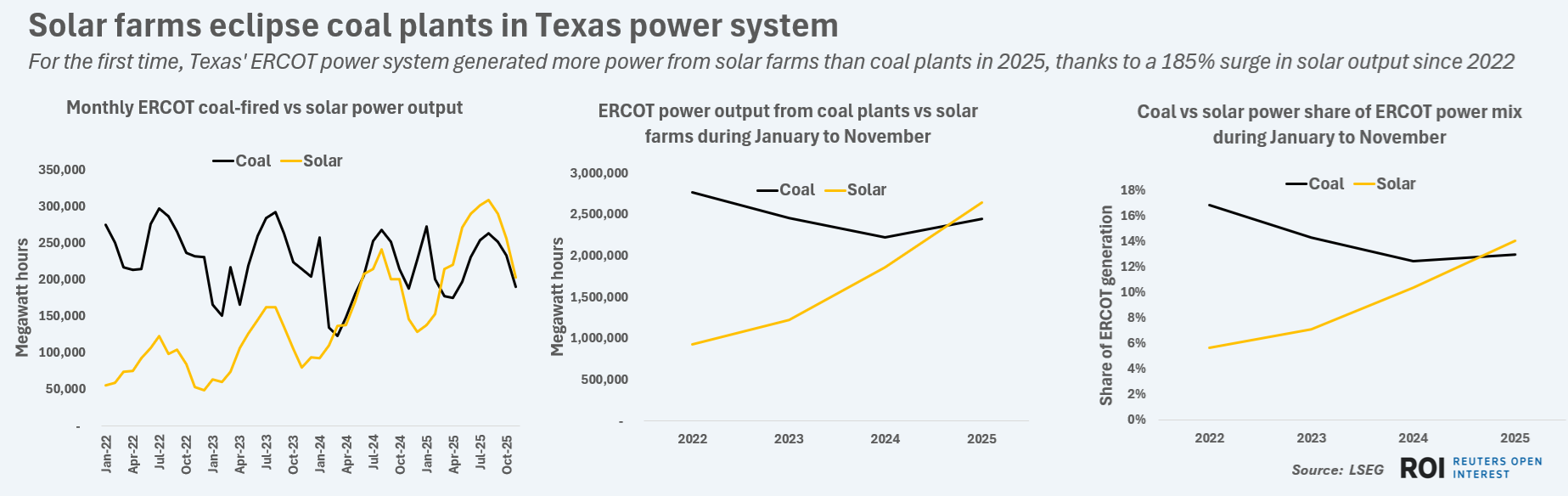 For the first time, Texas’ ERCOT power system generated more power from solar farms than coal plants in 2025, thanks to a 185% surge in solar output since 2022
Even as solar generation declines in the final weeks of 2025 due to reduced daylight, coal output is unlikely to overtake solar production for the full year as solar farms look set to generate at least 150,000 MWh in December.
Higher solar output versus coal output in Texas will mark a rare highlight for U.S. climate trackers in 2025. Nationally, coal generation has registered a steep climb this year and remains around three times greater than total U.S. solar output.
However, the steep growth of solar power in Texas – the main fossil fuel hub in the U.S. – will likely act as a blueprint for other states where utilities are attempting to boost output from all available sources to keep up with rising power demand.
BANNER YEAR
Greater installed solar capacity in Texas this year – up 24% compared to 2024’s levels, according to data portal Cleanview – has allowed solar power output in Texas to surge by 42% so far this year from a year earlier, LSEG data shows.
Indeed, ERCOT solar production has set new monthly records every month so far in 2025 and averaged 44% growth from the same months in 2024 from January through November.
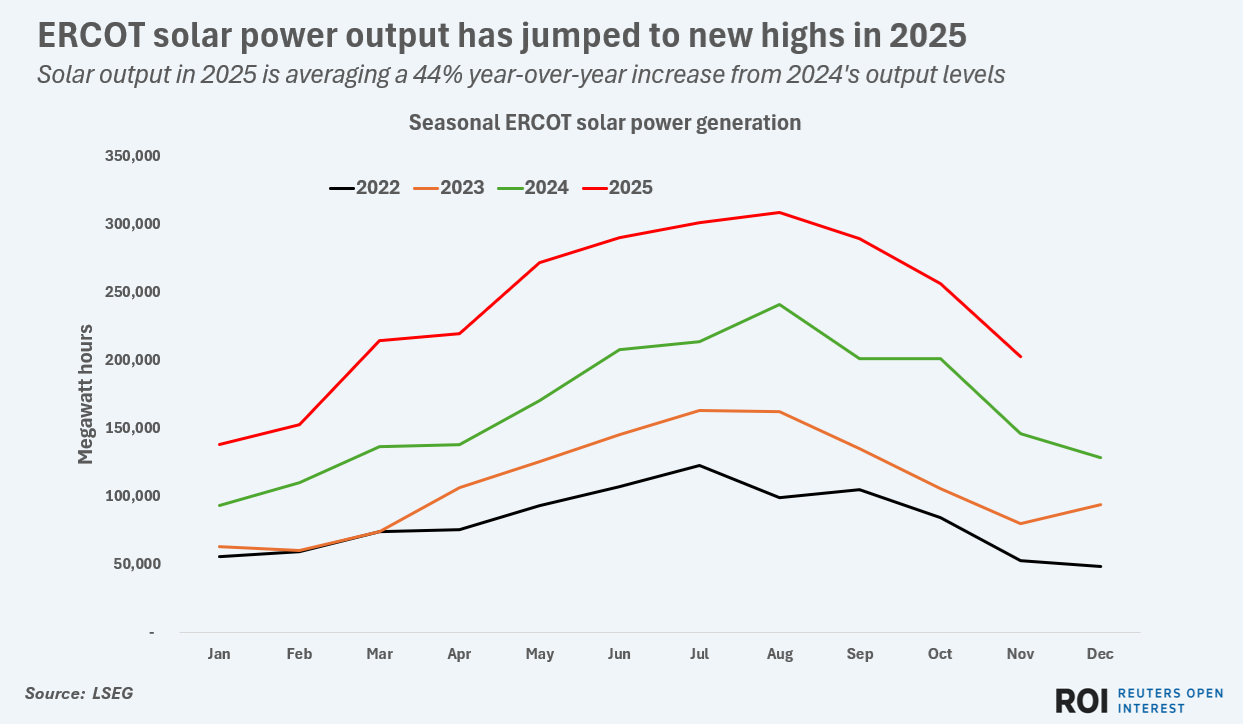 Solar output in 2025 is averaging a 44% year-over-year increase from 2024’s output levels
If solar output in December also posts a 44% gain from a year earlier, this year’s December output total would be roughly 185,000 MWh and would bring full-year solar generation to 2.82 million MWh.
COAL GROWTH
Texas’ solar outperformance of coal generation has occurred even as ERCOT output from coal-fired power plants posted a 10% rise from the same months in 2024, LSEG data shows.
Utilities in Texas – and across the country – have attempted to boost output from nearly all sources this year in order to meet higher energy demand, driven by rising use of artificial intelligence applications and greater overall electricity use.
However, higher coal generation is also a result of widespread cuts to gas-fired power plants in Texas and elsewhere, triggered by a steep climb in natural gas costs.
ERCOT gas-fired power supplies have dropped by around 4% from a year earlier to 7.74 million MWh so far this year, according to LSEG.
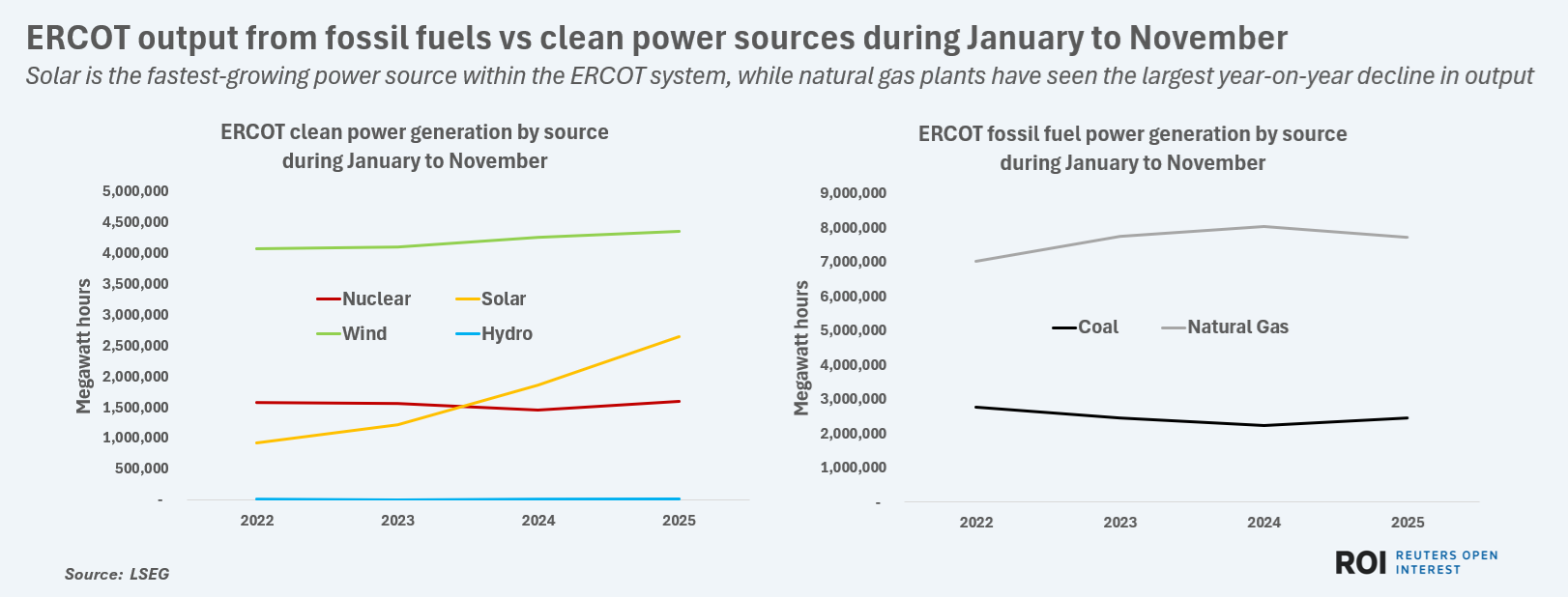 Solar is the fastest-growing power source within the ERCOT system, while natural gas plants have seen the largest year-on-year decline in output
With U.S. gas prices currently averaging around 50% more than the 2024 average, additional cuts to gas-fired output can be expected in areas where coal-fired plants are available to make up the output difference.
That means coal-fired output in Texas – which is the country’s top coal power producer – can also be expected to climb further heading into 2026 and result in a strong finish for coal production in the state.
CLEAR CLEAN MOMENTUM
Even with a fresh uptick in coal-fired generation just as solar production falls to annual lows, 2025 will remain a decisive year for solar generation in Texas.
From January to November, solar farms accounted for a record 14% share of the ERCOT generation mix, compared with a 13% share for the state’s coal plants.
This year’s solar share compares to just a 6% share during the same months in 2022, which underscores the speed and scale of the rollout of solar assets across Texas in recent years.
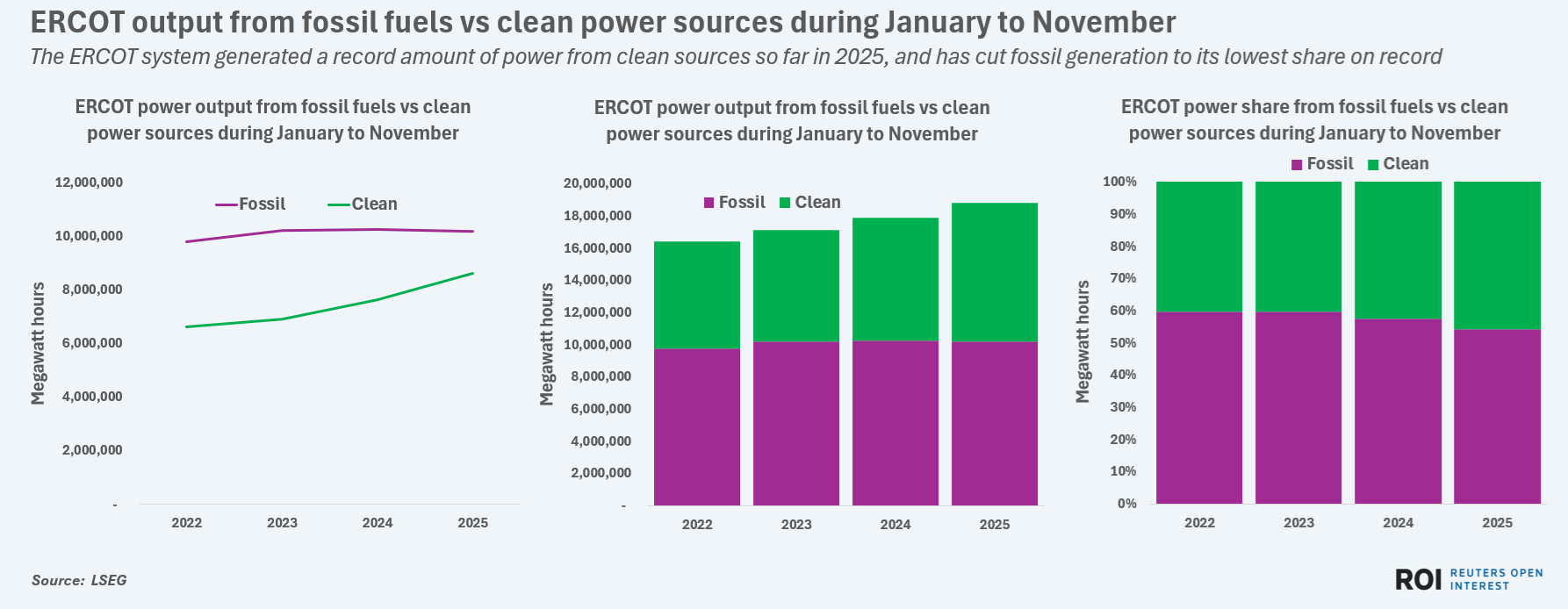 The ERCOT system generated a record amount of power from clean sources so far in 2025, and has cut fossil generation to its lowest share on record
Texas utilities have also been the country’s most aggressive deployers of utility-scale battery storage systems, which allow for surplus solar power that is generated during the middle of the day to be stored for discharge during peak demand periods.
This battery-plus-solar combination remains the quickest and most popular route for utilities to add power supplies over the year, meaning that even greater expansions to Texas’ solar parks can be expected in 2026 and beyond.
The opinions expressed here are those of the author, a columnist for Reuters.
Enjoying this column? Check out Reuters Open Interest (ROI), your essential new source for global financial commentary. ROI delivers thought-provoking, data-driven analysis of everything from swap rates to soybeans. Markets are moving faster than ever. ROI can help you keep up. Follow ROI on LinkedIn, opens new tab and X, opens new tab.
Reporting by Gavin Maguire; Editing by Thomas Derpinghaus
Our Standards: The Thomson Reuters Trust Principles., opens new tab
Opinions expressed are those of the author. They do not reflect the views of Reuters News, which, under the Trust Principles, is committed to integrity, independence, and freedom from bias.
