
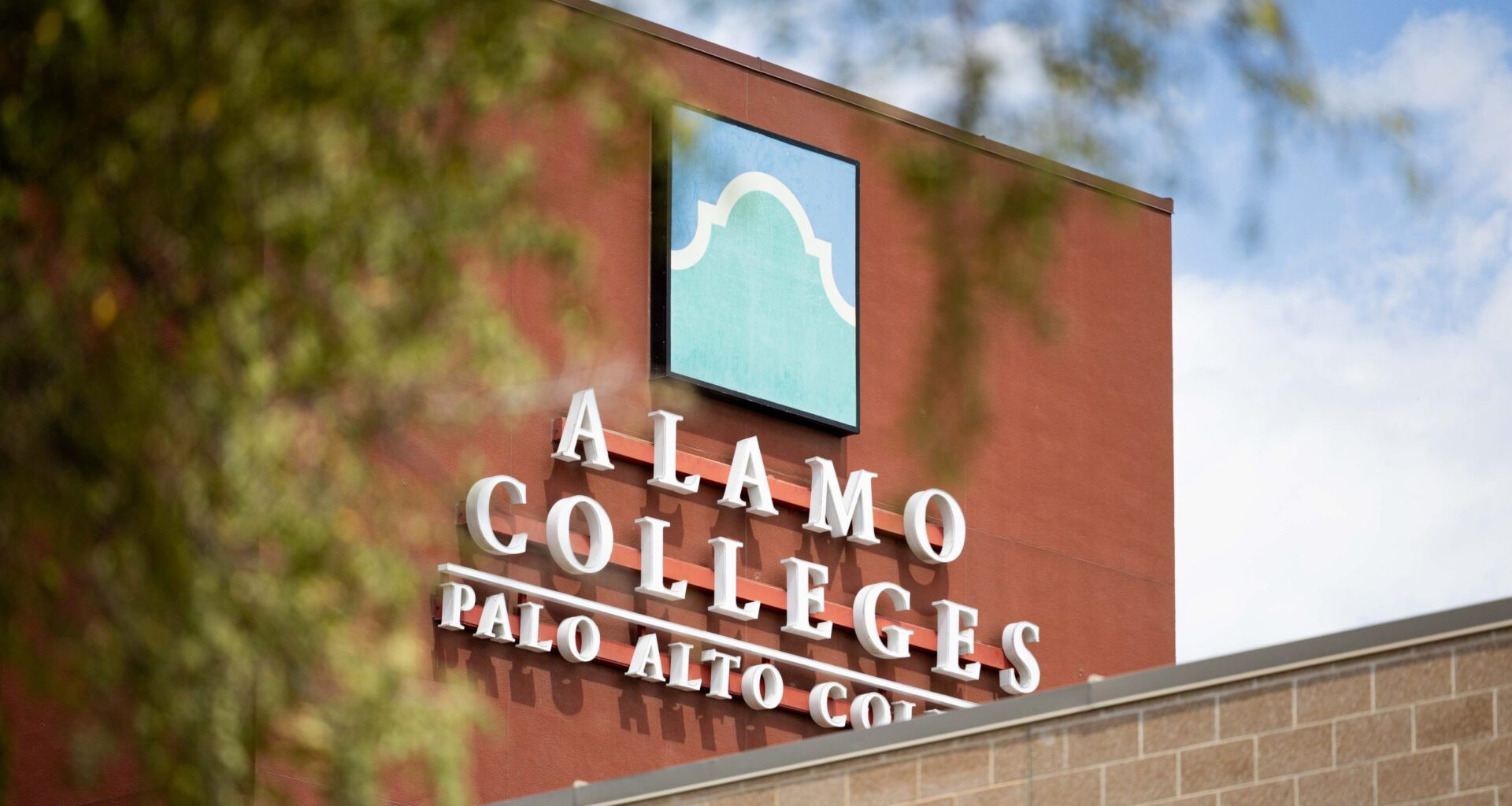
Life might not always align with the ideal college degree plan and Alamo Colleges District considers the competing priorities as they work with tuition assistance programs like Alamo Promise.
“We are constantly trying to figure out what is the best middle ground that serves students but also keeps them pushing forward,” said Stephanie Vasquez, Alamo Colleges District chief program officer for Alamo Promise.
On this week’s episode of bigcitysmalltown, host Bob Rivard interviewed Vasquez, who spoke about the past, present and future of the last-dollar tuition free program that has impacted more than 30,000 students across Bexar County.
Today, there are more than 13,000 students currently enrolled at Alamo Colleges through the program, Vasquez said, with about 7,800 of them entering their freshman year. This fall Alamo Colleges Districts reported a total student enrollment of nearly 90,000 individuals.
Alamo Promise launched in 2019 for Bexar County graduating high school seniors. The program started by focusing on some of the most in-need schools with low college-enrollment rates, but it expanded over the years to cover every high school graduate attending local public, private and charter schools, as well as those being homeschooled.
Its qualifications include enrolling in any of the five Alamo Colleges — San Antonio College, St. Philip’s College, Northwest Vista College, Northeast Lakeview College and Palo Alto College — for the fall immediately following the student’s high school graduation and applying to receive federal and/or state financial aid.
Part of the early-day qualifications included full-time enrollment at any of the five Alamo Colleges. But this requirement was quickly met with internal pushback from those who pointed out a good percentage of their students can’t meet it.
“They pushed back and said, ‘Look, that’s not going to work for everybody and we need to read the room. It is a pandemic, some of our students need to attend on a part-time basis,” Vasquez said.
The colleges then pivoted to allow students to work with their advisor to figure out what enrollment level worked for them, but wanted them to keep in mind that this tuition-free program would only be available for their first three years of college.
“So we’re still trying to encourage that enrollment intensity and that continuous enrollment so they stay on track to completion,” Vasquez said. “Because I think one of the other things that we find is that when students do stop out, their likelihood of returning is decreased.”
College officials have allocated about $5 million each fiscal year for the program, city interlocal agreements helping fund this program amount to about $4.6 million annually and private contributions have amounted to $1 to $2 million, she said.
The total cost of the program varies according to the need of that incoming class and their qualifications for other tuition assistance, she said.
As a business model, the colleges have made sure that the students qualifying for Alamo Promise fill out federal and state financial aid applications. This allows the program to operate as a last-dollar program, meaning it fills any gaps left in tuition costs by other financial aid sources.
“We make sure that we are using diverse funding sources, to support, you know, 13,000 students,” she said. “There is a cost in the back end that we make sure we’ve lined up from federal, state, private and also institutional funds.”
Time to completion matters, Vasquez said, and right now about 30% of Alamo Promise students have graduated within the three years covered by the tuition-free program.
Vasquez said they do meet with students who might have had to drop out of the program before the three year completion to take into account the life circumstances that have gotten in the way. Some students are allowed back into the program.
“We have some 18-year-olds who are serving as head of households in some capacity,” Vasquez said. “We hear a lot of contextual outside obligations that really become competing priorities. And we empathize with that because we understand they’re also trying to pursue their education.”