
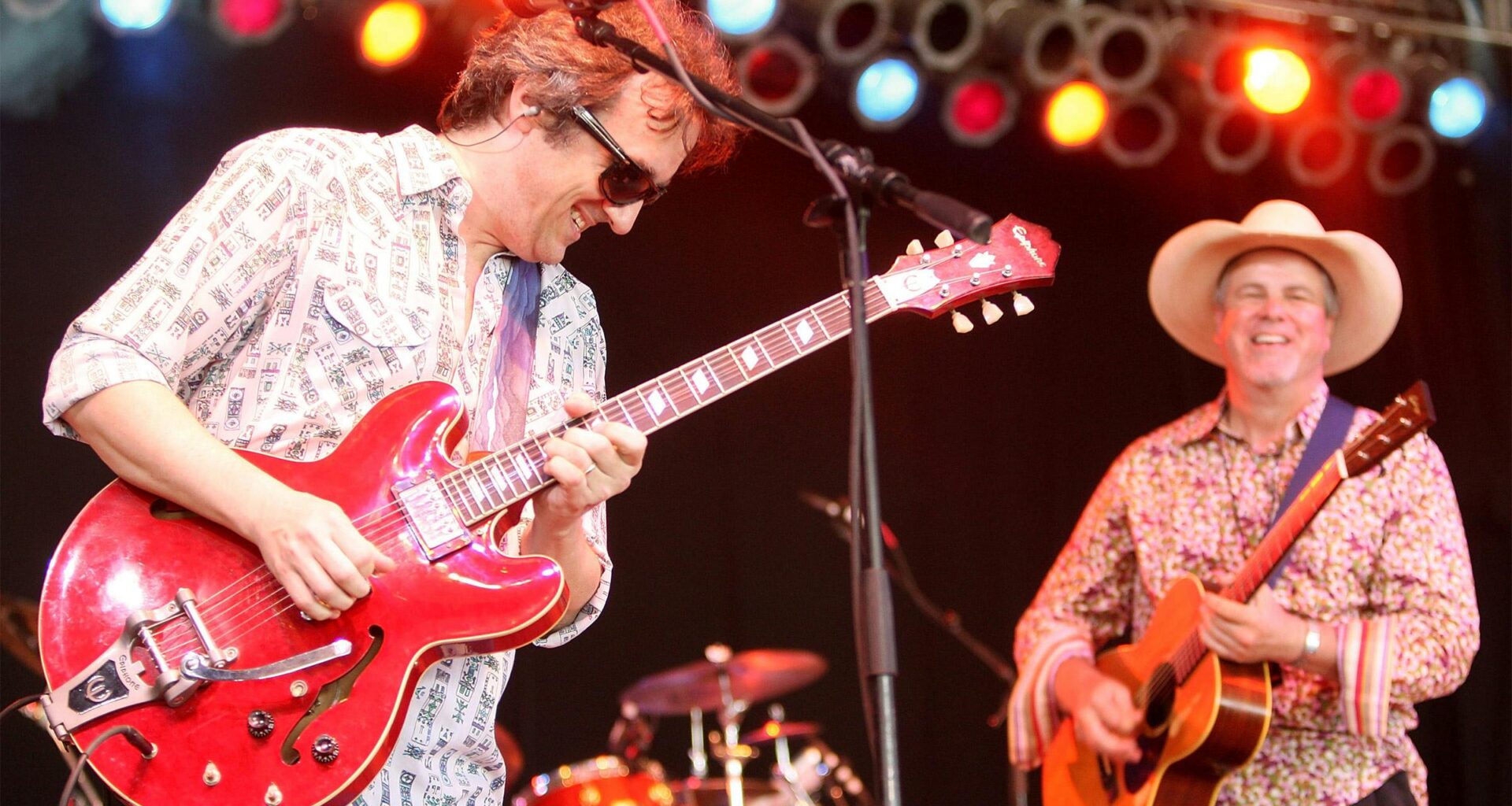
Rich Brotherton had been playing the guitar for more than five decades before he ever had a problem with his hands. Then, in September 2024, Brotherton—who, at 65, had worked with everyone from Robert Earl Keen and Patty Griffin to Scottish folkie Ed Miller and Lubbock cowboy singer Andy Hedges—was recording in his Austin home studio, using the Travis picking style he had executed tens of thousands of times: his thumb playing the alternating bass rhythm while his other fingers picked the melody. It was a fast, intense song, and while his fingers were doing fine, he realized that his thumb just wasn’t pushing the strings very hard. “My thumb was not speaking,” he said. “It was weak.” He finished the session—and since he didn’t have to play another fierce picking song for a while, he didn’t worry about it too much.
Come April of this year, he was playing a show with his Americana gospel group, the Purgatory Players, and his pick kept slipping from between his thumb and forefinger. A couple of weeks later, he was at the Loch Norman Scottish festival, in North Carolina, and couldn’t hold the pick at all. He put on some finger picks—which offer less precision and control—and finished the gig. When he got back to Austin, he went to his doctor, who sent him to a neurologist.
She had terrible news. “I hate to say this,” he recalls her saying, “but I think it’s ALS.” Amyotrophic lateral sclerosis, a.k.a. Lou Gehrig’s disease, is a condition that attacks a part of the nervous system, leading to paralysis and death. Brotherton was devastated, and he got a second opinion. It confirmed the first. “I was in a deep, dark depression,” he said.
Brotherton plays several times a week in Austin clubs, and he knew he wouldn’t be able to hide his condition for long. So in August, he posted on Facebook. “A tough day,” he began. He then broke the news. “The version that I’ve been diagnosed with can sometimes take longer than regular ALS to run its course, but also sometimes it doesn’t. Conventional wisdom says ALS lasts between two and five years. It always involves nerves and muscles becoming paralyzed, along with the loss of ability to swallow, talk, and breathe, though your brain keeps functioning. And always ends in death.” He went on to say that he was taking meds to slow his decline and was going to keep performing, now with finger picks. “My aim is to keep playing shows and making music in my studio as long as I can.”
Three months later, Brotherton sat in his studio eating a peanut butter–and–jelly sandwich and drinking a big glass of whole milk. His hair had always been short; now it was short and gray. He looked tired—and thin. His T-shirt was draped loosely over his torso. He’s lost 35 pounds in the last year. “I’m dealing with trying to put weight on and trying not to be tired right now,” he said.
His studio was cluttered with acoustic guitars, a banjo, a mandolin, a drum kit, and some amps. In the last few months, Brotherton—whose work ethic has led him to always have at least one production going and another in the works—had finished playing on and producing three projects, including one for his band Úlla. But since the diagnosis, he has been turning down jobs. “I can’t play like I used to play,” he said, speaking slower than he once did, as the disease has affected his voice. “It’s hugely frustrating.”
Brotherton does have one big project coming up, though it’s not in his studio. Tomorrow evening, at Austin’s Paramount Theatre, dozens of singers and musicians he has played with over the last forty years, including Lyle Lovett, Charley Crockett, and Loudon Wainwright III, will play a benefit for him.
The sold-out concert—the proceeds of which will help him outfit his home for his coming physical challenges—was put together by Úlla bandmate Andrea Magee. Brotherton was bewildered when she said she wanted to do the show not at one of the clubs where he regularly plays but at the regal Paramount, which seats 1,200 people. “Rich, you are not normal,” she told him. “You are a special human and a world-class musician. There is a lot of love out there for you.”
It’s not natural for a sideman to step out in front, and Brotherton’s friends know he’s loath to be the main attraction. “Rich is a guitar player and doesn’t expect any special adulation for it,” said his friend Jud Newcomb, who will play at the concert. But on a night demonstrating how one man shaped the musical identity of an entire city, he just might get it.
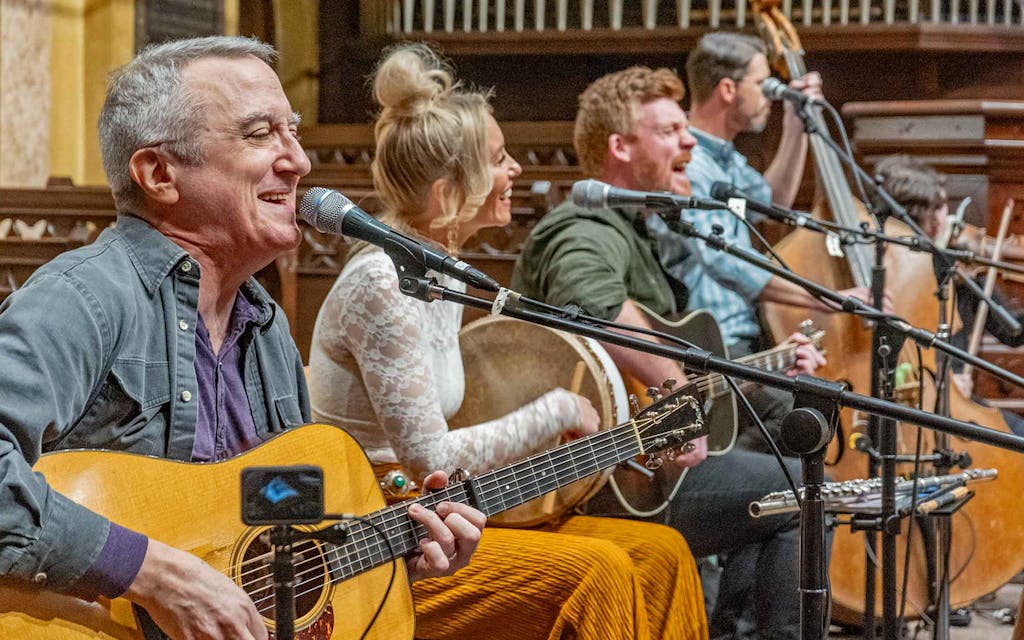 Rich Brotherton (left) performing with Úlla. Will van Overbeek
Brotherton was born in Augusta, Georgia, in August 1959, the second of seven kids. His was a musical family. When he was just eight, his father, who played the guitar, showed him some things, and soon Brotherton was performing and singing in front of people—first in an offshoot of a church folk choir and then as a teen playing solo folk, bluegrass, and pop tunes in local restaurants. After studying music at Colorado College, he spent a summer playing in Doolin, Ireland, and then wound up in Boise, Idaho, where he performed folk songs with local singer John Hansen for three years. At the time, he was influenced by both fingerpicking acoustic players like Leo Kottke and lyrical electric players like Richard Thompson.
Around 1985, Brotherton was looking for a new place to live and play music when he saw a video on TV of an Austin punk band with a pedal steel player. That was cool, he thought—but it wasn’t until he heard “Pretty Little Lights of Town,” by Austin group the LeRoi Brothers, that he made up his mind. The song, from the group’s 1984 album, Forget About the Danger Think of the Fun, is an ebullient rocker with a pop melody and a country feel. “This is Austin,” he remembers thinking. “That’s where I’m going.”
He loaded up his truck, headed south, and ended up crashing on a friend’s floor in South Austin. He quickly fell into the Irish-music scene at a local jam, and he began going out to hear rock bands. Soon he was playing at hoot nights and after-show parties, meeting and playing with locals like avant folkie Kathy McCarty, pop songstress Kris McKay, and songwriter David Halley. Brotherton was friendly but intense; at jam sessions, he was the thin, wiry guy who knew all the songs—old Scottish murder ballads, mid-seventies folk songs, contemporary pop hits—and all the chords. He also played mesmerizing solos, starting with the song’s melody and then blazing off into his own territory. Nobody played like Brotherton; by the nineties, he was regularly in the running, and sometimes winning, Best Acoustic Guitar in The Austin Chronicle’s annual music poll.
In 1988, Brotherton helped found local bluegrass band the Barnburners. He then backed up English expatriate rocker Ronnie Lane and wound up playing with Toni Price at her legendary Hippie Hour shows at the Continental Club. He sang high harmonies, played solid rhythm guitar, and often served as a de facto band leader. Even in that role, said Newcomb, he was always collaborative. “Rich is so accomplished and so capable, but also so encouraging. He knows he’s very skilled, but he’s open to others—he likes playing with people who have their own take on things.”
By this point, Brotherton had set up a little studio in a back room of his South Austin home—where he lived with his wife, Kathy—and began producing other artists, starting with Ed Miller. This led to more work recording and playing with musicians in the bubbling Austin music scene. Newcomb remembers that Brotherton wasn’t just about the musicianship. “He loves to be turned on by a great song. He’s always like, ‘Man, have you heard this?’ I remember being over at his house and staying up late, and the new Tom Waits record had come out—just all of us gathering around and listening to it in pure delight.”
In 1993, Brotherton—whose daughter Ailie had just been born—joined Robert Earl Keen’s band. Keen was getting popular, and he took care of his group, giving members health insurance and retirement accounts. When Brotherton wasn’t touring, he was producing artists in his studio: acts like Caroline Herring, the Barbers, and Ana Egge. He also produced two of Keen’s albums. “Those two are two of my very favorite records,” said Keen about Farm Fresh Onions and What I Really Mean. “Rich had a way of being able to pivot and grab ahold of stuff.” Once, said Keen, he and Brotherton were working on the song “Train Trek” when they realized they needed a particular guitar sound. “I’m like, ‘What do we do, Rich?’ And he’s looking around at this wall of guitars in the studio, and he goes, ‘This baritone guitar right here.’ And he just plugs it in and runs the track, and it’s a stunning piece. And he just did it totally on the fly.”
After 25 years with Keen, Brotherton left the band and dove back into the Austin scene, performing with Newcomb and others in the Purgatory Players as well as with recent Irish expat Pat Byrne, which led to the founding of Úlla, a traditional Irish group that breaks out occasional covers of Fairport Convention and Kris Kristofferson. Along with Byrne and Magee, Brotherton’s younger daughter, Maddy, plays fiddle, which has been particularly fulfilling for Brotherton. Sometimes, he says, they’ll be playing along behind one of the singers—dad on guitar and daughter on violin—and find themselves playing a similar riff. “Our brains seem to work the same way. It’s nice.”
Then came the diagnosis—and the despair, especially at being unable to do the astonishing things that had once come so easily. Brotherton’s doctor prescribed Prozac, which he’d never taken before. Then Brotherton started talking to a therapist—also a first. He played her some videos that he and his siblings had made for their parents, singing songs in harmony during the COVID pandemic. Her advice: Put together a playlist of music that calms you. Brotherton had spent most of his life seeing the effect his music had on other people, but he was in such a dark place that he’d failed to see he could do the same for himself.
“I hadn’t ever dealt with the calamity and the stress and the depression and the anxiety that go hand in hand with this disease that I have,” he said. “I didn’t know how to put that stuff together.” To do so, he started gathering songs he loved: lush and melancholy pop tunes like “Not Strong Enough” by Boygenius and “Friday Morn’ ” by Uma. He loved the sounds, especially the harmonies, but he discovered he was gathering lyrics that meant something to him—and that many, like the ones in “Funeral” by Phoebe Bridgers, were about death. “The notion of dying is a real thing for me now,” said Brotherton, “so it’s almost like standing up to it, confronting it, not backing down.” He finds himself listening to some of the songs over and over. “It’s surprising how calming it is.”
His August Facebook post brought hundreds of responses from friends and fans. He got a card from a couple he’d gone to college with. “She wrote, ‘Last year, I turned 65, and when I did, it just made me think that I have had a magnificent, wonderful life up till now, and whatever else there is, it’s kind of gravy and there’s not much to regret.’ And I just went, ‘Thank you for that. Yes, that’s the truth.’ The world is kind of doing what the world does, and I’ve got nothing to regret.”
He’s never had to get ready for a show like the one tomorrow at the Paramount. “It’s a little frightening that there are so many people that are going to be there, and so many of the folks performing are just my pals.” Brotherton plans to play with some of them, though how much he participates will depend on how he feels the night of. “This thing saps me like crazy. And if I run out of steam, I’ll go catch my breath somewhere.” He can still play melodies, but not as fast or as fluidly as before. Some chords—like the B minor—are harder now. “I’m improvising and playing different versions, accommodating what I can do.”
Brotherton has always found a way to make music—to improvise, to don finger picks, to do whatever it took to support somebody else. Now, in his hour of darkness, his friends are returning the favor.
Read Next