
Thirteen-year-old me stared up at my religious-education teacher, puzzled, and then back down at the jumble of materials strewn across the ground: white poster board, popsicle sticks, cotton balls, dried-out glue, cracked clay, and a handful of fading markers. The assignment for that week’s Saturday class at a jamatkhana (prayer hall) in south Houston was to build a model of what we’d want Houston’s Ismaili Center to look like one day. I didn’t exactly have the building blocks for an architectural masterpiece.
Still, I sought to capture the harmony between intricate architecture and nature that’s a defining feature of the other six global Ismaili centers. This translated to a white box with an unintentionally slanted roof, poorly drawn interlocking geometric designs spanning the entrance, unevenly cut windows, and a lopsided lake, accented with cotton bushes and stick trees. Think less “future cultural landmark” and more “half-baked art project.”
Hours later—armed with sticky fingers and an overinflated sense of artistic ability—I put the finishing touches on my creation. In a corner, I scribbled “Ismaili Center, Houston” in big letters and slapped on a copyright symbol to ensure my design wouldn’t be copied (it wouldn’t). There was, however, one addition I was particularly proud of: two humanlike clay figures holding hands, their heads angled toward the structure, on the verge of stepping through its doors.
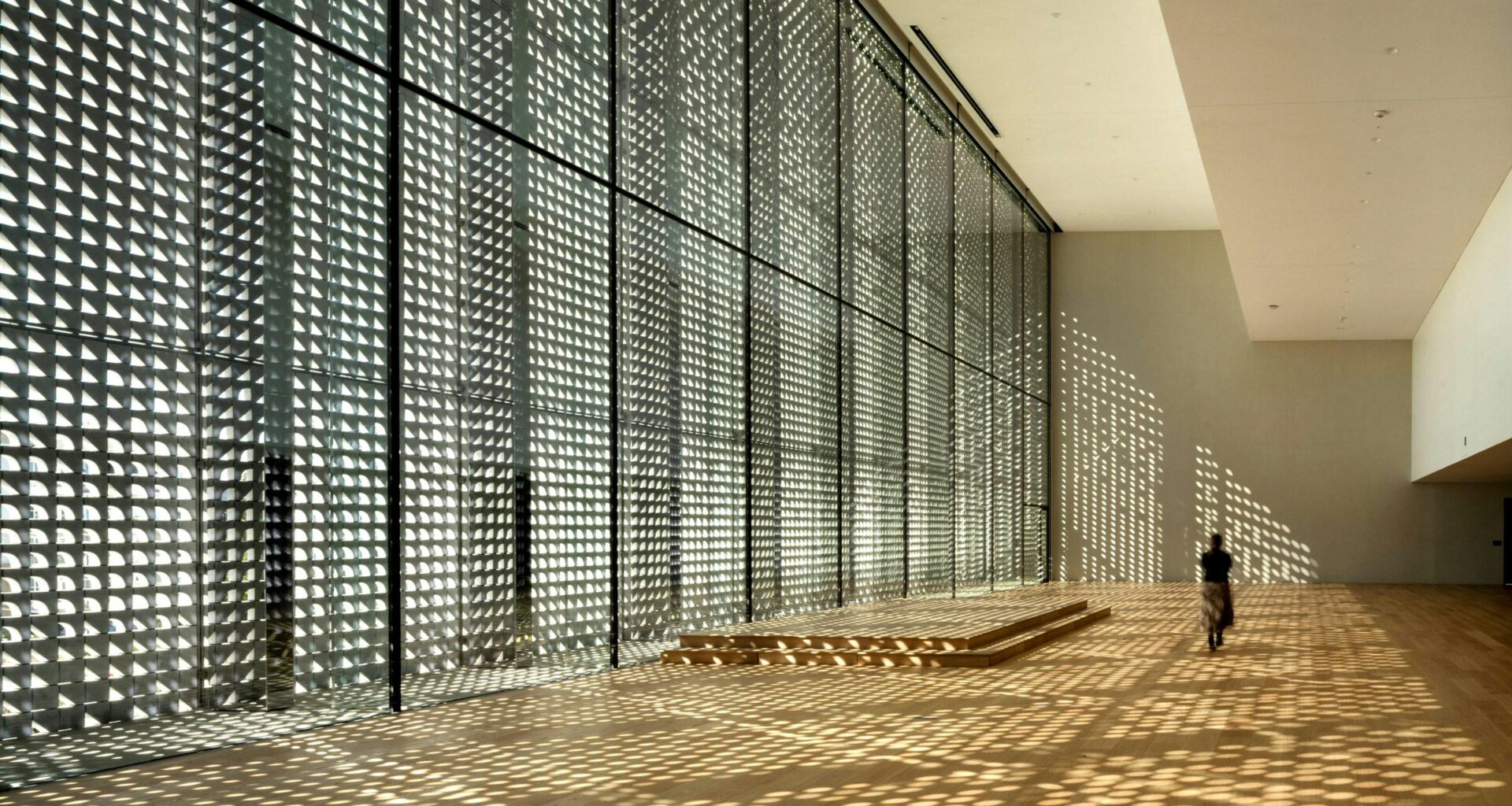
Eight years after I imagined it in a classroom, I slowly took in the real, finished Ismaili Center, Houston before me. The 150,000-square-foot, five-story structure towers over Allen Parkway on an eleven-acre plot in Montrose, surrounded by vast Persian-inspired gardens and anchored by a grand reflecting pool that leads to its entryway. The building’s row of silk-laminated glass panels reflects the light entering the space to create a vision of continuity between the inside and outside. The entrance opens into the main atrium, built to draw visitors’ eyes upward, 68 feet high, to an oculus encircled by seemingly endless stacked Vierendeel trusses, inspired by the skylights of Pamiri houses in Tajikistan. Sunlight cascades down and through the central wing, guiding visitors to the diamond-shaped jamatkhana underneath. The Ismaili Center’s design, led by Farshid Moussavi Architecture and Nelson Byrd Woltz Landscape Architects, blends Western and Islamic architectural elements, welcoming both Ismailis (pronounced like “smiley”) and non-Ismailis alike.
“[The building is] a lot of things—it’s a place for people to practice their faith,” says the lead architect, Farshid Moussavi. “It’s a place for people to grab something to eat or coffee in the cafe. It will be a place to come and socialize in the verandas and just relax. It will be a place to listen to music. It will be a place to have your wedding, have your birthday party. I really think that this building will be for different generations at any one time.”
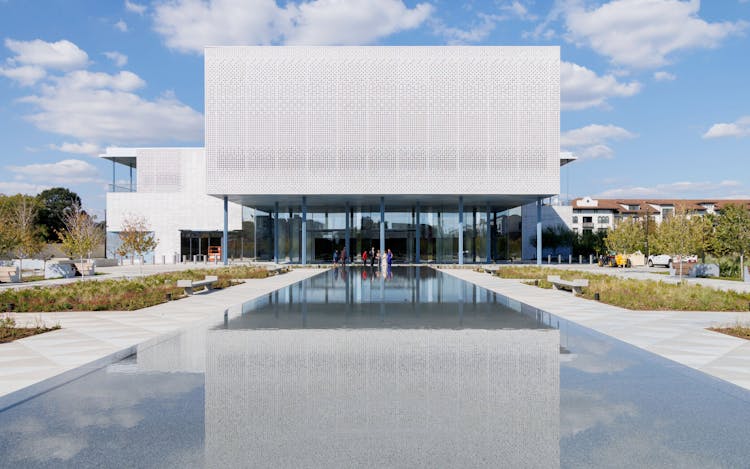 The building and sky are mirrored in the water of the Reflection Fountain, a feature inspired by other architectural designs around the Muslim world. Iwan Baan
 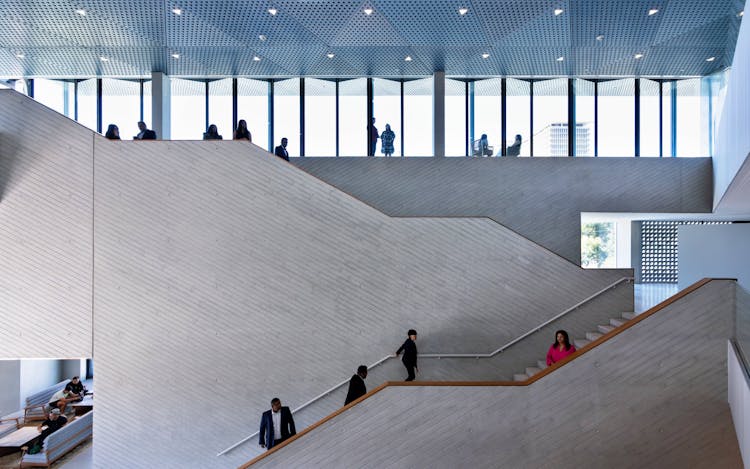 Indoor and outdoor spaces throughout the Ismaili Center offer opportunities for natural dialogue and connection. Iwan Baan
The morning of the dedication ceremony, on November 6, representatives of the global Ismaili community, faith leaders from across the country, members of Congress, and Texas state legislators filed in, the awe on their faces mirroring my own. Outside, dozens of Ismailis gathered, hoping to get a glimpse of His Highness Prince Rahim Aga Khan V. The spiritual leader, whose Ismaili Imamat is headquartered in Portugal, became the fiftieth hereditary imam following his father’s death in February. Ismailis are part of a branch of Shia Muslims who follow a line of imams stretching back to the Prophet Muhammad. People craned their necks for a better view, holding their phones up in the air. From a nearby balcony, one family hoisted a handmade poster reading “Welcome Hazar Imam.”
As I walked up the stairs to the social hall, where the ceremony would soon begin, a vivid piece of art caught my attention. Inspired by a verse in the Quran describing the Prophet Muhammad’s trek from Mecca to Jerusalem, the canvas depicted gold, blue, and ocher Arabic symbols made up of around four million beads. The artwork was created in 1999 by artist Ahmed Moustafa and twenty women from the Mumbai-based Ismailia Helping Society, a group working to improve the quality of life of women living in poverty. A few of these artists, along with their work, have now made Houston their home.
Inside the social hall, sunbeams filtered through the stone wall’s many small cutouts, casting shadow patterns onto some five hundred attendees finding their seats. Vibrant traditional clothing—shalwar kameez, embroidered saris, kurtas—mingled with floor-length dresses and pants suits as the guests’ chatter blended in with the rich, echoing sounds of instruments from Central Asia. An Ismaili student choir kicked the event off with the Pledge of Allegiance followed by a rendition of the Nashid al-Imamah, also known as the Ismaili Anthem.
The room fell silent when the TVs at the front showed a convoy of black cars pulling up to the entrance. Aga Khan V emerged from one car, followed by Houston Mayor John Whitmire from another, who greeted him with a firm Texas handshake. When the imam entered the hall, the crowd rose at once, watching as he tipped his head in greeting and headed to the stage, which was flanked by American, Texas, and Ismaili flags and the center’s new emblem.
“This building may be called an Ismaili Center, but it is not here for Ismailis only,” he said during his remarks. “It is my deep hope that with your engagement, the center will lift spirits and broaden horizons. This center will bring people together, strengthen bonds, and help us all, collectively, to bring happiness and harmony to societies here and elsewhere.”For the Ismailis in attendance, witnessing the dedication ceremony of this major cultural institution was a profound honor. The story will most likely get passed down through generations: Your great-great-grandmother was at the opening of the Ismaili Center in Houston way back when, in 2025. (I felt compelled to oblige my father’s incessant requests to take a selfie for proof.) For me, an Ismaili Muslim who grew up in the Houston area, the moment felt all the more special.
Houston was a natural choice for the first Ismaili Center in the U.S. (and only the seventh in the world), which opens its doors to the public on December 13. The city is home to nearly 40,000 Ismailis, the largest concentration in the country. In the sixties and seventies, Ismaili immigrants arrived from Africa and Asia, seeking education and economic opportunities. By the nineties, they had established roots in several states, bringing their culture and traditions with them; my own family settled in Sugar Land. The Houston metro area gained seven Ismaili jamatkhanas, with the one inside the center now serving as the eighth. While jamatkhanas primarily serve as places of religious gathering, Ismaili Centers are larger, multipurpose, and more public-facing, allowing people of all faiths to visit and participate in programming.
Ismaili Houstonians are business owners, politicians, health-care professionals, musicians, architects, artists, academics, and journalists. Many are proud to claim their Texan identities, indulging in Whataburger and Tex-Mex, unabashedly slipping “y’all” into everyday conversation, embracing country music, and throwing in a hearty “Hook ’em’” when the situation calls for it (or even when it doesn’t).
This group has often had a behind-the-scenes impact on the city and its residents. Seva, a philosophy of selfless volunteering, is ingrained in Ismailis at a young age and carried beyond the bounds of our jamatkhanas. During Hurricane Harvey, in 2017, Ismaili volunteers rescued families stranded by rising water, delivered food and medical supplies, and assisted at shelters and food banks in the aftermath. In 2021, Governor Greg Abbott and other Texas leaders formally recognized the Ismaili community during the COVID-19 pandemic for hosting vaccination events, donating 500,000 masks, and helping organize blood drives.
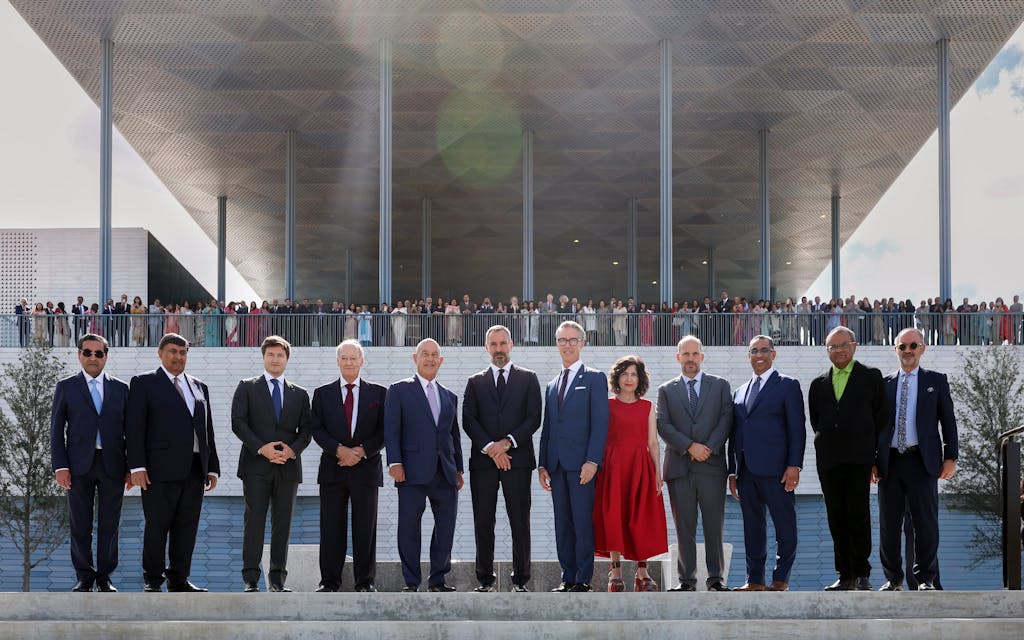 The Ismaili Center design and project teams posing for a photo with Mayor Whitmire, His Highness the Aga Khan, Prince Amyn, Prince Hussain, and Prince Aly Muhammad.Courtesy of Ismaili Center
His Highness Prince Karim Aga Khan IV purchased the property in 2006 for what would someday house the Ismaili Center, and the institution’s development was officially announced in 2018. Every photo shared, every visible bit of progress made, led to a barrage of WhatsApp notifications in Ismaili family and community group chats, and to subsequent mubarakbad (congratulations). Whenever a family member visited us, my father would load them up with bun kebabs (a type of Pakistani sandwich) before driving them to the site, circling it multiple times to see what had changed since his last drop-in: “That beam wasn’t there before!”
Jamatkhanas aren’t just places of prayer in Ismailism, a faith practiced by 12 million to 15 million followers in more than seventy countries. They’re hubs where people volunteer, attend religious-education classes, and participate in events. Zakia Lalani, a board member of the Islamic Arts Society and the wife of state Representative Suleman Lalani, says that being physically closer to a jamatkhana allows one to feel more spiritually connected to the space. “There’s this inner feeling, inner peace you find.” Raheel Ramzanali, a sportscaster, UT alum, and longtime resident of Houston, explains that in Karachi, Pakistan, where many Ismailis are from (himself included), communities are built around jamatkhanas. “This is something that is in our Ismaili community tradition and history,” he says. “It’s something that’s part of our identity.” When the Harvest Green location opened in Richmond in 2023, he moved near it, cutting his commute to a jamatkhana from ten to four minutes. In recent years, I’ve watched community members rent apartments and purchase homes in Montrose in anticipation of the center’s opening (my family tried to do the same, but the steep prices have deterred us for now).
Those who don’t live in an area with an Ismaili Center will travel far to visit one. Seeing all of them is almost an unofficial bucket list item for Ismailis. My family has made it a personal goal to visit every center as a group before 2030. We’ve ticked off Toronto and Vancouver so far—Houston, of course, is next.
Countless Houstonians have likely found themselves slowing down, curious, as they pass the massive site. On the other side of the street, the seven stainless steel, ten-foot Tolerance statues kneel in the grass, hands resting on their knees—a public art project partially funded by the Ismaili community and unveiled in 2011. The Ismaili Center sits near Buffalo Bayou Park, which stretches along Houston’s iconic waterway. Anne Olson, the president of the Buffalo Bayou Partnership, has long championed the project. She wrote a letter of recommendation years ago outlining the positive effect the center’s development would have on the locale, and she even met the former imam at a luncheon. “This area is becoming what I like to call a cultural corridor,” she says. “You have . . . Bayou Bend and the Rienzi. As you go down the bayou moving east, you have the Theater District, where the opera, symphony, and ballet play. There are all these different institutions that are suddenly lining the bayou, which is really exciting.”
The arts have long played a central role in Ismaili life. I grew up attending Katy Jamatkhana and participating in Dandiya Raas, a traditional folk dance; singing ginans and qasidas (devotional hymns and poems); and even performing a Sufi whirling dance for one of our religious-education open houses (always a dizzying crowd-pleaser). In Houston, Ismailis have spread their appreciation for the arts through the annual Navroz Spring Festival and the Islamic Arts Festival. In celebration of Aga Khan IV’s eighty-sixth birthday, in 2022, Mayor Sylvester Turner even joined the festivities, learning how to do the Dandiya.
The Ismaili Center, Houston plans to collaborate with local arts organizations to host concerts, exhibitions, and other activities. Aimée Froom, curator of the Art of the Islamic World galleries at the Museum of Fine Arts, Houston (MFAH), has previously worked with the Ismaili Council for the Southwestern USA and the Aga Khan Museum, in Toronto. The exhibits she curates at MFAH are part of the museum’s broader Art of the Islamic Worlds initiative, which was started in 2007. “Ismailis and other Muslims throughout Houston came to the museum and said, ‘We would like to see ourselves represented in this museum, and we would like to help you do that,’ ” Froom says. “So from the very start, the Ismailis have been a part of this cultural landscape in Houston.” She envisions MFAH collaborating with the Ismaili Center on complementary programming in the center’s theater and garden spaces. Performing Arts Houston CEO Meg Booth also hopes to host performances at the center. “I think art has a very unique ability to generate conversation, to generate community, to generate understanding,” she says. She already has a musical group in mind to perform in the center’s theater for the 2026–2027 season.
“Empty buildings, however striking, don’t serve their communities,” Aga Khan V said in his opening-ceremony speech. Ismaili leaders hope to fill the center with people from all walks of life and make it a gathering place for education, prayer, and social, cultural, and intellectual exchange. “Our goal is to create a sense of belonging and connection to the building for the non-Ismailis who visit it,” says Ismaili Center, Houston spokesperson Omar Samji. The week before the official opening, the Houston Chronicle editorial board had a message for Texas politicians currently turning up the heat on their Islamophobic remarks: Visit the Ismaili Center. Its very existence is grounded in our commitment to pluralism. The center is meant to spark conversation, deepen community relationships, build bridges between cultures, and unite visitors through shared experiences. I hope to see you there.
Read Next