
It’s a long way from Chicago to Texas, but what’s a thousand miles between butterfly rescuers?
Bob Erlich lives in Evergreen Park.
Therese Smith lives in Austin, Texas.
They’ve never met but, thanks to a Facebook post, they recently became cohorts in a quest to save nine monarch butterflies.
Their 11th-hour mission spared the late-blooming insects a certain death and gave them a chance to catch up with fellow migratory journeyers en route to the monarchs’ winter roost in central Mexico.
In late October, a friend called Erlich about nine caterpillars she’d found in her garden. Erlich took the larvae back to his south suburban home, which he has converted to a veritable butterfly hostel over the past 18 years, and pondered what to do.
If he let nature take its course, the vibrant orange and black insects would emerge from their chrysalises, hit the cooling Chicago temperatures and likely die within a few days.
The flutterers missed the last roost out in late September, Erlich said. There wasn’t enough time for them to get out of town safely.
But if he could somehow get them farther them along the migration path, he might be able to save the endangered insects.
He reached out to his daughter, Melissa Erlich, whose Facebook page, Missy’s Monarchs of Lindenhurst, now reaches more than 1,000 people across the country. She posted a plea for help.
Smith is among the page’s followers.
She read the post and offered her services.
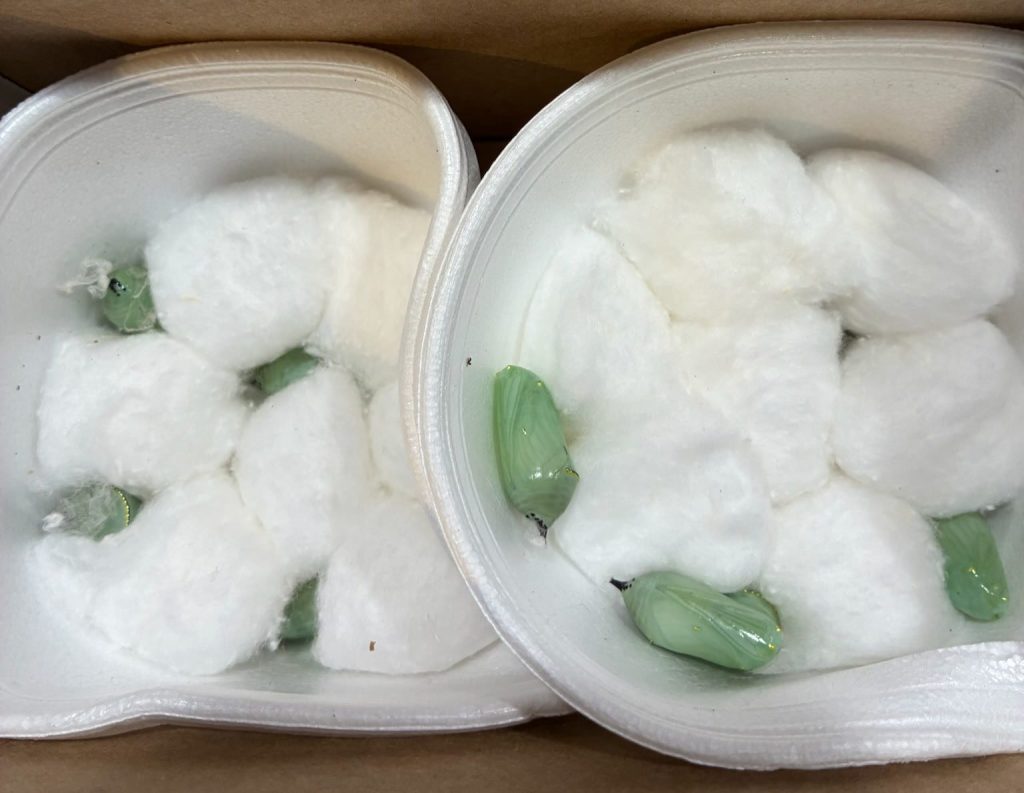
With the clock winding down before the larva would emerge, Erlich placed the pupas in Styrofoam cups, buffeted them with cotton balls and mailed the collection south to Austin.
“About two weeks after I got them,” Smith said, “all nine ‘eclosed’ (opened) and turned into butterflies.
“My grandson and I happened to be there when that happened,” she said. “It was wonderful. We tagged them and tested them for OE (the parasite ophryocystis elektroscirrha ) and then released them.”
Erlich said it’s unusual for monarch eggs to be laid so late in the season, but it does happen.
“Every year, three or four come along late. I feel bad letting them go because I know they’re just going to be dead in a day or two,” he said. “I always try to do whatever I can to keep them alive.”
Smith said she wasn’t nervous at all about receiving her first shipment of butterfly pupa.
“Actually, I was very excited about it,” she said.
“I don’t know Bob. I don’t know Missy. But I know the process” of helping butterflies take flight, she said.
“It’s just wonderful that you can connect with people who are like-minded and who care about the flight of these little butterflies,” she said. “It’s just amazing.”
Smith said Erlich cut about 1,000 miles off the typical monarch migration journey from the Midwest to Mexico.
“Bob made their trip a lot easier. They were probably really happy about that because it was a lot warmer here,” she said.
Like Erlich, who took an interest in the plight of monarchs after retiring from a career in sales, Smith became a butterfly rescuer later in life.
“I got involved after reading an article about the (struggle) years ago, just like Bob did. I thought that’s something I could do — plant milkweed, plant pollinator plants,” Smith said.
Her grandson Kyan, 8, has been at her side helping since he was 3. Whenever he or Smith’s other grandchildren visit, they run to her butterfly sanctuary to monitor the progress, she said.
“My grandkids are very fortunate. They are very well taken care of. But one thing they don’t get to do is garden with their parents because everybody is so busy,” Smith said.
She’s happy to fill that void.
“Gardening is something unique we do here for them. And they love it,” she said. “I like to think I’m not just raising butterflies, I’m raising a generation to help care for them.”
Both Smith and Erlich are members of Monarch Watch, a nonprofit education, conservation and research program based at the University of Kansas. The program encourages members to tag monarchs, which helps scientists monitor populations.
The effort, Smith said, has given her faith in humankind.
“There are so many good people out there trying to help,” she said. “Monarch conservation efforts are worldwide.”
Even though the crisis is still a big one, the connections fellow rescuers make seem to bridge the distance with wonder and fellowship.
“Who knew,” she said, “somebody from Chicago would connect with somebody from Texas over butterflies?”
Donna Vickroy is an award-winning reporter, editor and columnist who worked for the Daily Southtown for 38 years. She can be reached at donnavickroy4@gmail.com.