
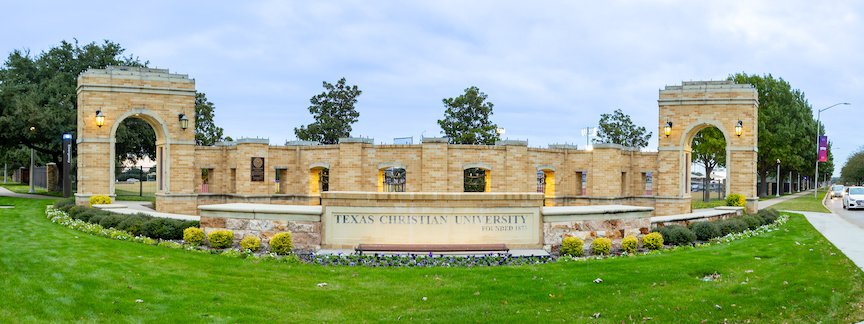
TCU this week announced a major institutional initiative aimed at advancing high-performance secure research computing.
AI² — Accelerating Institutional AI — will enrich student learning and expand the responsible use of artificial intelligence across campus, according to the university.
“AI isn’t just changing the rate of learning and the landscape of higher education — it’s making history,” said TCU Chancellor Daniel W. Pullin in a statement. “TCU has always prepared students with values and academic rigor to lead in a global society.
“We’re pleased to harness the opportunity and innovation of AI to accelerate learning, drive operational efficiency and expand research impact for our community at even greater scale. Launching AI² is yet another material investment in our Strategic Plan, LEAD ON: Values in Action and, most importantly, our students, faculty and staff.”
Floyd Wormley, provost and vice chancellor for academic affairs, added: “The volume of AI-driven work and research on campus currently is impressive, and these investments will scale TCU’s capacity quickly, ethically and collaboratively. It’s critical that we support the academic units with work underway and forge a path that empowers all TCU students, faculty and staff to leverage every innovation available to enhance our mission and make a lasting impact.”
AI² is powered by a hybrid infrastructure through Dell Technologies and cloud hyperscalers Amazon Web Services and Microsoft. The system blends secure on-premises computing with scalable cloud capability.
The university said the initiative represents a $10 million combined investment of institutional funding and corporate partner contributions — one of the largest research and technology commitments in TCU’s history.
TCU says AI² will centralize and accelerate faculty collaboration across disciplines under a unified ethical framework and strengthen the university’s role within the region’s expanding innovation ecosystem. The investment also supports TCU’s continued progression toward Research One (R1) classification.
The hybrid architecture deploys high-performance computing on campus for research requiring secure data and local control, while using cloud resources for projects that demand flexible or large-scale capability. TCU is leveraging the Dell AI Factory with NVIDIA, including Dell PowerEdge servers with NVIDIA GPUs, NVIDIA Spectrum-X networking and Dell PowerScale NAS. NVIDIA AI Enterprise software and open Nemotron models will support student and faculty development of agentic solutions for university operations.
“Dell Technologies is committed to empowering higher education institutions with the tools to transform learning and accelerate innovation,” said Jennifer Herbert, head of public sector sales, North America, Dell Technologies. “Our Dell AI Factory with NVIDIA provides the secure, scalable infrastructure behind TCU’s landmark AI² initiative. TCU researchers and students will be enabled to explore new frontiers in ethical AI, foster interdisciplinary collaboration, and drive meaningful impact across their campus and beyond.”
TCU says the university’s approach emphasizes responsible, interdisciplinary application rather than concentrating AI resources within a single field. As AI² develops, faculty governance will steer work in four areas: using AI tools in teaching, using AI in research, conducting research about AI, and ensuring ethical practices.
“TCU’s investment is more than hardware and software — it’s another proof point that we are serious about innovation and impact,” said Bryan Lucas, chief technology officer. “Powering research capability for new projects and many currently underway is one aspect of AI². In coming months, we will be launching additional tools and services for faculty teaching and research, student learning certificates that prepare them for real-world AI uses and institutional tools that enable TCU to continue to offer the best academic experience in the country.”
More information is available at tcu.edu/ai.