
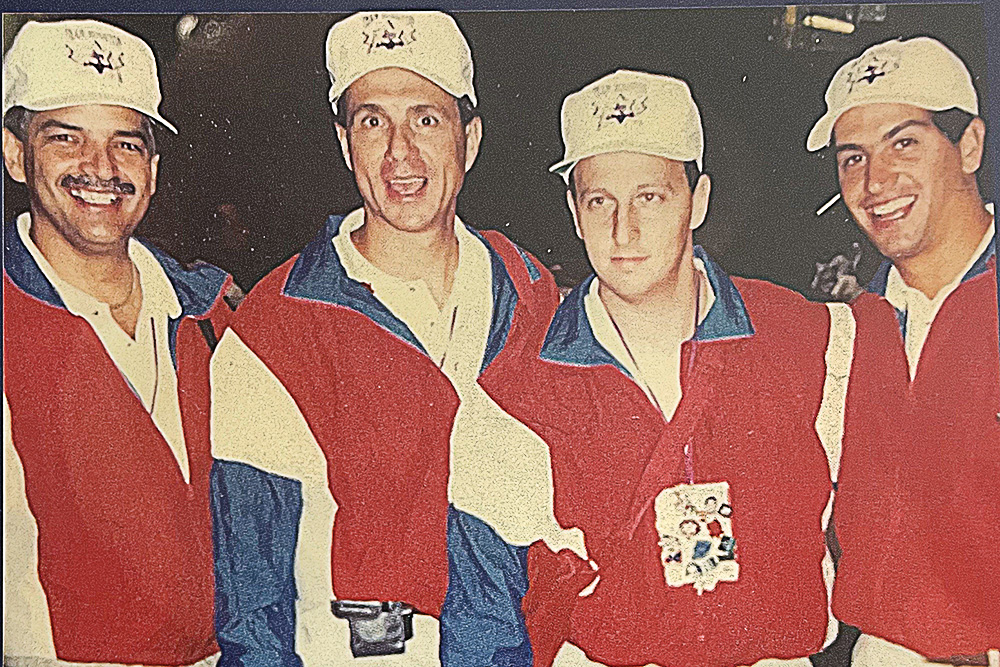
For three decades, Houston has helped thousands of Jewish teens experience the magic of Maccabi. The Evelyn Rubenstein JCC will be celebrating 30 years of the JCC Maccabi Games in Houston during a special reunion on Saturday, Jan. 24, at 7:30 p.m., at the J. In a series of stories leading up to the celebration, the JHV will first take you back to 1995.
Thirty years ago, a small group of Houston volunteers and JCC staff members were tasked with a unique assignment that, while at first challenging, soon became a life-changing experience for thousands of people.
The JCC Maccabi Games was a concept that hadn’t yet reached Houston in the early 1990s. Getting an entire community behind hosting the largest Jewish teens sporting event in the world would be no easy feat.
Louis Lippman was asked by Jerry Wische, then-director of the JCC, if he would lead the efforts.
“I had no idea what Maccabi was at the time,” Lippman told the JHV. “Most people didn’t even know how to pronounce it the correct way.” (FYI: It is pronounced Ma-Cobb-E, not Mack-A-Bee.)
In 1994, Houston sent five athletes to the Maccabi Games in Cleveland, Ohio. Lippman, along with Lenny Dubin, Stuart Wachs and Mike Grossman, z”l, joined the student athletes to observe and learn – with the plan to host thousands of kids in Houston the following year.
“Once we were there, I told Louis this is a no-brainer. Houston is going to eat this up,” Dubin told the JHV. “When we got back to Houston, we were pumped and made a presentation to the board of directors.
“There were three main ingredients that I knew we had to make it successful. We had the JCC and leadership with Jerry Wische and Stanley Rosenblatt on board. I knew our greater Jewish community would buy into a program like this. And I knew the Jewish kids in our community were going to love it.”
As optimistic as Dubin and Lippman were, the JCC Maccabi office in New York wanted to temper expectations.
“We made a small side wager with someone in New York. He said you will be lucky to get 100 kids,” Dubin said.
Houston’s first hosting delegation included an astonishing 265 local kids.
“We went from five to 265 in one year. I won the bet, but I think he still owes me a steak dinner.”
Now, with 265 youngsters committed and thousands more athletes and coaches from other cities on the way, the work was just beginning.
Wachs was hired as the Games director, as he had run the Games in Detroit. Lippman was asked as a lay leader to chair the Games. Dubin took the lead with the local delegation, while Jeremy Samuels was the JCC staff partner and Games assistant director.
“It was crazy back then, because the community had never heard of Maccabi,” Samuels told the JHV. “We were going to every youth group, every synagogue in town, Sisterhoods and Brotherhoods and recruiting athletes and host families.
“We were talking about this huge event that no one had ever heard of. It was big in the JCC world nationally, but it just hadn’t been through Houston. It was a true mobilization of the community.”
That mobilization included finding 50 local coaches, hundreds of host families, countless volunteers and committees coordinating sports venues, entertainment, transportation, security, food and more.
By the end of the summer, the 1995 JCC Maccabi Games in Houston was an astounding success. And, as a result, Houston was invited to host again in 1999, then 2003, 2007, 2012 and 2024.
“It was much too much work for one week of fun, so we created a year-round Maccabi committee,” Lippman said.
“These Games are so good that anyone who wants to do them should want to do them again. And anyone who hadn’t heard about them will wish they had. We planned on hosting again, which was unheard of to commit to every four years.”
Houston became a trendsetter for other Jewish communities, essentially creating the template for how to host a successful week of Maccabi Games.
Committee and subcommittees were formed with perfectly matched volunteers and JCC staff.
“When you host, it is a community-wide event,” Dubin said. “We were proud to build this model – that other JCCs have marveled at. We were being used as an example as they were trying to get other cities to host. We were very successful every time we hosted.”
There is something about Maccabi for people who get involved that becomes a part of who they are, Samuels said.
“I haven’t worked at the J in 25 years, but I’m still involved in Maccabi,” he said. “It is a great program for teens, but I also love the community-building. I love the way the whole community comes together for this big event.
“It is also a really strong statement of Jewish pride and Jewish peoplehood in a world where there are all sorts of controversies. Maccabi is a program that builds Jewish joy. I think we need Jewish joy, because otherwise, what is keeping us together as a community?”
While there are countless hours put into making the Games week a success, it is the end product everyone sees, on and off the fields and courts, that makes it all worth it.
“I had a boy come up to me at one of the early Games we hosted, and he said, ‘I always knew I was Jewish, but I never felt it until now.’ I remember that like it was last year,” Lippman said.
The social aspect of the Games for the kids was a big key, Lippman said.
“Those are some very pivotal years, with great relationships fostered – not only from within Houston – but with Jewish kids from other cities,” Lippman said.
“You had your phenomenal athletes, but you also had people who couldn’t bowl a 56.”
One of Lippman’s favorite memories was of a girl who made the table tennis team, not because she was a great athlete, but because she wanted to be a part of the program.
“I saw her at the venue and she seemed lost and uncomfortable,” Lippman said. “Then this guy from another city shows up all decked out with wrist bands and extra paddles and asked her if she wanted to warm up. That changed her whole demeanor.
“A few days later, I saw her at a Maccabi evening event. I go over to her and ask how she is doing and she looks like she just won the lottery. She was so happy and having so much fun.
“She said, ‘I haven’t won a single table tennis match yet, but I’m having the time of my life.’
“Then she goes to a guy on the dance floor and I realize that is the same guy she met two days earlier.”
While the experience is amazing for the teens, it has also been a way of life for the volunteers.
For Dubin, who many know affectionately as Mr. Maccabi, it has become a way of life. He has volunteered for three decades on both the local and national levels, most recently working with the Maccabi Access Games, which allows Jewish athletes with special needs to participate.
“Of all the things I do, Maccabi is the most rewarding,” Dubin said.
“For some kids, this is their Jewish connection. It is a very good feeling to know we have made such a big difference in the lives of so many Jewish kids.”
JCC Houston Maccabi alumni, sponsors, athletes, coaches and friends of Houston Maccabi are invited for a celebratory evening with drinks, dessert, memorabilia and Maccabi memories. The event, co-chaired by Lenny Dubin and Debbie Kaplan, is for adults 21+. To register and for more information, visit erjcchouston.org/event/jcc-houston-maccabi-30th-reunion.