
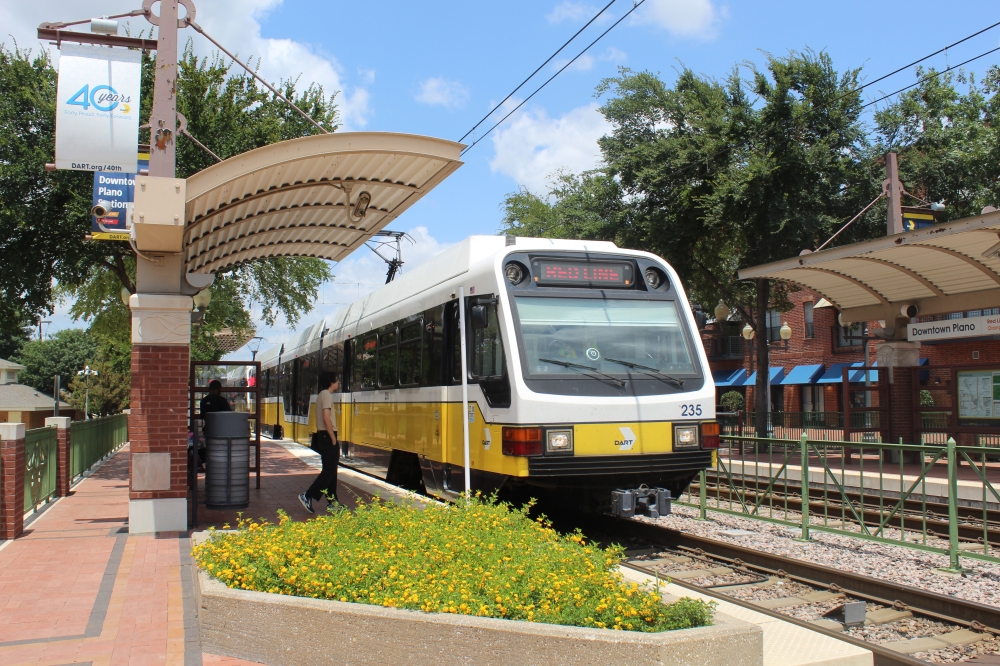
As a May special election is set to decide Plano’s future with Dallas Area Rapid Transit, the city’s plan for alternative transit options remains uncertain.
A citizen-led transit committee tasked with making a recommendation on alternative transit concluded its work without a formal consensus on Dec. 11. The 12-member, City Council-appointed Collin County Connects Committee had questions about cost, coverage and paratransit ahead of their recommendation to council on Dec. 16.
What happened
Committee members reviewed three alternative transit providers and were asked to rank them based on a variety of factors, including service coverage, reliability, safety, accessibility, wait times and connectivity.
However, several committee members said they chose not to rank any of the three transit providers, citing a lack of information and time.
“I did not [rank] because I don’t believe that an alternative should be chosen,” committee member Tod Marvin said. “I am not against choosing an alternate vendor. I just don’t believe I had enough information.”
Several members were also concerned they were not allowed to evaluate potential costs of alternate services when Plano officials cited an imbalance of financial contributions in return for DART services as one reason for calling the special election.
“There are large gaps in the ability to provide the vision that they’re setting out,” committee member Corey Reinaker said. “I’m concerned that these solutions aren’t going to get us there.”
Committee member Brett Cooper said he believes one of the transit options the committee should be able to rank is DART.
“I don’t feel that any of these can actually achieve the goal of continuity of service,” Cooper said. “It’s asking this committee to choose who is going to be stranded on May 3 if the election fails.”
During the meeting, Cooper passed out a four-page document detailing a report that he said seven or eight members signed on to, detailing that the committee “has not been provided with sufficient information to make a recommendation on any of the vendors.”
“We decline to make a recommendation on the vendors, as we have not been allowed to vet them in sufficient detail to reveal distinctions that would set them apart from one another or provide a basis to evaluate the financial implications of their service models,” the report states.
Several committee members also had concerns about future paratransit services, and questioned how paratransit services would work under alternative models.
Paratransit is defined as comparable transit service required by the Americans with Disabilities Act for individuals with disabilities who are unable to use fixed route transportation systems, according to the Federal Transit Administration.
“DART is the one who is able to do what we’re asking them to do, with some tweaks,” Cooper said. “With the priorities we’re being asked to choose [from], … [these vendors] would not meet the needs.”
Some context
Plano residents will vote on whether the city should stay with DART on May 2, 2026, unless an agreement between the city and agency is met prior to March 18.
After calling the election at a special meeting Nov. 5, Plano officials formally asked DART to consider a six-year, rail-focused transit agreement as an alternative to the expected election.
Approximately $251 million in annual sales tax contributions to DART could be impacted by the four cities considering a special election, according to the agency’s budget.
DART’s 13 member cities contribute 1% of sales tax revenue to the transit agency.
The proposal details a six-year agreement under which DART would continue providing rail service and express buses in Plano but discontinue “all standard bus, demand-response and other non-rail transit services within the city” by Jan. 1, 2029.
Plano Director of Government Relations Andrew Fortune previously said Plano officials have “repeatedly” tried negotiating to receive more Plano-specific services, submitting four reform plans dating back to last December.
What they’re saying
DART Board Chairman Randall Bryant attended the committee’s meeting and said he believes that Plano residents “do not want to end their relationship with DART.”
“This is a very complex problem to solve,” Bryant said. “I think there’s a lot of anxiety to make swift decisions, but there are a lot of lives at stake. There’s a lot of financial impact at stake, and it’s unfortunate that we’re making these decisions in real time with a deadline fastly approaching.”
Bryant said DART is still in discussions and internally reviewing the proposal Plano submitted to the agency to assess the “financial impacts and operational impacts.” Of the cities that called special elections, Bryant said the agency has only received “formal proposals” from Irving and Plano.
“This moment in time is not just about the four cities that are considering withdrawal elections,” Bryant said. “There are 13 cities that we have to make happy, … [and] we are working very diligently to meet with all of our cities and try our best to meet the demands of our cities at the same time.”
Fortune said that regardless of the May election, city officials will be working to establish an alternative transit service in Plano. Additionally, Fortune said Plano officials have set aside $4 million as an initial investment into alternative transit options.
The alternative service would supplement DART’s services if the city reaches an agreement with the agency prior to March 18 or if voters opt to stay in DART in May.
“It’s not a question of leaving DART to go to this service,” Fortune said.
Committee chair and former Plano Mayor Phil Dyer said he hopes the committee’s perspective can help guide the council.
“I think what you’ve done and what we’re sending to them may not be ideal for what you would have provided had you been given more time and more information,” Dyer said. “Nevertheless, I think they’ll find it extremely useful as they go through [this] process.”
What’s next?
The committee will present its recommendation to Plano City Council at its Dec. 16 meeting.
Residents can find more information at www.plano.gov/transit.