
B-52 modified with AESA radar completes ferry flight
A B-52 Stratofortress has completed its ferry flight from the Boeing Company’s San Antonio facility to Edwards Air Force Base (AFB), California, following the installation of a new, modernized radar system as part of the B-52 Radar Modernization Program. This milestone marks a significant step forward in the aircraft’s ongoing modernization efforts to ensure it remains a critical component of the United States Air Force’s conventional and nuclear long-range strike capabilities.
A crew from the 49th Test Evaluation Squadron at Barksdale AFB, Louisiana, and the 419th Flight Test Squadron at Edwards AFB, Calif., transferred the aircraft from Boeing’s facility Dec 8. The test team will execute ground and flight test activities on the aircraft throughout 2026 to enable a production decision later in the year. The modern Active Electronically Scanned Array (AESA) radar system replaces the aircraft’s antiquated and failing legacy radar, providing an upgraded all-weather navigation and targeting capability for the 65-year-old strategic bomber to ensure its future effectiveness. The AESA radar, developed by Raytheon Technologies, and integrated into the B-52 by Boeing, follows successful radar upgrades on the US Air Force F-15 and the US Navy F/A-18, and will bring a similar level of capability and maintainability to the venerable B-52.
Additional upgrades
“The ferry flight of this upgraded B-52 marks an important moment in our efforts to modernize the bomber force,” said Secretary of the Air Force Troy Meink in a USAF news release. “This radar modernization ensures that the B-52 will continue to serve as a cornerstone of American airpower well into the future. We are committed to extending the life of this vital platform, allowing it to operate alongside next-generation fighter and bomber aircraft.”
 The Active Electronically Scanned Array (AESA) radar is installed on a B-52 Stratofortress as part of the B-52 Radar Modernization Program. This modernized radar will enhance the bomber’s all-weather navigation and targeting capabilities, extending its operational effectiveness for years to come.
The B-52 Radar Modernization Program is a key element of the broader strategy to modernize the B-52 as its planned service life now extends through 2050 and potentially beyond, as it becomes the long-range strike complement to the Air Force’s newest strategic bomber, the B-21 Raider. Along with a new radar, the fleet of 76 B-52s are scheduled to receive additional upgrades, including new engines, crew compartments, conventional and nuclear communication systems, avionics, weapons and other capabilities which will enhance the B-52’s ability to carry out the full spectrum of combatant command and USSTRATCOM-directed missions.
An unmatched symbol of US airpower
“This milestone ensures our future Airmen inherit a modernized, ready Air Force,” said Air Force Chief of Staff Gen. Ken Wilsbach. “The B-52 Radar Modernization Program is about more than technology, it’s about readiness, deterrence and the ability to fight and win; the B-52 remains a powerful example of how we fly, fix, and fight to sustain global strike capability.”
The B-52 remains one of the most versatile and enduring assets in the Air Force’s inventory. Despite its age, it continues to adapt to meet evolving mission requirements. The completion of this ferry flight of the B-52 with its upgraded radar system is a clear signal of the Air Force’s ongoing commitment to bomber modernization and its dedication to ensuring these platforms remain viable for years to come.
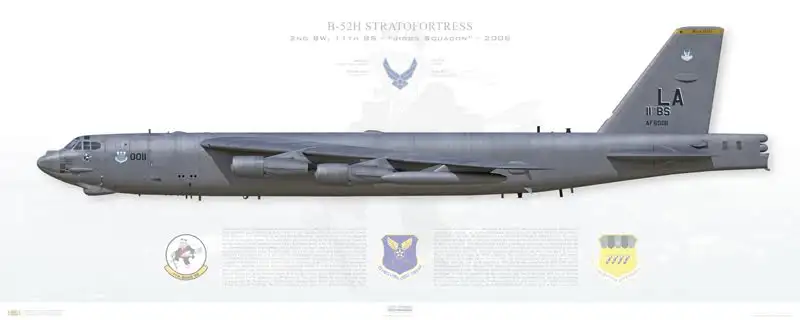 This print is available in multiple sizes from AircraftProfilePrints.com – CLICK HERE TO GET YOURS. B-52H Stratofortress 2nd BW, 20th BS, LA/60-0008 “Lucky Lady IV”. Barksdale AFB, LA
“The B-52 will continue to serve as an unmatched symbol of US airpower,” Wilsbach said. “With these upgrades, the aircraft will remain ready to execute our nation’s deterrence and strike missions for decades.”
B-52 modified with APG-79B4AESA radar
The BUFF (Big Ugly Fat F****r, as the B-52 is dubbed by her aircrews) will receive a new radar in the form of the new APG-79B4 active, electronically scanned array radar (AESA).
As the USAF migrates toward the two-bomber fleet of B-21s and B-52s the new AESA radar is a “game changer” for the BUFF. The APG-79 is effectively the same radar as on the export version of the Navy F/A-18 fighter, with the array turned “upside down” so it looks more down at the ground than up at the sky.
The APG-79 will be a fighter-quality radar and will be used not only to support air-to-ground operations but will also be better able to operate with other coalition partners because the bomber will be able to use the same sensor format. It will be able to scan farther, guide weapons in flight, and improve the bomber’s situational awareness. The B-52 today is still flying with its 1960s mechanical-scan radar.
New radars will be installed in early 2027 and initial operational capability (IOC) with the radar will consist of 12 aircraft as the required assets available for the declaration.
The USAF expects the new B-52J variant with both new Rolls-Royce F130 engines and new radars to be available for operational use before the end of the decade.
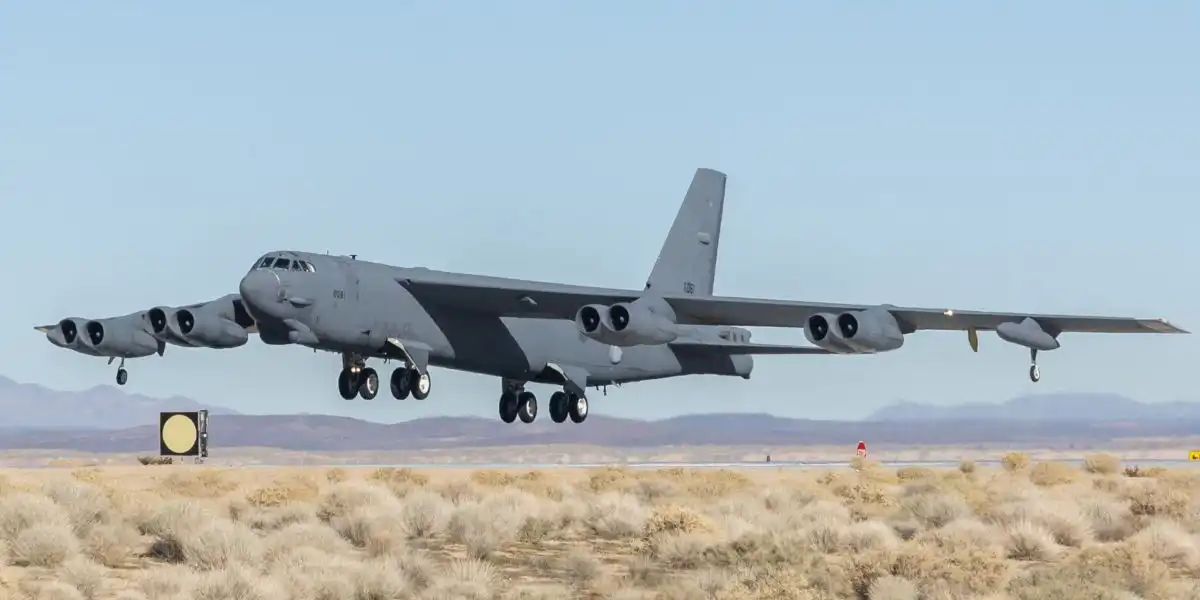 A B-52 Stratofortress arrives at Edwards Air Force Base, Calif., after completing its ferry flight on Dec. 8, 2025, marking a significant step in the ongoing B-52 Radar Modernization Program. This upgrade, including the installation of a new AESA radar, enhances the bomber’s navigation and targeting capabilities, extending its service life through 2050 and beyond.
Photo credit: James West / U.S. Air Force