
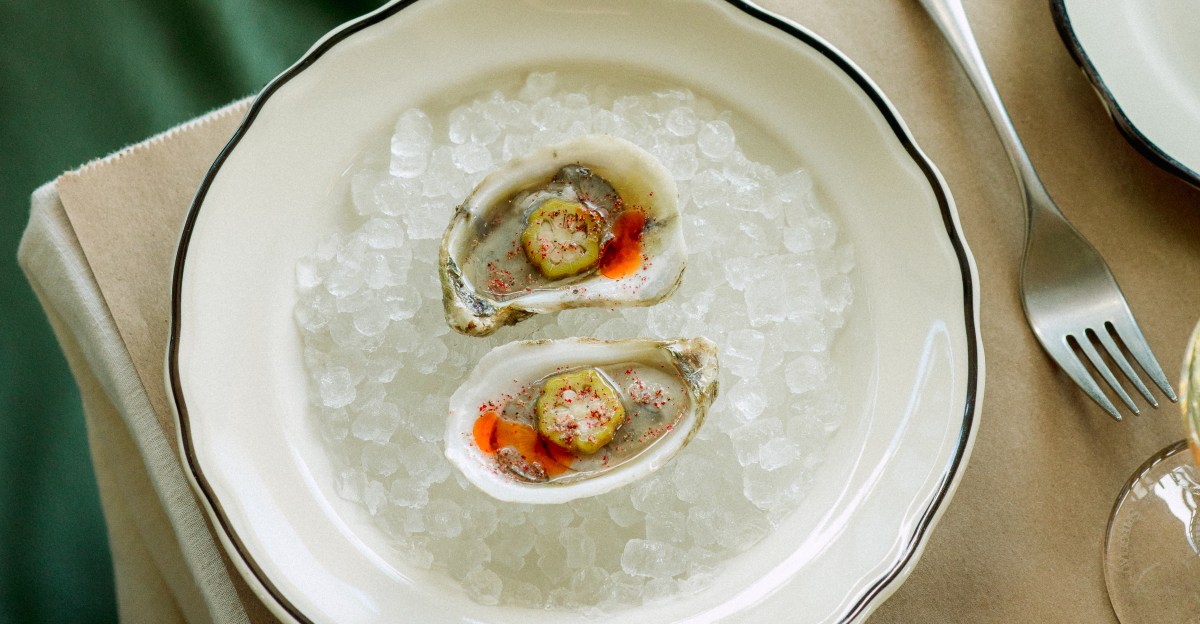
Something’s underway in Copano Bay, an estuary west of Rockport. A transformation spurred by a family of conservationists is rewiring brains and palates around Texas. No, Gulf oysters aren’t awful — some of them can be quite good.
Texas was the last coastal state in the nation to legalize oyster mariculture, passing a crucial bill in 2019. Just a few years later, the industry’s success can be tasted in the bright, briny shells emerging from Big Tree Oyster Company. This Rockport farm, led by Dr. Amy Belaire and Seth Gambill, is one of just 17 fully permitted grow-out locations in the state. Their success has put high-quality half-shells on the menu at top restaurants in Rockport, Austin, and San Antonio, including Dai Due, Le Calamar, Skipjack Oyster, and Barley Swine, giving diners a reason to reconsider everything they thought they knew about Gulf oysters.
Big Tree is run by Belaire, a conservation biologist, and her husband Gambill, a marine hydrographer and builder of Black Duck Skiffs. Both grew up in Rockport and reconnected years later at Belaire’s mother’s memorial at the Boiling Pot, a local seafood institution. That meeting became a hinge moment — not just for their romance, but for the Texas oyster industry.

Dr. Amy Belaire and Seth Gambill. Big Tree Oyster Company
These days, Big Tree Oyster’s owners return to the Boiling Pot every week with their blended family to order their oysters off the menu in what Belaire calls a “full circle moment.” Their three help out with the business too.
“Everett helps tumble them; Merritt helps deliver them; Cooper helps harvest them,” she says. “Each of the kids plays a role in getting these oysters here. How cool is that?”
Belaire earned a PhD in biology and spent years in Austin working in conservation, returning to the coast just as oyster farming opened in Texas. Gambill’s mapped the Texas coastline for more than two decades, building boats and gear designed to withstand the shifting currents of Copano Bay.
“Texas is a high-energy environment,” he says. “Constant wind, constant chop. A lot of the gear used elsewhere just does not hold up here.” Gambill’s expertise ensures every piece of equipment is engineered for the bay, a practical advantage most growers lack.
Their timing was crucial. Texas oyster reefs have faced years of crises. The state long relied on wild reefs, but storms and changing environmental conditions have devastated natural habitats. For example, Hurricane Ike in 2008 destroyed roughly 60 percent of Galveston Bay reefs, and Hurricane Harvey in 2017 caused catastrophic flooding that led to prolonged low salinity, widespread oyster mortality, and shellfish harvest closures. Because oysters cannot move, repeated hits compounded the damage. When House Bill 1300 legalized oyster farming in 2019, with permits following in 2020, the path for sustainable, long-term production had been laid out.

Dozens of farmed oysters. Big Tree Oyster Company.
For Belaire, whose parents ran a restoration company rebuilding wetlands and reefs, oyster farming is a continuation of her family’s legacy. Farmed oysters are naturally sustainable. They don’t need feed or added nutrients and filter water as they grow — up to 50 gallons a day. Their floating cages function as microhabitats for marine life. After harvest, Big Tree sends shells to reef restoration groups so the calcium can return to the bay.
“We want to put more back than we take out,” Belaire says.
To ensure consistent, high-quality oysters, Belaire and Gambill employ a rigorous hands-on approach: tumbling cages every few weeks to thicken shells and deepen cups, and sun-drying weekly to control barnacles. This controlled method produces oysters uniform in size, shape, and flavor.
The flavor reflects merroir, the marine equivalent of terroir. Copano Bay is fed by creeks and rivers that keep salinity bright, and constant winds keep the water well mixed. The result is a plump, briny oyster with a hint of sweetness. Dr. Lindsay Glass Campbell of Texas Parks and Wildlife notes that farmed oysters challenge long-standing stigma in Texas.
Dr. Campbell tells Eater that oyster mariculture wasn’t common in Gulf states until recently, thanks to robust wild oyster populations. As mariculture became more common on the East and West coasts, preferences began to shift in that direction. “Many people have only had a wild or dredged oyster from the Gulf,” she says. These oysters don’t have the look or taste of what people have become used to thanks to mariculture on the coasts, lending to the idea that Gulf oysters are better suited fried and on a sandwich.

Map of where Big Tree Oyster Company is. Emma C. Schmidt / Big Tree Oyster Company
These perceptions haven’t caught up to a new reality. “If you placed a Texas mariculture oyster in a sampler with those from the East Coast, I doubt anyone would be able to say it was from Texas,” Dr. Campbell says.
Even outside Texas, the quality is turning heads. Author Rowan Jacobsen, who won a James Beard Award for his book A Geography of Oysters, sampled Big Tree oysters and others from the state and emailed the couple: “Texas farmed oysters can go toe-to-toe with any oysters in the country. Plump, meaty, and beautifully balanced in sweetness and brine, they are an essential component of any well-curated raw bar.”
Chefs see the difference immediately. At Le Calamar, executive chef Casey Wall uses Big Tree to reintroduce diners to Gulf oysters. “The balanced salinity with a touch of sweetness puts them over the top,” Wall says. “You can taste the brine and the oyster. They offer a true expression of Texas.”
Hesitations fade quickly. “There’s definitely a stigma around Gulf oysters. We talk people through it, and many order a second plate after tasting them.” He also praises the consistency: “Because Big Tree controls the growing process, what we get each week is unrivaled.”
For Gambill and Belaire, the work is both personal and strategic. They grew up on these waters and watched their town’s OysterFest shift from local oysters to out-of-state supply as reefs declined. Now, the festival serves the couple’s Big Tree oysters, cementing a local legacy and ensuring the Gulf oyster industry has a long-term future.
“This is all so new. Texas is just getting started,” Belaire says.
Korean American wine bar Underdog gets a second life as Le Calamar, a French bistro with Texas flair. Co-owners Claudia Lee and Richard Hargreave partnered with North Carolina native and chef Casey Wall to revamp the entire menu, sourcing ingredients primarily from Texas and the Gulf Coast to craft a menu that could only exist in the Lone Star State. There are oysters Charentaise paired with spicy Texas hot links, grilled trout slathered in a brown butter-based salsa macha, an ever-changing menu of steaks cooked over charcoal, and compelling chicken wings à la Koffman (deboned chicken wings stuffed with mousseline) that appears deceptively simple. The beverage menu is just as impressive, with Hargreave sourcing most of the wines from France and a spirits list that focuses on Texas and Mexico.
Open for: Dinner, Brunch
Price range: $$$
This Cherrywood Texan restaurant is so regionally minded that even beer and wine are exclusively from the state. Equally satisfying for a lingering brunch or blowout feast at dinner, the Texas-forever menu under chef Jesse Griffith has heavier dishes like dry-aged wagyu rib-eyes, quails stuffed with boudin noir, grilled chicken hearts, and coffee-cured antelope leg filets. Diners can go lighter, too, with dishes like mixed greens salads and grilled cabbage. The decor vibe is industrial farmhouse — wood, brick, black accents, walls of preserves — and the outdoor patio has a vine canopy with twinkle lights.
Best for: Showing out-of-town visitors why Texas is great.