
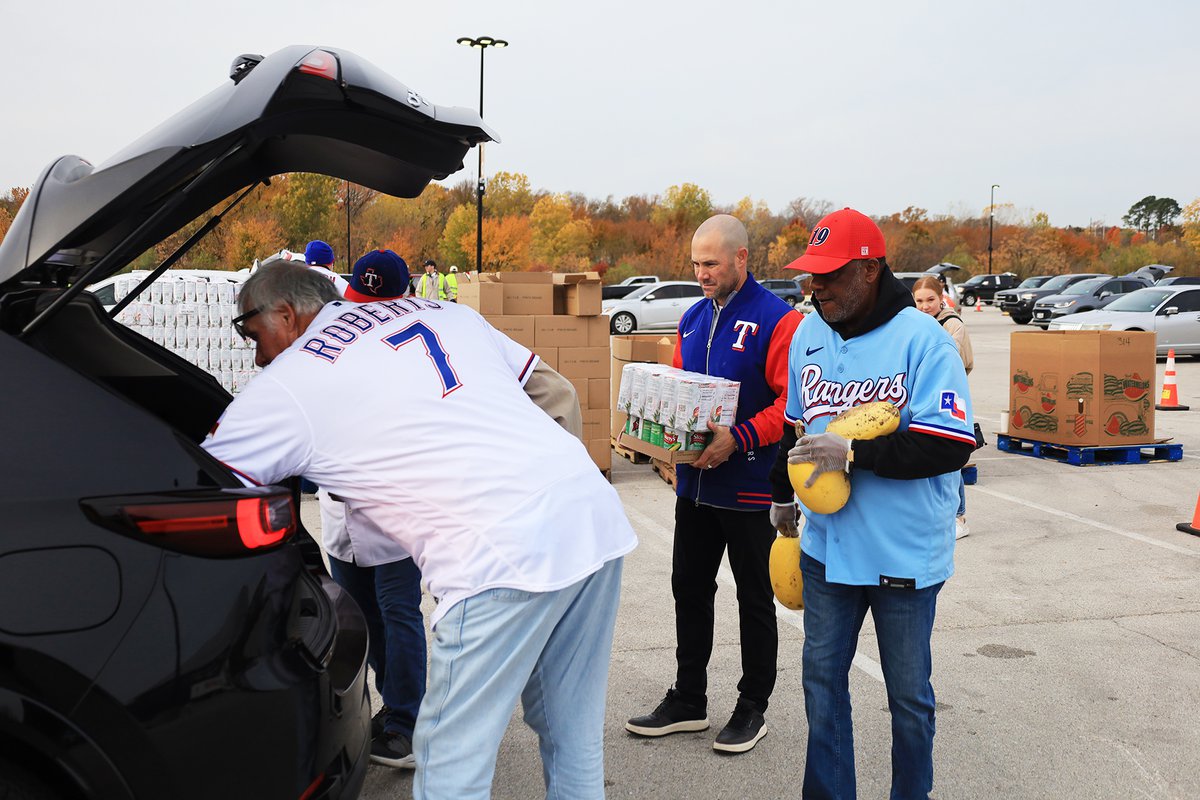
On a cold December morning in Arlington — the kind that sharpens the air and makes coffee taste better — Parking Lot R of Globe Life Field filled with something other than baseball traffic: a slow, patient line of cars, each one carrying a family hoping to put a holiday meal on the table.
By noon, 3,000 meals would leave the parking lot, each weighing nearly 80 pounds and packed with fresh produce, canned goods, rice, apples, onions, chicken, and ham. The Holiday Mobile Distribution, organized by Tarrant Area Food Bank in partnership with the Texas Rangers Baseball Foundation, Coca-Cola, and the Kate & Sonny Dykes Foundation, was designed to meet families where they are, with no paperwork, no questions, and no barriers.
The timing mattered. The holidays can magnify financial stress, especially for families already living close to the edge. Paychecks interrupted by federal shutdowns and SNAP benefit pauses have forced families into months-long recovery cycles, making way for events like this.
“The holidays are an especially difficult time for families who are already stretching their budgets,” said Jared Williams, vice president of external affairs for TAFB. “This is especially important for families with kids who are out of school for the winter break.”
Pulling off an operation of this scale requires military-style logistics. The setup began days earlier with pallets, traffic plans, and volunteer coordination. On distribution day, truckloads of food rolled in before dawn.
“With us serving 3,000 families, about 80 pounds per family, that’s a lot of food that we have to get here,” Williams said.
Each vehicle moved through the line marked with a simple system indicating how many families it represented. Volunteers loaded identical assortments, including holiday staples, fresh produce, shelf-stable goods, and fresh protein. The goal was not just to feed, but to dignify.
Beyond the parking lot, the pressures driving demand remain stubborn. Families affected by the federal shutdown lost multiple pay periods, often relying on credit to survive. “When families go without a paycheck for two and a half to three paychecks, families have to do all kinds of pivots to ensure that they can make ends meet,” Williams said. “They’re going to take anywhere from three months to six months to recover from that.”
The SNAP benefits pause compounded the strain. Food bank assistance, Williams explained, helps families stabilize, freeing limited cash for rent, utilities, or debt. “So that they don’t at least have to worry about groceries and they can use that money to help try to get back on their feet again.”
But this strain isn’t just felt by the patrons of this event. TAFB also felt the ripple effects of the government shutdown.
“We’ve had to double our operations since the government shut down,” Williams verified. “We’re still operating at that level. And so any bit of support, whether it’s donated, volunteer lending, or anything else, helps us to do the great work we’re doing.
For the Texas Rangers Baseball Foundation, the solution was as much about space as it was about support. Globe Life Field sits quiet during the offseason, its vast parking lots empty of tailgaters and ticket scanners.
“We’ve been longtime partners with Tarrant Area Food Bank,” said Karin Morris, executive director of the foundation. “When the government shut down, we knew that we’d have parking lots that were not being used during the off-season and so offered our space.”
That offer grew into a full-scale collaboration. Before the distribution, the Rangers Foundation and Coca-Cola made a joint $20,000 donation, and the Kate & Sonny Dykes Foundation contributed an additional $10,000, totaling $30,000 and funding 120,000 meals across the food bank’s 13-county service area.
Morris said the visual impact of the line underscored the need. “We know that the need is huge … you can see the line,” she said. “It’s good to be building and working collaboratively. The parking lot’s a big space, so we’re able to really get folks through quickly and hopefully serve as many people as we can.”
As cars rolled forward through the organized lines, volunteers moved with practiced ease, lifting boxes, exchanging brief smiles, keeping traffic flowing. It wasn’t charity as spectacle. It was logistics, teamwork, and neighbors helping neighbors in the shadow of a ballpark.
Williams sees the day as one moment in a longer fight against hunger, one that depends on sustained community support. “Our community is resilient and has been very supportive so far,” he said. “We certainly can’t do this without our community.”