
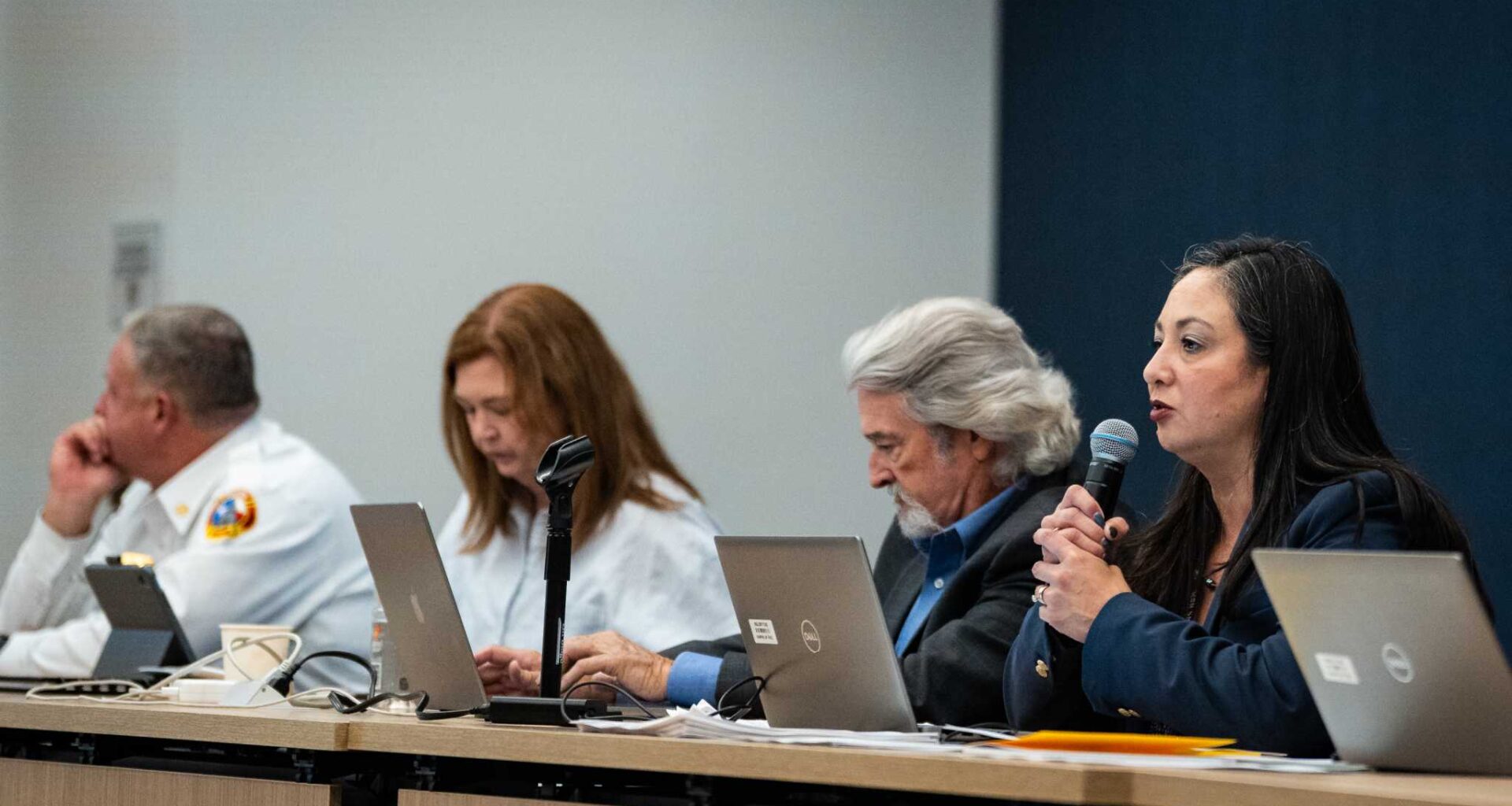
Acting Chief Labor Relations Officer Roxy Stevens, right, lays out ground rules for bargaining between the Austin Firefighters Association and the City of Austin as contract negotiations begin at the City of Austin Permitting and and Development Center, July 30, 2025.
Sara Diggins/Austin American-Statesman
Austin City Council is poised Thursday to approve a four-year labor contract with the city’s firefighters union, ending months of tense negotiations that repeatedly appeared headed for collapse and threatened to spill into a costly ballot fight.

The agreement settles a high-profile dispute over staffing, pay and overtime as city leaders are grappling with lingering budget instability.
Article continues below this ad
While the first year of the contract is largely funded in the city’s recently adopted budget, key provisions — particularly a last-minute compromise preserving minimum staffing at structure fires — could drive millions of dollars in additional overtime costs that are not yet accounted for.
City Council set aside $5.9 million in its Nov. 20 budget to cover the first year of the deal. That funding pays for negotiated wage increases, one-time bonuses and the hiring of 22 additional firefighters required to implement a new shift schedule sought by the Austin Firefighters Association.
But the agreement also locks in a requirement that at least four firefighters respond to every structural fire — a standard the union has long argued is essential for safety and effective emergency response. Maintaining that model often requires overtime when staffing levels fall short, and city officials acknowledge the final cost remains uncertain.
Read More:Austin firefighters push charter amendment to lock in minimum staffing
Article continues below this ad
In his July budget proposal, Austin City Manager T.C. Broadnax proposed loosening the four-person requirement in limited situations as part of a broader effort to rein in overtime spending. The Fire Department’s overtime budget was ultimately reduced by $8.3 million in the adopted spending plan.
The firefighters association responded by launching a petition drive to enshrine the staffing standard in the city charter, making it harder to repeal than a regular ordinance.. As the campaign gained traction, council members grew concerned that the proposed amendment could significantly restrict the city’s ability to manage costs during future financial downturns.
Austin Fire Fighters collected their fire hose and belongings after extinguishing a fire in the 3000 block of Pecan Springs Rd. early Monday morning, which resulted in two fatalities.
Ricardo B. Brazziell/Austin American-Statesman
In recent weeks, council members pressed city labor negotiators to reopen talks with the union in hopes of averting the ballot measure.
Article continues below this ad
After two days of negotiations, the two sides settled on a deal that achieves that goal.
Under the agreement, the city will drop its plans to modify the four-person staffing model while the association will halt its charter amendment campaign.
The agreement stipulates that staffing changes can occur only with union consent — a scenario outgoing association President Bob Nicks said is unlikely. As a result, city officials may soon face pressure to restore funding for firefighter overtime if spending exceeds what council budgeted.
“It is going to require some tough choices down the line,” Council Member Ryan Alter told the American-Statesman. “We can’t just pretend we’ll get everything we want without difficult choices.”
How much overtime the Fire Department will need in 2026 remains unclear.
Article continues below this ad
City officials did not directly answer questions from the Statesman about whether current funding levels are sufficient to sustain four-person staffing based on historical overtime usage..
“Mandatory four-person staffing has been the standard by ordinance since 2018,” city spokesperson Yasmeen Hassan said in a written statement. “If overtime is required to implement, the City will manage that accordingly.”
Read More: Escalating APD budget deepens financial squeeze for Austin leaders
The agreement does give the city greater flexibility to temporarily take fire apparatus or stations offline to save money, but only under strict conditions. The city’s chief financial officer must determine that Austin is facing a “severe financial crisis” that impairs its ability to deliver critical services. A six-member committee of city and union representatives would then be convened to discuss possible service reductions.
Article continues below this ad
Only recommendations receiving at least four votes would advance to the city manager, who retains final authority over whether to implement them.
Nicks, the association president, said he supports the compromise because it ensures public transparency around potential service reductions but he remains wary of further cuts.
“The Fire Department is worried we won’t be able to make budget if the city doesn’t do something,” Nicks said. “My concern is they’re going to do that by cutting even more from our budget.”
Despite the unresolved questions around overtime, council members have largely rallied behind the deal. Several said it was preferable to allowing the charter amendment to go before voters.
Article continues below this ad
Austin City Council members Mike Siegel, left, and Chito Vela discuss a new city budget at City Hall on Thursday, Nov. 20, 2025. The Austin City Council is set to vote on a budget that includes millions of dollars in spending cuts after voters rejected Proposition Q in November, a ballot measure that would have raised property taxes and generated $110 million in new revenue.
Jay Janner/Austin American-Statesman
Council member Mike Siegel said the ballot proposal would have sharply limited the city’s options during emergencies.
“The impact of that ballot measure would have required the city to close every park and library before closing down a fire station for one hour,” Siegel said.
Article continues below this ad
Asked how the city would cover potential overtime overruns after cutting $8.3 million from the Fire Department’s budget, Siegel expressed confidence in Broadnax’s ability to adjust.
“My current frame is that the manager has a lot of different levers to find that money if it’s needed,” Siegel said.