
A scholarship at Texas Tech is about more than funding Sara Martinez’s education;
it’s unlocking a future dedicated to helping others through their darkest moments.
CREATORS
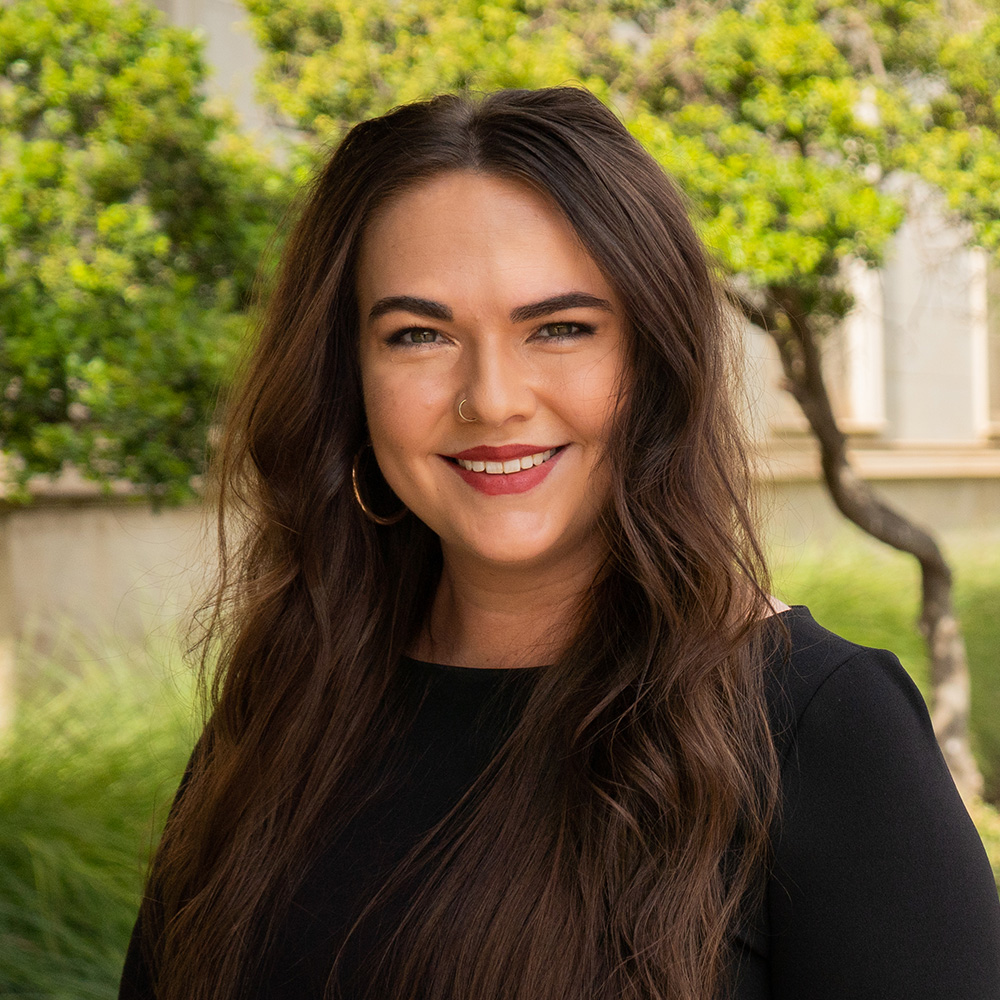
Sara Martinez has been an advocate since she was 5 years old.
She had to be.
For the now 21-year-old Texas Tech University student, this trait has become instinctive — thrust upon her by circumstances most
people can’t fathom, much less experience.
At age 5, Sara corrected a nurse who tried to give her the wrong medication during
a chemotherapy session. She already knew what her port was, which medicines went into
it and who was allowed to touch it.
She quickly learned that advocating for herself could mean the difference between
going home and staying in the hospital.
“They got a new nurse in there, and they did things the right way,” Sara joked about
the encounter, highlighting the optimistic attitude she kept throughout her diagnoses.
While her peers’ most significant concerns were learning to write their names, tie
their shoelaces and navigate the new social norms of kindergarten, Sara was learning
to survive.
Sara was born with neurofibromatosis type 1 (NF1), a genetic condition that causes
tumors to grow throughout the body — some of which can become cancerous — and affects
the muscles, bones and nervous system.
Before graduating from high school, she had been diagnosed with three life-threatening
ailments. She underwent two major surgeries and completed countless hours of chemotherapy
— all linked to NF1.
This diagnosis and the conditions and procedures that followed were undoubtedly defining
moments in Sara’s life, though not in the way most people might expect.
Within the halls of CHRISTUS Children’s Hospital in San Antonio, Sara discovered a
community that would shape her outlook on life and lay the foundation for a career
built by compassion, advocacy and a commitment that no child will face illness alone.
The Diagnosis That Changed Everything
The first five years of Sara’s life were relatively normal. She grew up in San Antonio,
the only child of two hardworking parents. Her mother was a special education teacher,
and her father was a military veteran and owner of an auto repair business.
They were both attentive parents who kept a close watch on their daughter’s health.
A watchfulness that would soon prove crucial in Sara’s health journey.
“It started as an average fever and became pink eye,” Sara said. “My eye started looking
even more abnormal to my parents, and then they and my grandma made the decision to
take me to the hospital.”
At the hospital, the Martinez family was immediately referred to an ophthalmologist,
who promptly ordered a series of scans. The ophthalmologist noticed Sara’s right eye
showed no response — she seemed blind in that eye.
Then they received the call: come to CHRISTUS Children’s Hospital in San Antonio as
soon as possible. From the urgency, they knew the news wasn’t good.
Sara had an optic glioma, a slow-growing tumor found on her right optic nerve that
had already stolen the vision in her right eye. It was inoperable. Attempting to remove
it could leave her paralyzed or brain-dead. Radiation wasn’t an option due to NF1.
The only viable treatment was chemotherapy — with no guarantee it would work.
Sara started kindergarten with a chemo port implanted in her chest. Not only did the
port provide direct access to her bloodstream for a demanding chemotherapy regimen,
but it also served as a physical barrier that prevented her from connecting with her
classmates.
“It was hard,” Sara confessed. “I’m about to start big-girl school, and this is happening.
When my classmates were playing tag or going on field trips, I wasn’t able to participate,
or I missed out altogether because I was at the hospital.”
When Sara went into remission at 7 years old, the family moved from San Antonio to
Floresville, Texas, a neighboring town about 30 minutes south. They were looking to
start fresh, live in a calmer environment and be closer to her grandparents.
A New Challenge Emerges
She was essentially symptom-free until she reached middle school. It was there her
parents once again noticed signs they couldn’t ignore. Their daughter was struggling
in school in ways she hadn’t before, getting Bs and Cs in most of her classes.
While her parents hoped the grades could be blamed on the transition to middle school,
they knew in their gut that it wasn’t the case.
“When I made the switch, I was drowning,” Sara admitted.
Her parents took her to the doctor for answers.
A CT scan revealed dangerous pressure building inside her brain, a complication linked
to her NF1. She needed surgery to place a titanium ventriculoperitoneal shunt to drain
the excess cerebrospinal fluid. The news was alarming, but the operation was a resounding
success.
“A week and a half later, I was on the operating table getting a shunt,” Sara said,
marveling at how simply her doctors resolved such a serious issue. “Fast forward,
and we thought, ‘OK, all good. She’s finally out of the woods. Everything is normal.’”
It Takes a Village
Through both diagnoses and resulting treatments, Sara and her family leaned heavily
on those around them.
When a new complication arose, the family’s life quickly became a careful choreography
of treatment schedules, blood draws and scans, and they had to find a way to adapt.
With both parents working full time, it quickly became clear they needed additional
help.
Her grandparents became the family’s anchor, providing in-home support so everyone
could aid her recovery. They were there for school pickups and drop-offs and drove
her to appointments when her parents couldn’t.
Beyond her immediate family, she found refuge in her care team, with whom she would
spend eight-plus hours a week at the hospital. They knew her by name and her preferences.
They celebrated her wins with her and brought comfort during the hardest days.
Among those who stepped into Sara’s life during long hours in treatment was Leanne
Embry, her pediatric oncology psychologist. Little did Sara know at the time, but
Leanne would be instrumental in shaping her future.
Leanne didn’t just help Sara navigate the complex emotions that came along with uncertainty;
she also taught her to recognize her own strength, ask questions and use her voice.
These lessons have followed her through every stage of her life, revealing a calling
that has grown stronger as she has grown older.
“I love her to death and still text her all the time,” Sara said of the psychologist.
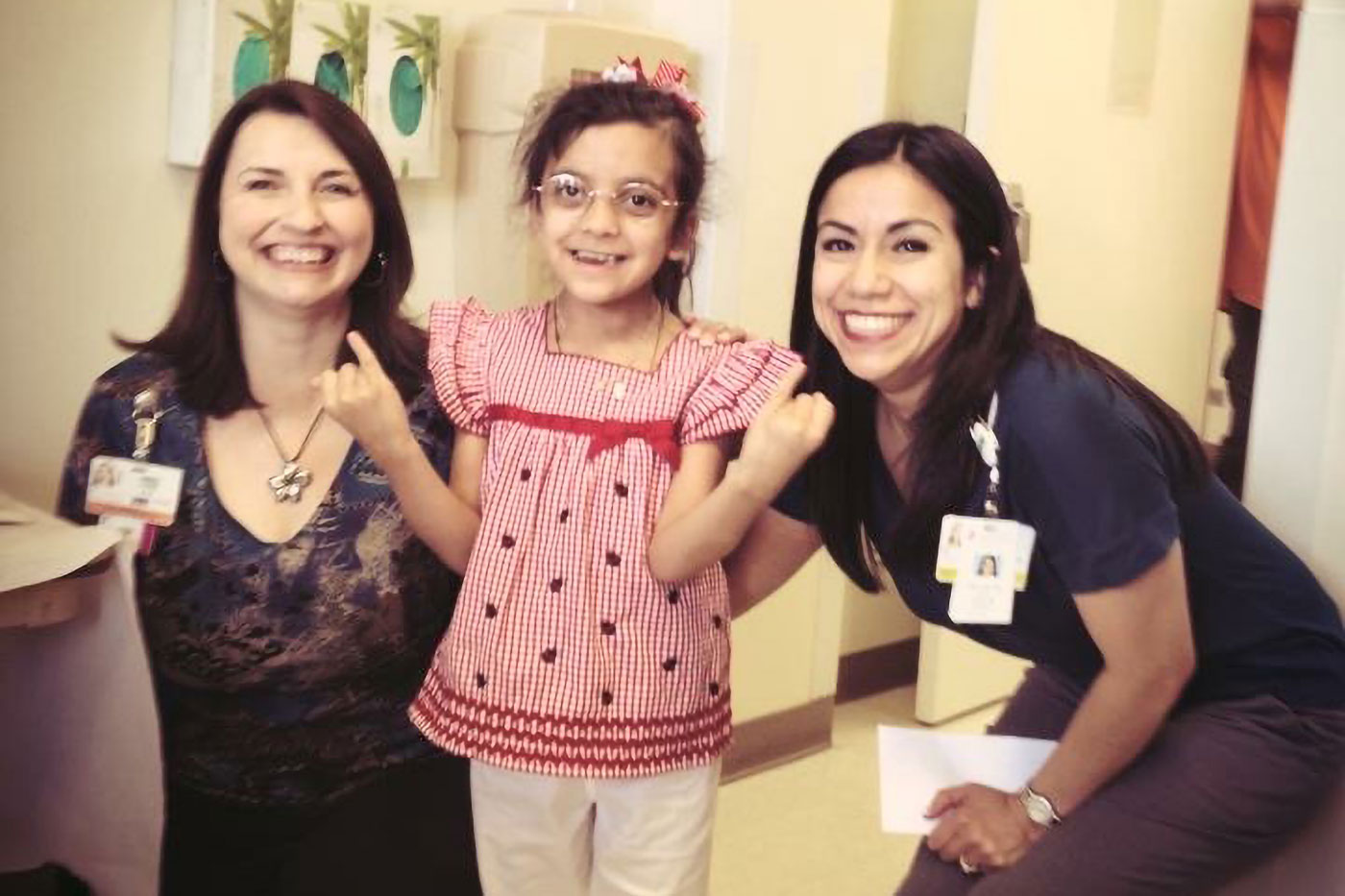
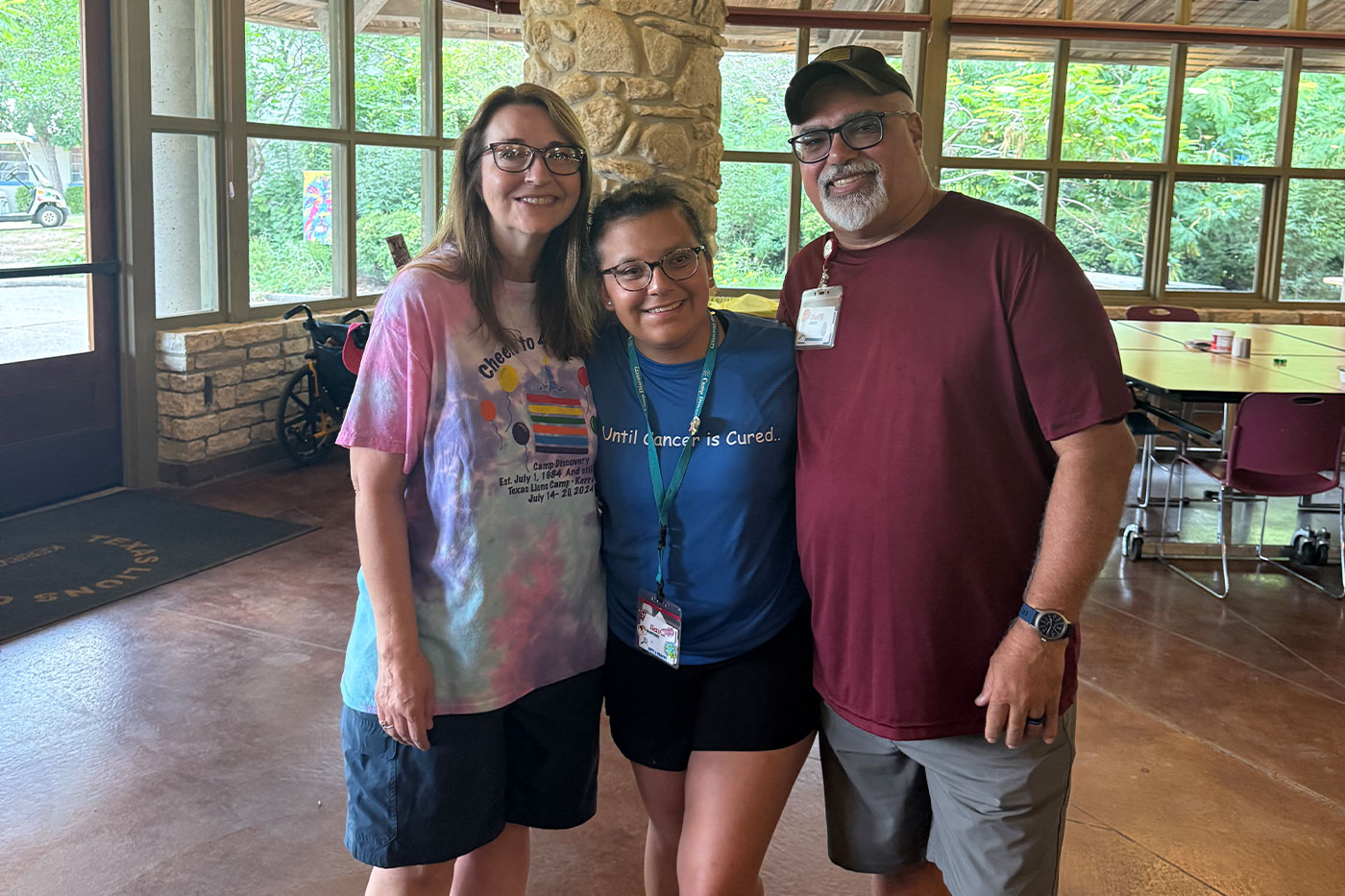 Left – Sara (middle) in the hospital with Leanne (left).
Right – Sara with Leanne and her husband, Zeff, at Camp Discovery, a unique camp experience
for children ages 7-16 who are battling or have battled cancer.
Her experience managing her own illness made her realize she wanted to be the same
kind of advocate and support system that Leanne was for her. She was inspired to pursue
a career where she could treat the person living with an illness, not just the illness
itself.
With this clarity, Sara knew she wanted to become a pediatric oncology psychologist
who could serve as a patient advocate.
Signs in Red and Black
Sara needed to attend college to pursue this dream, but the idea of leaving Floresville
made her anxious. It meant leaving behind the community that had supported her through
her health journey.
She wanted to attend a college near home. However, her parents encouraged her to get
out of her comfort zone and convinced her to visit Texas Tech during her junior year
of high school.
While she conceded to her parents’ plans, she made a promise to herself: She wasn’t
going to get attached to a university unless all the “signs” were there.
“I was looking for a place that had camaraderie,” she said. “I wasn’t going to commit
to a university unless the environment felt like the right fit.”
At first glance, Texas Tech didn’t seem like it was quite the one.
The day they toured, the campus initially seemed quiet, almost like a ghost town.
But, as they continued their trek, they found themselves drawn to the reverb of an
announcer’s voice coming from Rip Griffin Park, the baseball stadium. When they entered,
the emptiness of the campus suddenly made sense. The stadium was jam-packed, alive
with energy, spirit and the unmistakable clang of cowbells.
The Saddle Tramps, an iconic Texas Tech spirit organization, was out in full force.
“My dad saw them first,” she said. “We both thought it was so cool. We hadn’t seen
an organization like that before.”
Sara was naturally drawn to the group.
She had grown up dancing during the periods between her recoveries and remissions.
She was also active in extracurricular activities and worked diligently to build community
and team spirit — things she had often missed.
She was hopeful there was an organization like the Saddle Tramps that she could join.
She wanted to reconnect with the community she had longed for as a child.
Later, during her campus tour, she bonded with her tour guide over dance. The conversation
came naturally and felt familiar. They discovered they shared a mutual acquaintance
and had danced in some of the same circuits.
After her tour, she couldn’t help but feel all the signs were there.
“The connections, the culture, the campus, even the church across the street, everything
just felt right,” she said as her face lit up, reliving the moment. “For the first
time, I could see myself here.”
Even before she left campus, she was all in on Texas Tech. For the first time in years,
she could picture a future she chose for herself, one full of possibility.
A Symbol of Hope
Just as Sara’s plans started to fall into place, she was quickly reminded that journeys
like hers don’t always follow a predictable path.
At the start of her senior year of high school, Sara once again began experiencing
medical symptoms she couldn’t ignore. Initially, she attributed these to the usual
demands of being an active student in her senior year of high school. However, they
continued to progress.
Multiple biopsies, scans and other tests confirmed she had invasive carcinoma, a type
of breast cancer.
“I got my port, I saw the surgical oncologist and I started my senior year of high
school,” Sara said. “So, I started kindergarten with one kind (of cancer), and then
I was ending high school with a different kind. It was kind of freaky.”
She underwent six rounds of chemotherapy during the fall of her senior year and then
surgery in January to remove the tumor.
Despite this, her care team, school and family fought to preserve a sense of normalcy.
She went to events when she could. She stayed connected with classmates. Her community
strived to ensure she didn’t miss the milestone moments senior year had to offer.
And in the midst of it all, she looked down at her phone to find an email from Texas
Tech.
Her pulse quickened, and her head filled with thoughts about another potential setback
in an already difficult year. When this email arrived in her inbox, Sara had just
finished her first round of chemotherapy and had just shaved her head. She really
needed some good news.
“I kept thinking, ‘Did I get in? Do I open it? Do I wait?’ I was terrified,” she confessed.
She allowed herself to take one quick glance at the summary of the email, where she
found one word that cut through the ambiguity: Congratulations.
She had been accepted.
In a year defined by uncertainty, this moment provided new resolve for a bright future.
Finding Her Home Away From Home
This moment gave Sara the burst of energy she needed to start planning her next steps
to build her life in Lubbock. Around this time, her dad had revisited the Saddle Tramps Instagram page and had seen a post about the High Riders — a women’s spirit organization dedicated to supporting Texas Tech women’s athletics.
She filled out an interest form immediately. Not long after, she heard from her future
pledge mom, Kierstyn Marches, about a meet-and-greet she could attend at the beginning
of her first semester of college.
By then, Sara was trying to regrow her hair after her recent chemotherapy treatments.
It wasn’t uncommon for people to treat her differently or be unsure of how to act
around her.
In situations where people didn’t know her well, she felt pressured to explain her
situation to avoid discomfort. So, when she arrived at the High Riders meet-and-greet,
she instinctively went straight to the president, ready to explain her recent treatments
to reassure others about her appearance.
This conversation was different.
Expecting the same awkward silences and uncertainty people showed when they didn’t
know what to say, she was instead met with open arms. She was welcomed into the group
effortlessly and was offered the option to reach out for help if she ever needed anything
as she settled into her new environment.
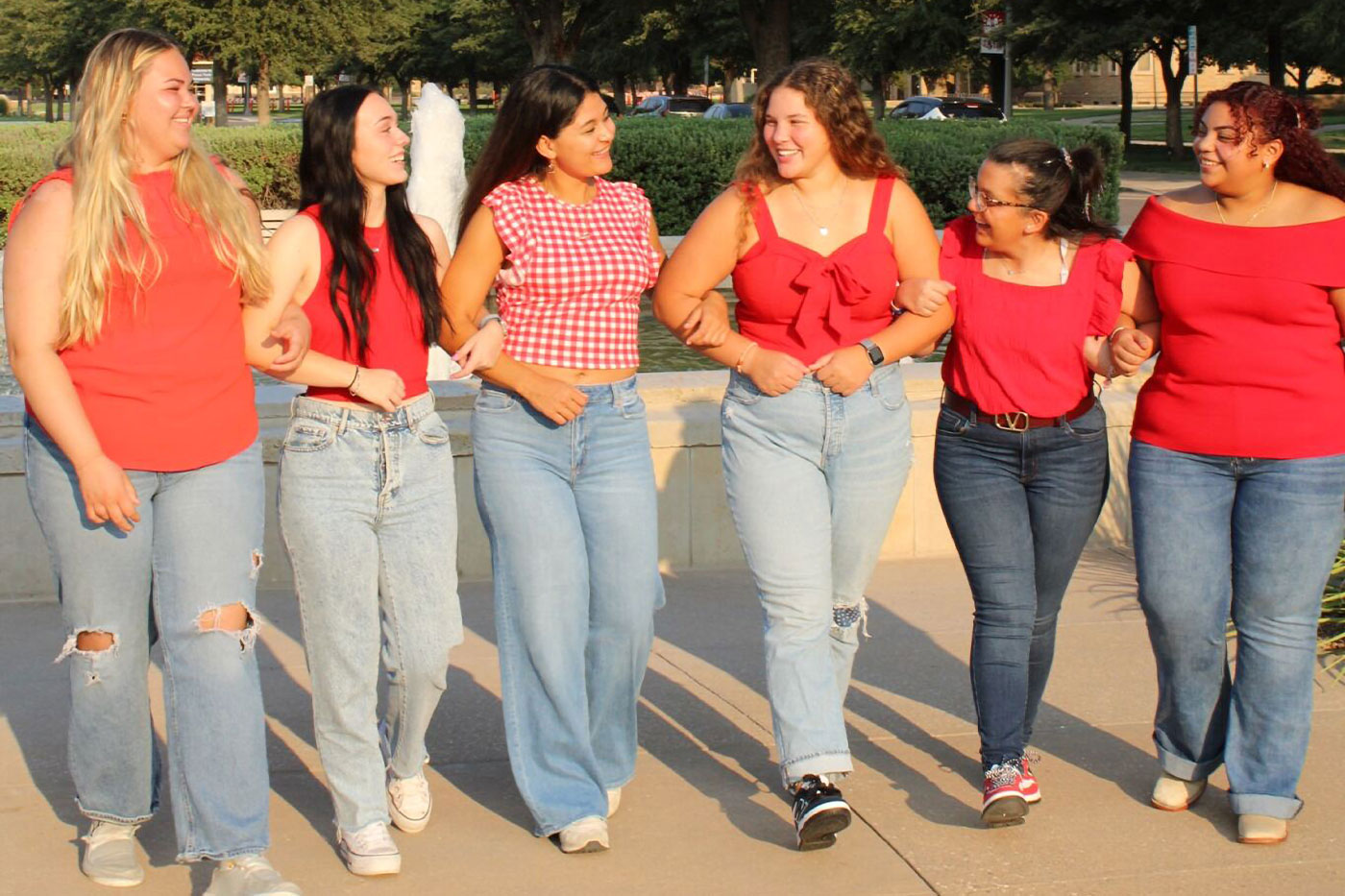 Sara with the High Riders
Through rush, meetings, service events and eventually her pinning, Sara knew she had
found the community she had been worried about missing when she left Floresville.
She had found her home away from home.
“I wasn’t just a girl with cancer to them,” she said, beaming. “I was myself. I was
just Sara.”
The Scholarship That Made It Possible
Sara’s next defining moment of reassurance came from an unexpected source.
During her senior year of high school, she had navigated the overwhelming scholarship
application process, meeting numerous deadlines without receiving even a rejection
letter.
However, her persistence paid off when she was awarded the Presidential Merit Scholarship at Texas Tech, along with additional funding for graduating in the top 10% of her
class.
This scholarship covered a portion of her tuition and fees, but she was inspired to
pursue additional opportunities to further support her education. At the end of her
first year of college, Sara scoured the list of available scholarships from her academic
advisor and submitted applications once again.
Her determination was rewarded when she received word she had been selected for the
Gres Family Endowed Scholarship.
The scholarship, offered to full-time undergraduate psychology majors in the College of Arts & Sciences, covers the full cost of attendance — tuition, fees, room, board and books. For Sara,
it was more than financial relief. It was affirmation.
“(The Gres family) is not only contributing to my education, but also to my vocation,”
Sara said. “I can only pray that someday I will be able to contribute to students
working toward a dream, as they have done for me, and I want to work hard to make
them proud.”
The support has helped her see her potential more clearly. School is tough. What she’s
been through is tough. But in the end, she’s going to be a psychologist working with
pediatric cancer patients — and that’s her goal.
“I feel like I’ve accomplished something that I had longed for for so long,” she said.
“Having NF1, there’s always something that’s going to be coming up, and at certain
points in my life, I questioned whether I’d be able to attend school, in person or
otherwise. Receiving the scholarship, it felt like someone understood my journey and
showed me there’s a light at the end of the tunnel.”
Inspired by the Gres family’s investment in her future, Sara hopes to one day create
her own scholarship at Texas Tech, continuing the cycle of opportunity that made her
education possible.
A Legacy in Motion
Still in remission, Sara reflects on the winding path that led her to Texas Tech.
When she thinks about her setbacks and triumphs, she hears the voice of her pediatric
oncology psychologist, Leanne. It’s a reminder that has followed her around her whole
life.
“You’re a lot tougher than you think.”
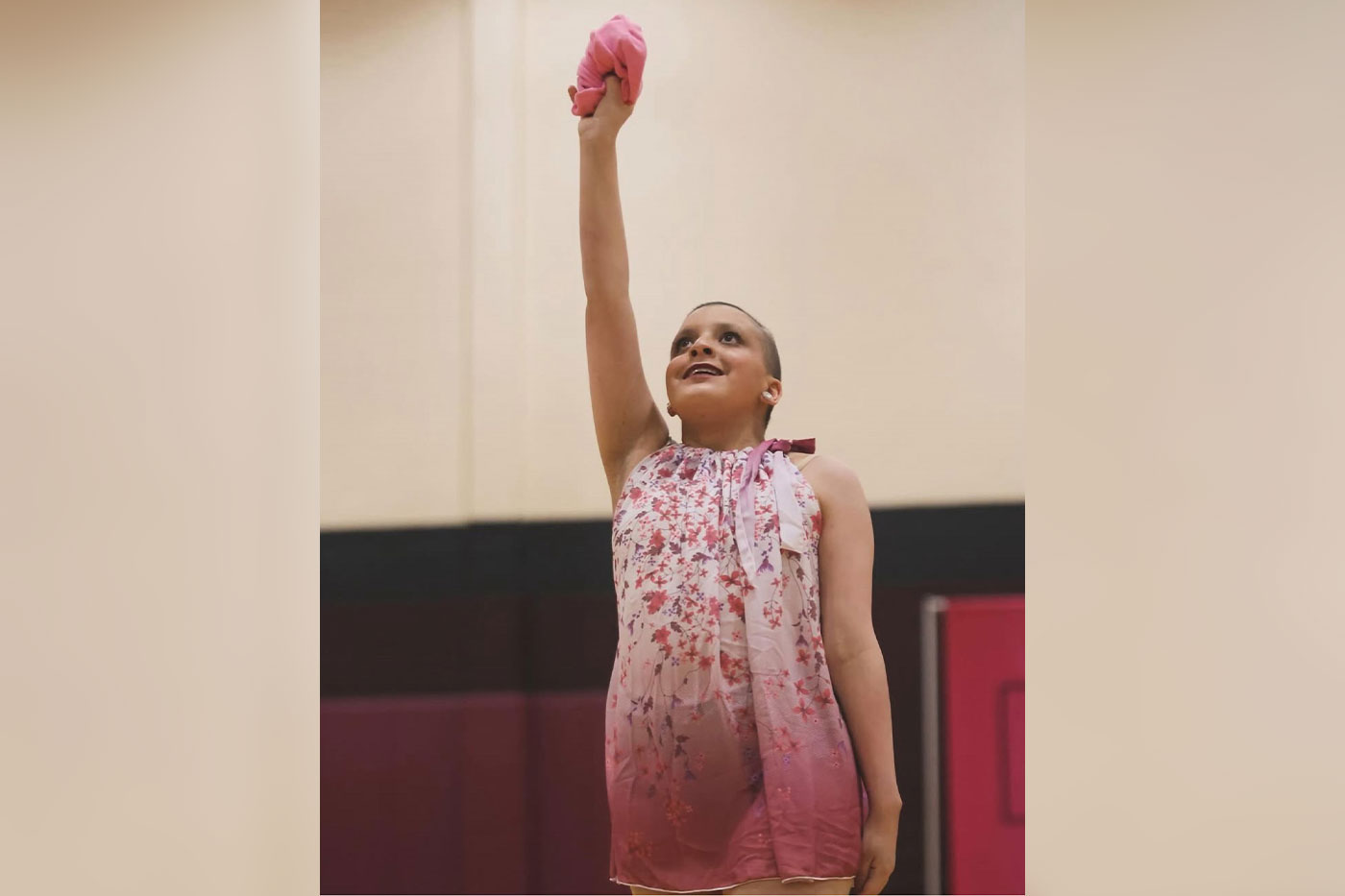
She still carries that truth with her today as it shapes the way she approaches her
studies, service work and future. Already mapping out the next steps in her academic
journey, she plans to continue into a master’s program at Texas Tech and eventually
pursue a Ph.D.
Her ultimate goal is to return to CHRISTUS Children’s Hospital in San Antonio, the
place where her battle began, to help children facing situations similar to her past.
“I was deeply impacted by the encouragement of Leanne,” she said. “From my first diagnosis
at age 5 to my most recent fight at 18, she walked the journey alongside me and encouraged
me to go through every step. Her empathy and encouragement motivated me to want to
deliver that same message to other survivors.
“I want to give kids what I had. I want to provide them support and guidance through
their own experiences.”
And because of the Gres Family Endowed Scholarship, Sara has that opportunity.
The impact of a single scholarship extends far beyond one student. For every child
Sara will counsel through their cancer journey, for every family she’ll guide through
difficult decisions, for every young patient who will learn to advocate for themselves,
the Gres family’s investment will multiply exponentially, transforming countless lives.
If there is one message she hopes others take from her story, it’s that her journey,
and the journey of others like her, is not one of setbacks, but rather one about resilience
and strength.
With every step forward, Sara continues to prove that. And through her work, the cycle
will continue on and on.
“We’re more than the challenges we face,” she said with determination. “When a setback
happens, you pivot. Nothing is ever impossible, so go full force.”
To learn more about how to establish a scholarship to support students like Sara,
click hereor email ofc.advancement@ttu.edu.