
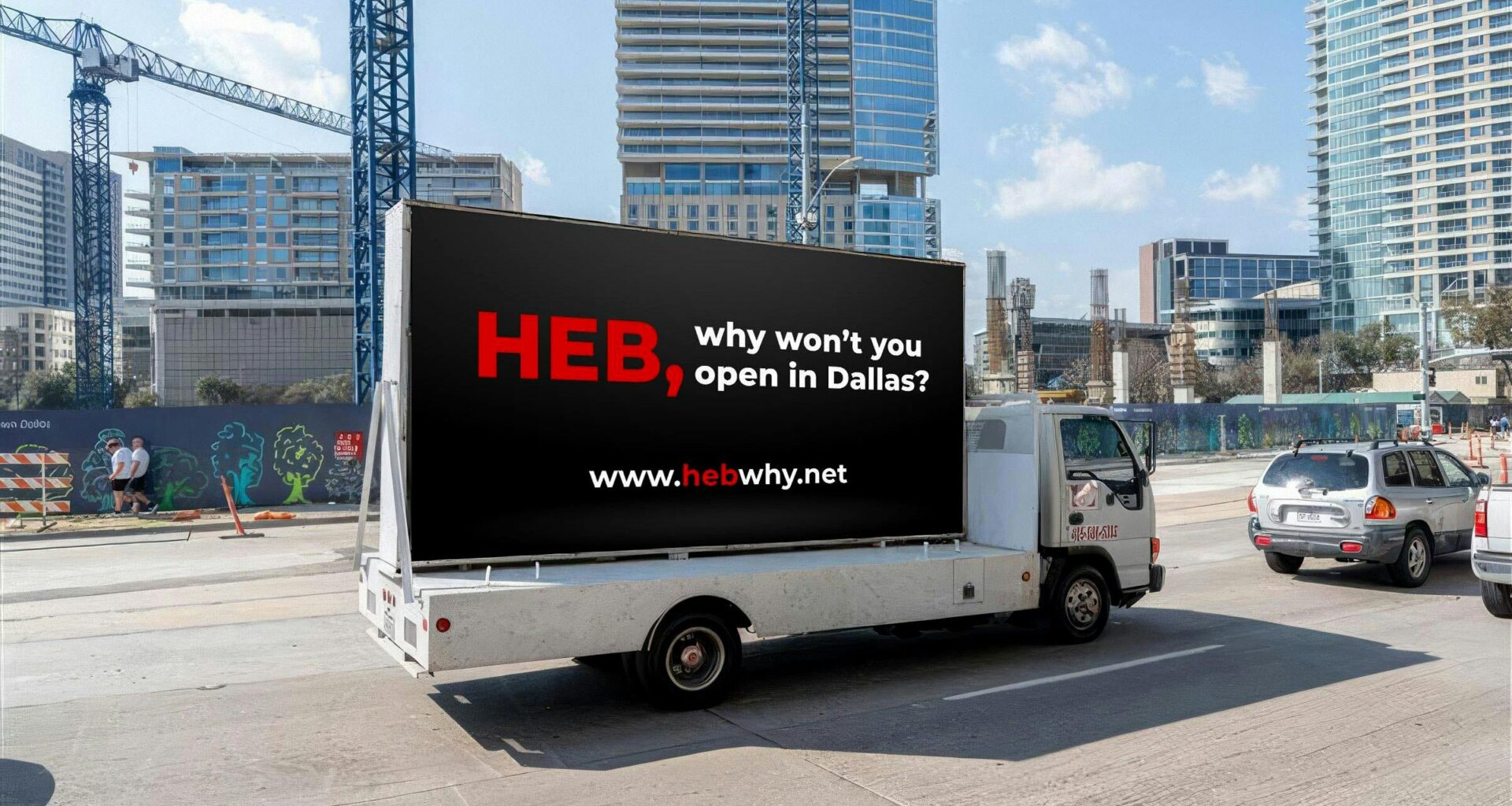
Weaving through the city last month, a mobile billboard posed a question many of the local drivers who encountered it may well have asked themselves: “HEB, Why won’t you open in Dallas?” While Texas’s favorite grocery chain finally began adding stores in North Texas a few years ago, it has yet to set up shop anywhere in Dallas County, let alone in the city proper.
It’s possible that few feel that slight as acutely as Fredrick Terry, the man who put up $8,000 of his own money to pay for that billboard. He hopes to pressure H-E-B to come to his southern Dallas neighborhood, which lacks convenient access to a grocery store. “Just sitting there complaining, it’s not going to do anything,” he said. “Let’s put some feet on the pavement. Let’s raise some concern. Let’s bring attention to it.”
Shortly before Thanksgiving, Terry escalated his campaign, instructing the driver of the mobile billboard to park in front of H-E-B’s local offices, on Northwest Highway. “Just sit in the parking lot until somebody tells you to leave,” he told him.
Terry lives in the same house in East Oak Cliff where he grew up during the seventies. His father was a truck driver for Kroger for 43 years. His mother was a homemaker and, as he put it, a “Jane-of-all-trades.” Life was good. “I didn’t get everything I wanted, but I had everything I needed,” said Terry, who shared a bedroom with his three brothers, two sets of bunk beds among them. “I loved it.”
He took some things for granted. Like many teenagers, he’d open the refrigerator, content to find food inside without giving much thought to where it came from. If his mother mentioned she had to drive all the way across town for groceries, the young Terry barely registered the fact.
He eventually left Oak Cliff, bouncing around before settling in the Houston suburbs, where he worked as a human resources executive for 25 years. There he had a whole host of grocery stores nearby. He developed a taste for complex cheeses. But in 2023, after his parents died, he returned to Dallas. He bought back the family home and remodeled it. Much had changed about the neighborhood and the demographics of his neighbors in what had been a predominantly Black area, but it remained a food desert—by the U.S. Department of Agriculture’s definition, a low-income community where at least a third of residents live more than a mile from a supermarket or large grocery store.
Terry, now retired from his HR career and with a part-time job as a sales associate at the Home Depot, found himself doing most of his grocery shopping near his work in North Dallas. On his days off, his options shrank dramatically. If he ever needed just a few items, he drove to the Kroger in Cityplace, just north of downtown—a trip that takes ten minutes, if there’s no traffic. “If I didn’t have reliable transportation, it would be a very difficult thing,” he said.
For Terry, the dearth of access wasn’t simply an inconvenience. “This is the civil rights issue of this area,” he said. “I don’t mean that from a racial standpoint; I mean it from an economic standpoint.” East Oak Cliff is a relatively low-income area, with a median household income of $46,000. Interstate 35 forms its western edge, beyond which sit higher-income portions of Oak Cliff that have some grocers, including Sprouts, Kroger, and Tom Thumb.
Terry’s dream is to bring H-E-B—which he considers the pinnacle of the grocery experience, thanks to his years in Houston—to his neighborhood, or at least close to it. When he started digging into the matter, Terry discovered that H-E-B owns several commercial properties in the city of Dallas, including one 2.4-acre parcel in West Oak Cliff that’s two miles from his home. H-E-B representatives did not respond to multiple requests for an interview with Texas Monthly.
In 2023, he began distributing bilingual fliers around his neighborhood, which led him to meet other residents who shared his concerns. They held a handful of meetings and eventually launched a community Facebook page, “A Better Oak Cliff,” to help raise awareness and build momentum around the issue. By then, Terry had already begun communicating with H-E-B leadership to emphasize his community’s need for a grocery store. He began attending the chain’s grand openings elsewhere in North Texas. He combed through commercial real estate listings that might work for a future store.
In June 2024, he emailed Mabrie Jackson, the managing director of public affairs for H-E-B and Central Market, pointing to fifteen acres of green space along East Colorado Boulevard, just off I-35, across from a new apartment complex. “This is a much larger location that seems to be in keeping with your company’s strategies of building your HEB locations just off major highways,” he wrote her. “Secondly, because of the property’s location, adjacent to the Trinity River levee, anyone downtown looking south would have an unobstructed view of your store. Finally, with no competitors in the area, a grocery store there would draw throughout the core of the city and would be profitable immediately.”
Jackson replied: “I believe we may have looked at this—although it is on the smaller side for our needs (parking!!). Nonetheless, I have sent to our real estate team for consideration.” Later she followed up to say the real estate team felt the parcel was too close to another store location. “They are always looking though,” Jackson added. “20-22 acres is optimal for parking needs.”
So Terry was surprised when, in January, news broke that H-E-B planned to build its first Dallas store at the intersection of Hillcrest Road and LBJ Freeway, in a neighborhood with a median income of $110,000. The site was only ten acres.
“Congratulations, on the plans to build the first HEB in North Dallas,” Terry wrote to Jackson, along with reminding her that she’d previously said locations needed to be at least twenty acres. “If the company’s acreage requirements have changed, would you now be willing to consider the Colorado location? We still desperately need a store in our neighborhood in the southern sector of Dallas, and H-E-B would be a great addition to our area.” He did not receive a response, and Jackson declined my interview request.
Terry was further bothered by H-E-B’s decision to build in the North Dallas neighborhood after news reports this fall indicated some residents weren’t thrilled about the proposed store, due to concerns about traffic and parking. “There are twelve grocery stores within a two-and-a-half mile radius there,” he told me. “Why are you fighting with people who are not completely sold on you being there, when you could come a little bit further south and you’d be welcomed with open arms? There’s no competition in the place where I live. We might actually have a parade if they were to start building here.”
He’s hardly exaggerating. “Last year neighbors formed a line around a city block when the new Sprouts opened on Fort Worth Avenue,” said Chad West, the council member of District 1, which encompasses a portion of Oak Cliff west of I-35. “There are still many food-access gaps throughout our neighborhoods.”
Earlier this month, the Dallas City Council approved a zoning change that would allow H-E-B to build a 100,000-square-foot store on the North Dallas site, bringing it one step closer to becoming a reality.
Terry is keeping his expectations realistic, even as he continues raising awareness in his neighborhood through the Facebook group and regular communication with local officials. He doesn’t expect an H-E-B on his side of I-35 anytime soon but would be happy to see the chain open a store on the Oak Cliff parcel it already owns, to the west.
“I always tell people that the dollar that I spend in the southern sector of Dallas is the same dollar that I would spend in the northern sector of Dallas,” he said. “We’re basically trying to convince people that we’re good enough to deserve what other people already have and take for granted. I deserve smoked gouda just like everybody else.”
Read Next