
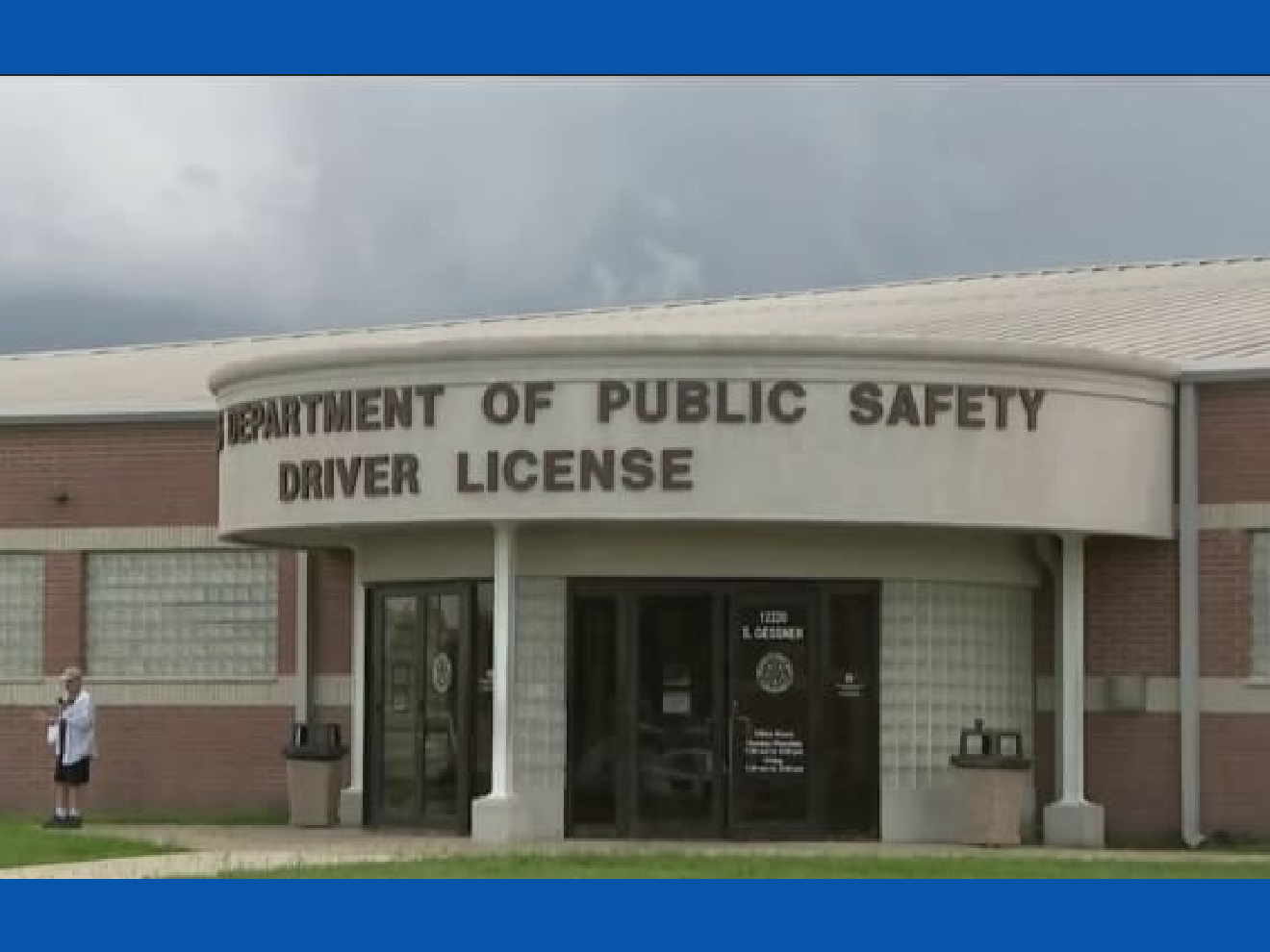
The federal government is pre-emptively thwarting immigrants from getting identification cards — and simultaneously creating an inconvenience for legally documented residents — by requiring a birth certificate or passport when renewing a Texas driver’s license.
A federal law has been in place since the 9/11 terrorist attacks requiring states to verify identity and lawful status for a REAL ID, which features a gold seal and is necessary for domestic flights and entrance to secure federal buildings.
REAL IDs have been issued in Texas since at least 2016 so most Texans have one and were not required to produce a birth certificate to get it. Prior to that, a policy was in place since 2008 that residents must prove they’re in the country legally when applying for a driver’s license or state ID. A state law to that effect was passed in 2011.
But a random, unofficial survey of Houston residents who have recently renewed their licenses produced zero people who remember ever having to produce a birth certificate or passport.
“This isn’t a brand new law, but stricter enforcement of existing REAL ID Act requirements means Texans born at home without records, like some older residents, are now finding they need official documentation to prove identity and lawful presence for renewal,” according to the Texas DPS website.
The Texas Department of Public Safety’s Media and Communications Office did not respond to repeated voice mails and emails requesting comment for this story.
Cesar Espinosa, executive director of the immigrant-led civil rights organization FIEL Houston, moved to Texas from Mexico in 1991 when he was 5 years old. The process for getting identification as an immigrant has always been challenging, he said, but barriers have increased under President Donald Trump’s administration.
“Some of these things were already happening, but the administration is putting things out on paper that are mandating these things happen more broadly and it’s emboldening people who are in positions of power to have less discretion when it comes to issuing driver’s licenses and things like that,” he said.
Espinosa, 40, recalled being in high school and picking up an ID card at the Social Security office. He became a Deferred Action for Childhood Arrivals recipient in 2012 and got a limited-term driver’s license.
“You had to prove that you had some sort of status or pseudo-status and you had to present a physical work permit and your acceptance letter to DACA,” he said.
He got his permanent U.S. citizenship when he married his wife Karynna, a Houston native. But his status wasn’t immediately updated in the federal registry.
‘I had a really hard time,” he said. “I had a harder time renewing my driver’s license as a legal permanent resident with a green card than I did when I had a work permit. Even though I had my green card physically in hand, and all my paperwork, I didn’t appear in the federal registry at the Social Security office or the DPS office.”
He drove without a valid license for about six months before the records updated, he said.
That’s the dilemma facing many Houstonians today. Those who are documented still have trouble getting the ID to prove it; many who are undocumented are avoiding government offices altogether for fear of being detained, Espinosa said.
“They don’t get driver’s licenses,” he said. “They have to get consular IDs or other forms of IDs, like an enhanced library card at Houston Public Library that has their name and picture on it. In theory, that’s the only thing you need to prove identity.”
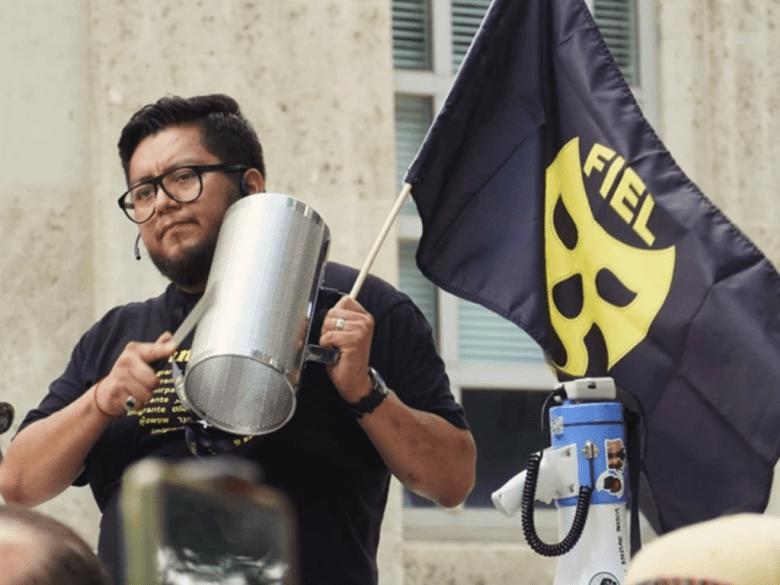 FIEL Houston executive director Cesar Espinosa, pictured at a protest earlier this year, says the birth certificate requirement is just one more way immigrants are being targeted. Credit: Screenshot
When attempting to speak during public comments at City Hall, FIEL members get turned away “about 50 or 60 percent of the time” because they can’t produce a Texas driver’s license, Espinosa added.
“It’s very, very frustrating because they’re supposed to let anybody speak,” he said, clarifying that this has gone on for years under administrations prior to that of current Mayor John Whitmire. “Sometimes the security [officer] doesn’t know. We have to educate them, and oftentimes there’s tension because they’re the authority figure and we’re challenging them.”
Recent policies and increased enforcement intended to target undocumented people are also harmful to lifelong U.S. citizens, Espinosa said. It appears that the timing is suspect, as Trump has taken an aggressive approach to deporting college students and people who have had a minor run-in with the law, such as a traffic violation.
A Texas birth certificate can usually be obtained from the county courthouse where one was born or via an online form, but other documentation has to be produced to prove identity.
Immigration and Customs Enforcement agents have arrested undocumented residents at immigration court and at their job sites in Houston, and city officials say they are required by law to report to the federal agency when they encounter someone who has an outstanding warrant. That has prompted some undocumented individuals to refuse to report domestic violence situations or car accidents because they don’t want to get on the radar of local police.
“Since we heard about them becoming more stringent on ID cards, one of the things we’ve been telling people is that this has consequences, even as citizens,” Espinosa said, adding that many legal residents were delivered by midwives and don’t have a birth certificate, or they’ve lost it.
Another new Texas law prohibits vehicle registration for people who are not U.S. citizens or green card holders.
“All of these people who are living in Houston who are undocumented and have vehicles basically have to give their car to someone else to get it registered,” Espinosa said. “An unregistered vehicle gives police reason to pull them over.”
Although lapses in ICE enforcement in Houston have occurred occasionally over the past year, Espinosa said he encourages his members to remain vigilant and aware. Espinosa said his brother carries documentation with him at all times, even though he’s been a legal resident for more than a decade. Espinosa said he believes he could be detained even though he’s documented, simply because of the nature of his work.
“The hardest part about that was having a conversation with my 7-year-old son about what to do if Papi gets arrested in front of him,” he said. “That was really tough. This is something we live with, even as permanent legal residents. There is fear throughout our community.”
This article appears in Jan 1 – Dec 31, 2025.
Related