
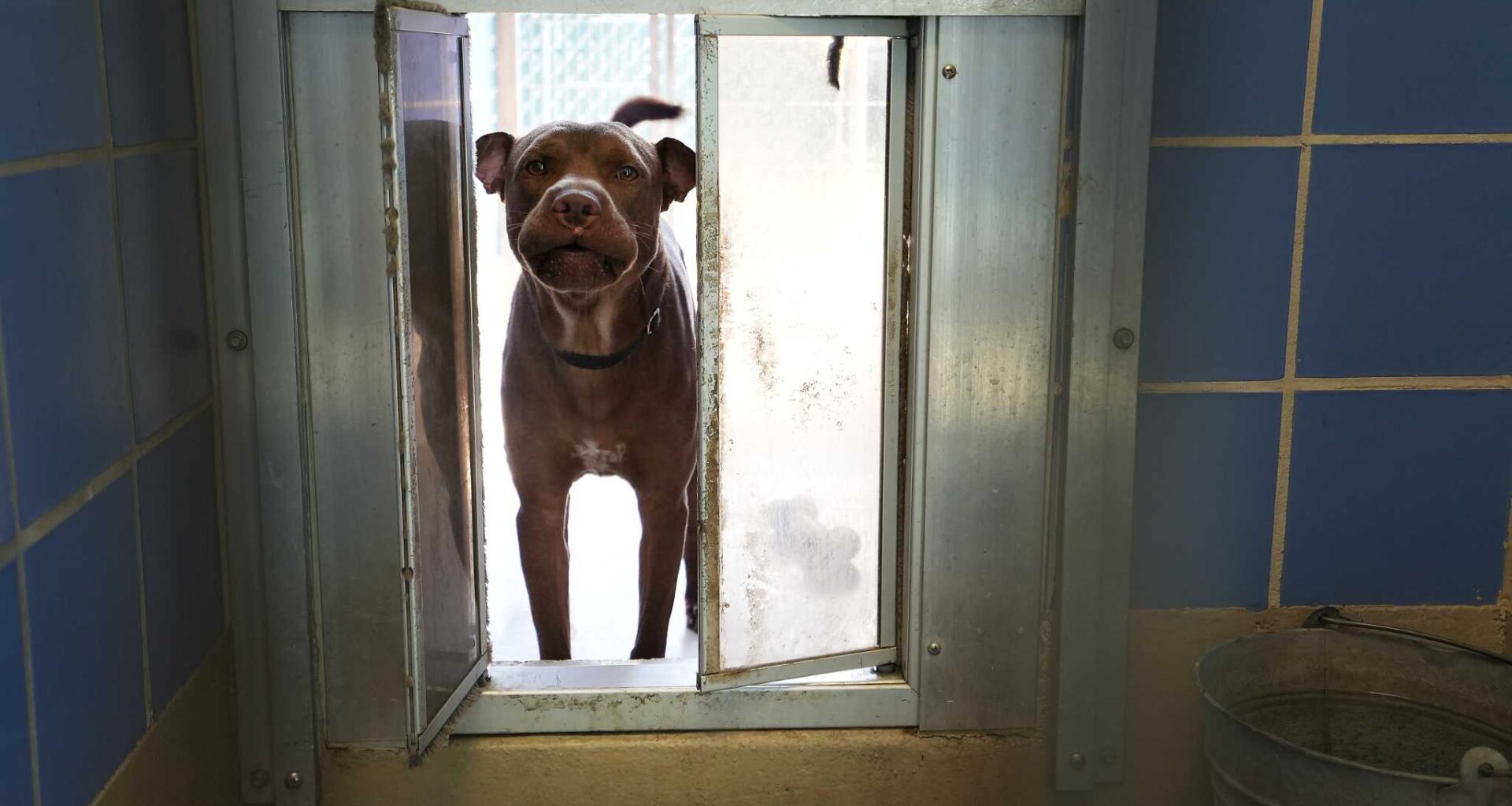
Trap, a mixed mutt, watches Melody Courtney clean kennels at the Austin Animal Center last fall.
BRIANA SANCHEZ/AMERICAN-STATESMAN
Austin Animal Services is exploring a partnership with the Travis County State Jail that would enlist inmates to clean kennels at the city shelter — an idea leaders say is in its early stages but one that has already raised safety concerns among staff and ethical questions from civil rights advocates.

The proposal, outlined in a Nov. 24 internal email obtained by the American-Statesman, comes as the shelter grapples with high turnover, slowed hiring and budget pressure following the failure of the city’s 20% property tax hike ballot initiative. Staff members say the plan could restrict women’s access to key work areas during inmate work hours and shift workloads rather than ease them, while rights advocates argue the use of incarcerated labor risks exploitation.
Article continues below this ad
The program would bring in inmates who were arrested for nonviolent and nonsexual crimes and who have demonstrated good behavior in prison, the email said. They would assist in cleaning kennels and doing “work outside the main shelter” Monday through Friday from 7 a.m. to 11 a.m.
Rolando Fernandez Jr., the shelter’s interim director, said the idea is in an early exploratory phase and has not yet been officially proposed as a recommendation. According to the email, the proposal would supplement the shelter’s Animal Care team with state jail inmates, assigning them to kennel cleaning and outdoor work. The email cited a desire to support employees’ work and maneuver “tight budget constraints.”
“I don’t want my staff to feel like they’re being replaced or looked over,” Fernandez told the Statesman. “I’m augmenting your work, so you can do better, focus on other stuff and not be burnt out. It’s a hard job.”
A labor fix under consideration and scrutiny
Fernandez emphasized that the partnership is simply under discussion and nowhere near being established — “not anywhere near the baking pan to be put in the oven to start baking.”
Article continues below this ad
“This would allow our Animal Care team to redirect time and energy toward other essential responsibilities,” the email reads.
Melody Courtney cleans kennels and fills up food bowls at the Austin Animal Center Tuesday, Sept. 13, 2022, in Austin. The shelter is temporarily restricting intake at the shelter and will only take in animals for emergencies.
BRIANA SANCHEZ/AMERICAN-STATESMAN
While the email outlined several elements of how the program might operate, key details remain unresolved. Fernandez said he did not know whether inmates would be paid, instead characterizing the work as an opportunity to build job skills and spend time outside the jail. He said he believes participants would welcome the chance to do community work and get a “respite” from incarceration, noting that inmates could be removed from the program for rule violations.
Article continues below this ad
Savannah Kumar, staff attorney at the ACLU of Texas, called this type of program “inherently exploitative.”
“The vast majority of incarcerated workers report that they are forced to work, face additional punishment if they refuse, and are not paid,” Kumar said. “Municipalities should push back against exploitative forced labor rather than normalizing it at the expense of human beings forced to do unpaid labor without basic protections.”
Limits on women’s work
During a Dec. 10 staff meeting, shelter leadership outlined restrictions that would limit where female employees could work while inmates were on site, according to a shelter employee who attended the meeting. The employee said women would be barred from certain kennel areas during those hours, even though the spaces are central to daily animal care operations.
Article continues below this ad
Melody Courtney cleans kennels and fills up food bowls at the Austin Animal Center Tuesday, Sept. 13, 2022, in Austin.
BRIANA SANCHEZ/AMERICAN-STATESMAN
“We have other functions throughout that time that we wouldn’t be able to do,” said the employee, who requested anonymity out of fear of retaliation. “That actually shifts our strain of what work we have to do later or around the hours they’re there. If we can’t access those in kennels, it changes things.”
According to the employee, the plan discussed would require male staff members to transport inmates to the shelter in city vans, accompanied by two guards. Several employees said the explanation raised safety concerns. An Animal Services spokesperson later said that at this early stage of discussions with the Texas Department of Criminal Justice, the proposal contemplated a staff member, without specifying gender, assisting with transporting inmates to and from the shelter.
The staff member said the restrictions felt like an implicit acknowledgment of risk, noting that “unless it was one guard with one person, it doesn’t seem fully monitored.” The employee said “it’s scary,” particularly given ongoing issues with broken gates and facility security. Another employee questioned how women — including volunteers and staff from other teams — could realistically be kept out of shared spaces in a busy, active shelter environment.
Article continues below this ad
The Animal Services spokesperson said staff were not told women would be treated differently, and that employees were told no one would be required to work in close proximity to inmates if they felt uncomfortable, regardless of gender. The spokesperson said some staff expressed support for the idea during discussions, noting that additional cleaning help could ease workloads, and emphasized that the concept remains in an early, exploratory stage.
Staffing woes
Fernandez told the Statesman that the Dec. 10 meeting was intended as an early-stage discussion to gather feedback and address staff concerns. But the employee who attended the meeting said it felt as though the proposal was being presented as a near-term solution rather than a distant concept, with limited opportunity for meaningful feedback.
Melody Courtney cleans kennels and fills up food bowls at the Austin Animal Center Tuesday, Sept. 13, 2022, in Austin.
BRIANA SANCHEZ/AMERICAN-STATESMAN
“It wasn’t really a collaborative meeting,” the employee said. “It didn’t feel like we could speak. It was kind of like, ‘Here’s a plan that will help with the understaffing, because we’re all drowning.’ There wasn’t much room to say how we felt about it.”
Article continues below this ad
They said high turnover, slow replacement of departing workers and recent cost-cutting measures — including the loss of holiday pay — have hurt morale and increased workloads, along with a reluctance to refill some temporary positions despite getting reliable budget increases that have allocated money for additional staff.
Animal Services disputed that employee’s characterization of holiday pay, saying the department continues to follow the city’s holiday pay policy and that holiday pay cannot legally be eliminated. Their spokesperson said recent guidance gave essential staff the option to work either Thanksgiving or Christmas so more employees could earn additional compensation by working beyond a 40-hour workweek, but that hours worked within the 40-hour threshold are treated as regular time, not holiday pay.
One employee argued the solution lay not in using inmates, but in hiring and retaining staff.
Article continues below this ad
A shelter spokesperson told the Statesman that no decisions have been made about the program. The Austin City Council on Dec. 11 approved a partnership between Austin Animal Services and the Texas Department of Criminal Justice to create an in-house foster program for incarcerated veterans. Under that program, Austin Animal Services employees will teach military veterans at the Travis County State Jail to train the dogs in their care. According to the City Council agenda item, the program would provide “transferable skills” for the veterans while also enhancing animal welfare and increasing the dogs’ chances for adoption.
Unlike the proposed kennel-cleaning plan, the city’s newly approved incarcerated veterans foster program does not involve inmates working on site at the shelter — a distinction staff say highlights the difference between rehabilitation-focused programming and stopgap labor solutions.