
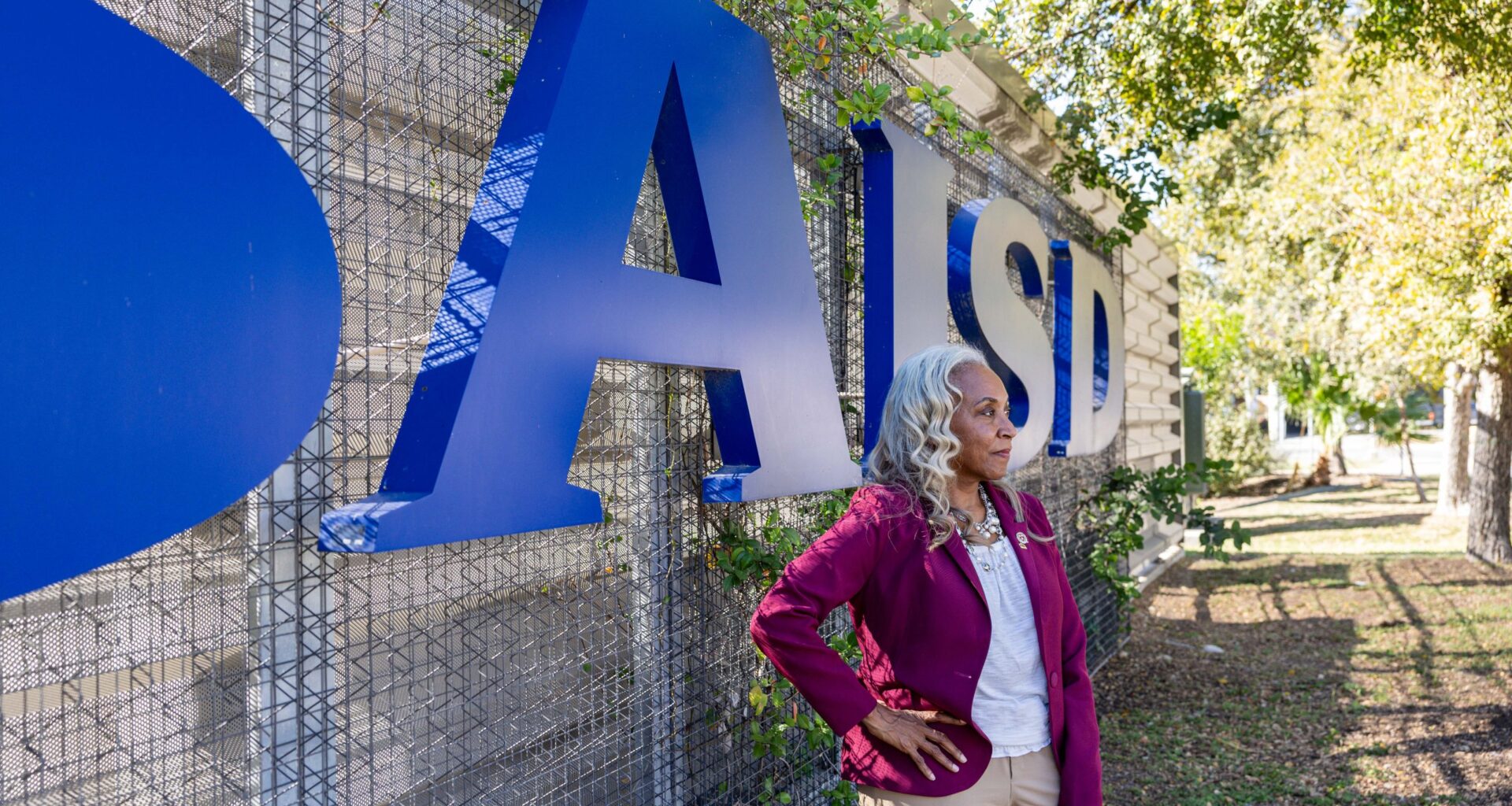
Angelique Smith wants to change the world through education.
That’s why she’s currently embedded in San Antonio Independent School District’s executive team, learning the ropes of public education leadership.
Smith, 57, is a student at the Harvard Graduate School of Education pursuing a doctor of education leadership. Now in her third and last year of the program, Smith moved to San Antonio after choosing SAISD for the paid residency portion of the degree, which started in August and ends next May.
“At my age, I believe in doing this work because I believe that there are still some policies and some barriers out there that are not really helping children,” she said during an interview at SAISD’s downtown headquarters last month. She wore a crimson blazer with both SAISD and Harvard emblems pinned to the lapel.
Studying and working alongside the top leaders of San Antonio’s third-largest school district, encompassing the city’s urban core, Smith is also completing a capstone project she’ll have to present and defend in April to her superiors at both SAISD and Harvard.
Her subject: how to improve schools by improving leadership and using data.
Smith is no newbie to public education. With more than 30 years of experience, Smith has worked in preK-12 education across the country and the world — stretching from her home state of Georgia to Abu Dhabi, United Erab Emirates and later Boston — as teacher, principal, consultant and professional mentor.
She decided to go back to school after virtually coaching principals during the COVID-19 pandemic and feeling like she needed to learn more before training other administrators.
“I’m just sitting in my house, you know, virtually. And that’s when I realized I had a gap that needed to be filled. And so that’s what made me go to Harvard,” Smith recalled.
When it came time to choose her residency, Smith’s only choice was SAISD. It was the district’s history and the people that compelled her, she said.
This is the first time SAISD has had an embedded student like Smith.
 Smith sports Harvard and SAISD pins on her blazer when studying leaders and working at the central San Antonio school district for her doctoral program at Harvard’s Graduate School of Education. Credit: Amber Esparza / San Antonio Report
The famous history of SAISD
San Antonio ISD is known nationally for the landmark 1973 court case San Antonio Independent School District v. Rodriguez, which reaffirmed the constitutionality of using local property taxes to fund public schools despite resulting disparities between poor and wealthy school districts.
Though the case upheld the way schools had long been funded, it also sparked long-term activism and reform efforts to create a more equitable funding model for public schools.
San Antonio’s public education history struck a personal chord with Smith, a self-described “Georgia peach.”
Smith attended Georgia public schools as the state underwent racial integration in the 1970s, years after the federal government outlawed racially segregated schools. Smith also grew up with undiagnosed tone deafness, making it difficult for her to learn how to read at a time when literacy education leaned heavily on using sound.
It wasn’t until her sophomore year of high school that Smith took a hearing test, shedding light on her struggles in English classes.
Marked by these experiences, Smith knew she wanted to be a teacher when she was 9, and still feels the calling to right the wrongs she went through in the public education system more than three decades later. Smith worked as a secondary school math teacher through the 1990s and early 2000s, and moved up to administrative roles by 2003.
SAISD is no utopia of public education, Smith said, but she believes “there are processes in place to help every child.”
Smith also commends the district’s focus on gathering community input through advisory council and committees on everything from school health to budgeting and special education, an unusual setup in her experience.
Aquino: The ‘Beyonce’ of education
As a school principal between 2008 and 2018, Smith read “Breakthrough Principals: A Step-by-Step Guide to Building Stronger Schools,” authored in part by SAISD superintendent Jaime Aquino, who was then working with education mentoring group New Leaders Org.
For a Harvard assignment, Smith later went on to interview Aquino, a school administrator who Smith said “does not fit the mold” of superintendents in the U.S.
Across the nation, more than 70% of superintendents are male, and of those, nearly 90% are white, according to a study by the School Superintendent Association.
“I truly had a celebrity moment, to be quite honest,” Smith said of meeting Aquino in person a few years ago. “It wasn’t Beyonce, but for me, it was like Beyonce.”
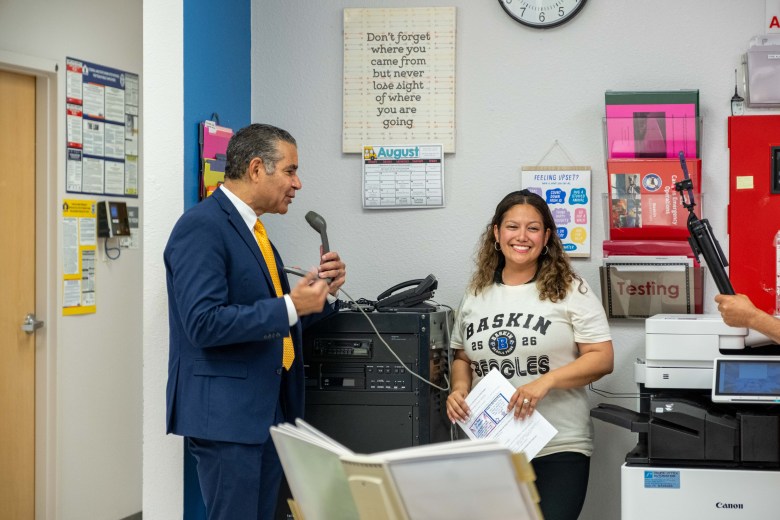 SAISD Superintendent Jaime Aquino, left, and Baskin Elementary School Principal Yvonne Martinez share morning announcements from the main office after the bell rings on the first day of school on Aug. 13, 2025. Credit: Amber Esparza for the San Antonio Report
Smith is not the only one benefiting from her SAISD residency — the district is putting her skills to work.
As part of her residency, Smith works as a “senior leadership strategist” for the district.
Before meeting with the Report at 9 a.m. on a Friday in November, Smith had already attended an executive meeting and would later go on to make a data report, attend a virtual class at 12:30 p.m. and then keep working through the afternoon like any other full-time district employee.
“I take notes on the leadership moves that the superintendent is making, and the conversation that’s happening. Then, he and I debrief on that: what went well, if I have questions. And he really values my opinion,” Smith said.
Other days, she’s walking through SAISD campuses, observing teachers and administrators, taking notes and providing feedback.
Using data to improve schools
While she’s embedded at the district, SAISD also draws on Smith’s years of mentoring experience and her skills as a certified Data Wise coach. Data Wise is a data-processing method designed by Harvard faculty to “improve instruction and student outcomes” within school districts.
SAISD does not use Data Wise, but Smith is using her expertise to give feedback and refine the district’s own data-measuring system in the hopes of improving schools, said Aquino.
Currently, SAISD has 18 “priority” campuses that have received failing state ratings for two or three years in a row. A big part of turning campuses around is having the right leadership, especially when it comes to principals, assistant principals and the people that hire them.
In fact, roughly 25% of student outcomes can be directly attributed to principals, even though they have an indirect effect on how well a student learns compared to teachers who have a direct effect, Aquino added.
And finding qualified and eager principals is becoming more difficult.
During the 2023-24 school year, 21% of principals in Texas left their positions, representing a 5% increase in turnover over the past decade, according to state data. Campus administrators cited job-related stress, lack of support and intensifying pressure as reasons leaders stepped down.
In recent years, the district has invested in “grow-your-own” leadership programs for new and aspiring principals to address shortages and retention rates. These programs streamline certification processes and build mentorship communities, potentially easing the stresses of the job.
Often, when an “effective” principal leaves their post, the school’s academic progress and outcomes leave with them, Smith said, marking the importance for districts like SAISD to cultivate strong leaders and take a uniform approach in analyzing data to keep improving schools even through turnover.
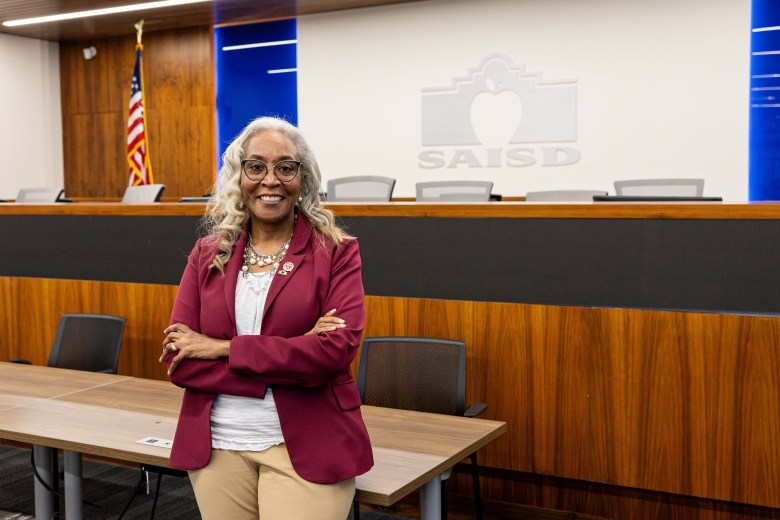 As part of the paid residency portion for her doctoral degree, Angelique Smith chose to study leaders at San Antonio ISD while working alongside them. Credit: Amber Esparza / San Antonio Report
At the same time, most school districts in Texas are dealing with tightening budgets, political attacks from state and federal leaders and more competitors vying for student enrollment, making public education a decreasingly popular career field.
Despite the challenges, Smith and her mentor Aquino said they still feel called to serve in public education at the highest levels.
Changing the world through education
Aquino went into education after leaving a seminary of the Redemptorist Order in the Dominican Republic, where he taught literacy to adults and underprivileged children, also working with people with disabilities and communities with leprosy.
After working in top leadership roles in places like Denver Public Schools and the Los Angeles Unified School District before SAISD, Aquino says it’s his “personal” responsibility to mentor others who also want to lead in public education.
“I believe that education is the greatest power for change and transformation, so that’s why I decided to pursue teaching,” Aquino said.
Smith put it this way: “The changes that happen in society happen in the schoolhouse.”
Aquino will be on the panel of judges Smith has to present her final project to, and if all goes well, she’s set to graduate from Harvard in May. Ultimately, Smith’s goal is to be a superintendent in the Georgia school district where she grew up, but she acknowledged she still has a lot of work to do.
“My mom just always told me, ‘No matter where you go, make your pilgrimage back to take care of your children’,” Smith said about bringing all that she’s learned back to her hometown. “Where so much is given, much is required.”