
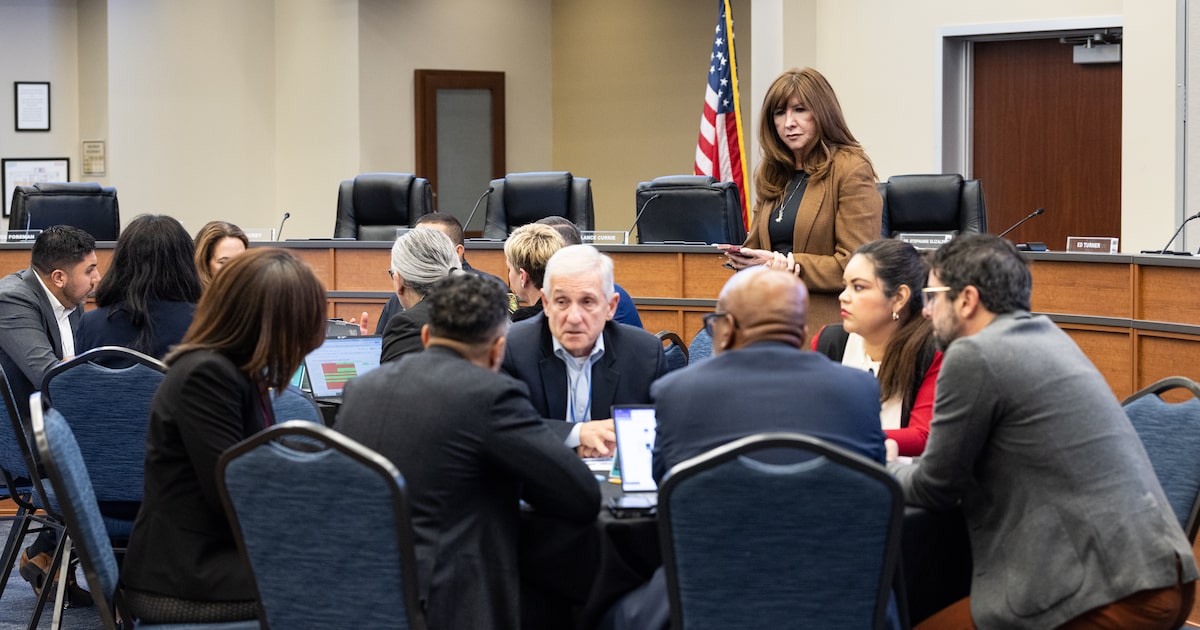
Dallas ISD presented more details Thursday for the school district’s next bond package, a multibillion-dollar plan to bolster campuses and classrooms across the 240-school system.
Officials outlined two bond options, funding $4.9 billion to $6.25 billion, to fix aging buildings, add classrooms, upgrade technology, refinance a maintenance loan and repair five pools.
Trustees will refine the package next month, as district leaders eye an election in May or November 2026.
Related
The Education Lab
Board President Joe Carreón cautioned that trustees have work ahead. The current plans are all considerations, and there’s no official proposal at the moment.
Trustees still need to refine recommendations next month. They urged the administration to bolster transparency and clear communication, including posting draft materials for feedback.
Superintendent Stephanie Elizalde said the materials will be online before the board reconvenes on Jan. 8 and 22.
Texas school districts receive funding for students, operations and maintenance. But major construction, renovations, land, buses and technology purchases require voter-approved bonds repaid with property taxes.
The four-part proposal includes Propositions A (facilities), B (technology), C (refinancing), and D (pool repairs). Recommendations were created after over 100 members of the Citizens’ Bond Steering Committee voted on proposals informed by facility assessments, surveys and months of resident engagement.
An October survey found Proposition A would pass, B was within the margin of error, and the others would fail, said Brent Alfred, DISD’s chief construction officer. Most surveyed supported all four after receiving explanatory information.
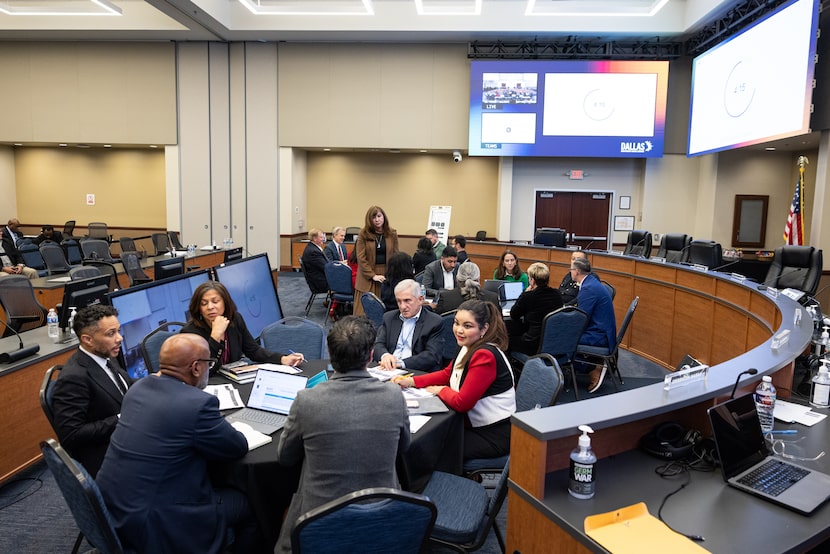
Dallas ISD Superintendent Stephanie Elizalde walks around tables filled with trustees and leadership team chiefs during a bond workshop on Thursday Dec. 18, 2025. The board workshopped the district’s next bond package, a potential $6 billion plan aimed at modernizing campuses and stabilizing classroom conditions across the 240-school system.
Angela Piazza / Staff Photographer
Trustees and staff spent an hour dissecting the recommendations at roundtables in front of the dais. No vote occurred, but the session offered a glimpse at board priorities before further debate next month.
“I know that it is sometimes messy,” Elizalde said. “[But] the conversations that I was able to eavesdrop on just give me such faith.”
Bond scenarios
Dallas ISD’s first funding option keeps the debt-service rate the same and would fund about $4.9 billion in upgrades and new construction, according to the district’s documents for DISD’s board workshop. The debt-service rate is the portion of school taxes that pays for long-term construction and major projects.
The second option asks voters to approve a one-cent increase for $6.25 billion, costing the average home $2.79 per month, or $33.48 a year, workshop documents show.
School property taxes would not go up under either option for homeowners 65 or older with a homestead exemption.
District materials show DISD’s debt-service rate is 24 cents per $100 of property value, lower than many large districts in DFW and the state.
Proposition A
Proposition A is the largest part of the bond proposal, at over $5.9 billion. It would replace 26 school buildings ($1.88 billion), carry out districtwide renovations guided by facility and educational suitability assessments ($2.385 billion), and add 400 classrooms ($218.8 million), according to the district’s preliminary documents for the proposal.
“I started my career in a portable [classroom] and I hope to end my career with zero portables in this district,” said David Bates, chief of operations.
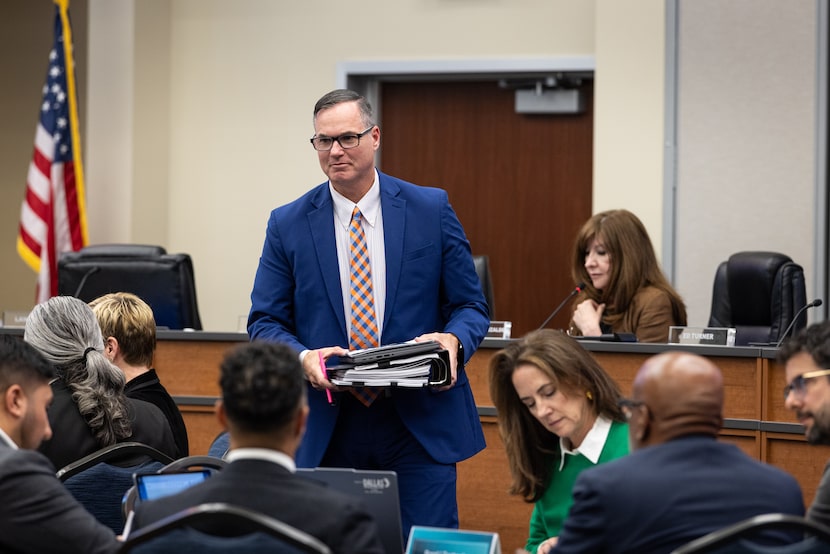
Dallas ISD Chief of Operations David Bates helps lead a workshop on a potential $6 billion plan aimed at modernizing campuses and stabilizing classroom conditions across the 240-school system on Thursday Dec. 18, 2025.
Angela Piazza / Staff Photographer
Proposition A would also consolidate two pairs of schools into new or replacement campuses: Piedmont G.L.O.B.A.L. Academy with San Jacinto Elementary, and Dr. Frederick Douglass Todd Sr. Middle School with Whitney M. Young Jr. Elementary, preliminary documents show.
Additional investments include 500 new school buses; safety systems such as GPS and onboard cameras; 150 white-fleet vehicles and lawn equipment; repurposing vacant facilities; solar and wind-energy investments; refreshed playgrounds, courtyards and turf; security upgrades; and athletics improvements for high schools and middle schools.
“The majority of the needs that you see here are mandated by the state by law, and they are without funding,” said Dallas ISD Chief of Police Albert Martinez, noting security needs.
Proposition B
Proposition B would invest about $144.7 million in technology, preliminary documents show. It covers student and staff devices, classroom displays and computer labs to keep instruction running reliably and equitably across campuses, said Marlon Harrison, the district’s chief technology officer.
It also funds connectivity, cybersecurity and data infrastructure. The combined technology investment across Propositions A and B exceeds $420 million, preliminary documents show.
“A lot of the things that Chief Martinez mentioned in safety are reliant upon robust networking,” Harrison said.
Proposition C
Proposition C would refinance a 2013 maintenance loan through the bond program to stabilize finances and lower overall cost, said Dallas ISD Chief Financial Officer Eduardo Ramos.
The district borrowed $143.34 million for emergency capital maintenance using operating property taxes, preliminary documents show. The full principal is due in 2033, and the district sets aside $7 million annually.
With voter approval, moving this note to the bond program’s debt-service side would free roughly $100 million for operations over time, allow earlier payoff and generate interest savings.
Proposition D
Proposition D would invest over $26 million to repair Dallas ISD’s aging swimming pools to make them safer and modern, preliminary documents show.
Campuses can bolster support for water-safety instruction, lifeguard training tied to student jobs, and year-round access for athletics and community use with this investment.
While partnerships with the YMCA and the City of Dallas expand access, officials said bond funding is needed to address DISD’s mechanical systems and code and accessibility issues.
Voters rejected a similar measure in 2020, but officials said district pools have seen little investment in over a decade.
Next steps
Dallas ISD leaders said the survey found voter support for the bond was about the same whether the election occurs in May or November 2026. Some preferred a small, clearly explained increase over “no tax increase” language.
“There is strong support for these bonds if the vote is informed,” Alfred said.
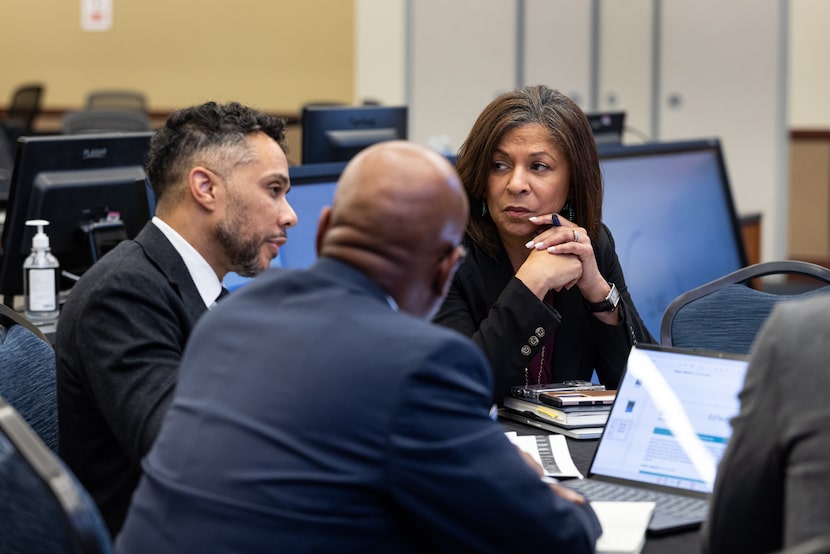
Dallas ISD Chief of Communications Libby Daniels listens to Chief Construction Officer Brent Alfred speak during a workshop on a potential $6 billion plan aimed at modernizing campuses and stabilizing classroom conditions across the 240-school system on Thursday Dec. 18, 2025.
Angela Piazza / Staff Photographer
Framing the package as an investment, Trustee Sarah Weinberg said, “as we spend this money, it gives us visibility on also saving money.” Trustee Ben Mackey prioritized clarity on which campuses gain or lose funds and why. He suggested collecting and sharing trustee feedback before the next discussion to sharpen the proposals.
More detailed, campus‑by‑campus documentation topped Trustee Joyce Foreman’s list, with an emphasis on equity for southern Dallas.
Trustee Lance Currie urged administrators to clearly explain any proposed tax increase, noting $4.9 billion would already be historic. He praised the recommendations for their “almost extreme amount of community feedback” and “objective data,” adding he trusts the proposals are grounded in evidence rather than “the emotional aspects of the process.”
Trustee Prisma Y. Garcia echoed that point: “Sometimes, with our limits, we have to go based on data‑driven decisions.”
Trustee Byron Sanders praised investments in new schools, technology, and safety.
“I would love to see us foray out into potentially workforce housing,” Sanders said, referring to an initial, conceptual teacher‑housing idea. “[But] this is a bond that has stayed true to community voice.”
Trustee Dan Micciche lauded DISD’s “comprehensive and thorough” data-oriented review. He stressed the board’s recommendations will be based on assessments and student needs rather than “who screams the loudest.”
He also warned the ballot language could confuse voters, especially Propositions C and D.
“A lot of people don’t know what a natatorium is,” Micciche said, referring to a term related to swimming pools. “It wasn’t really part of my working vocabulary until I was on the board.”
This reporting is part of the Future of North Texas, a community-funded journalism initiative supported by the Commit Partnership, Communities Foundation of Texas, The Dallas Foundation, the Dallas Mavericks, the Dallas Regional Chamber, Deedie Rose, Lisa and Charles Siegel, the McCune-Losinger Family Fund, The Meadows Foundation, the Perot Foundation, the United Way of Metropolitan Dallas and the University of Texas at Dallas. The News retains full editorial control of this coverage.