
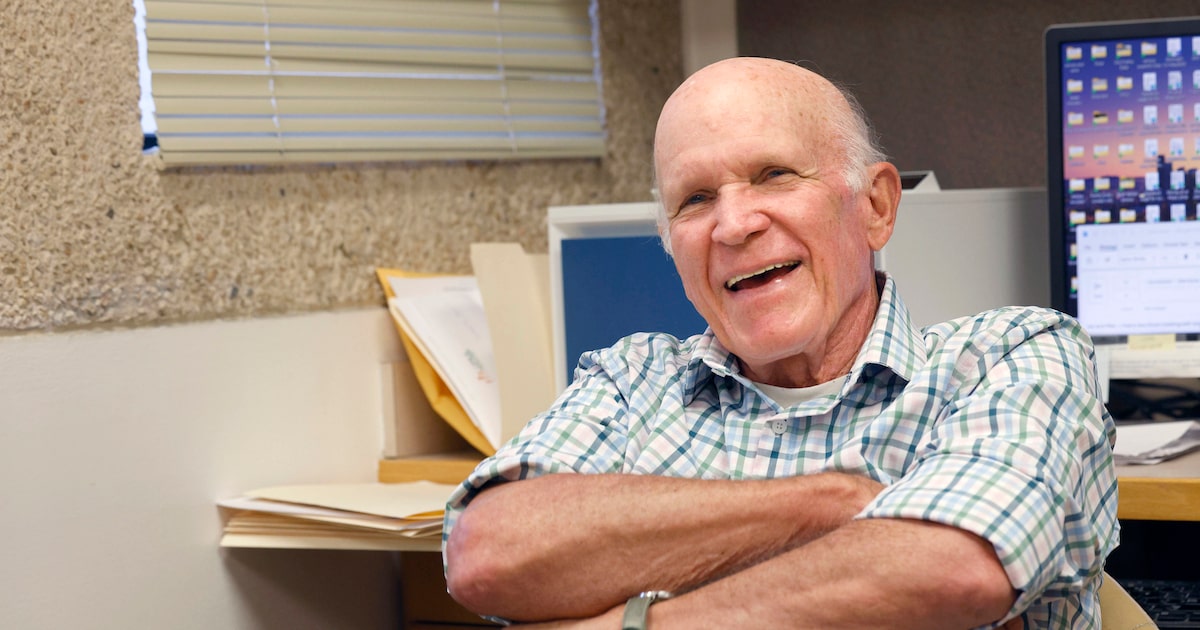
Steven McKnight, a professor of biochemistry at UT Southwestern Medical Center, told us scientific breakthroughs have happened only a handful of times in his long career. One such discovery led to an important recognition earlier this year, the 2025 Albert Lasker Basic Medical Research Award, dubbed “America’s Nobel.”
McKnight, 76, shares this distinction with Dirk Görlich of the Max Planck Institute for Multidisciplinary Sciences in Germany for their research on “ugly duckling proteins.” That research has provided the scientific community with new clues that might help it treat neurodegenerative diseases.
For this critical work, McKnight is a finalist for 2025 Texan of the Year.
Living organisms are full of tiny molecular machines, and proteins are the parts that make those machines work, McKnight explained.
Proteins usually look like they belong somewhere, like puzzle pieces that snap neatly into place. But there is a small group of proteins that don’t behave this way. They didn’t fit into the puzzle, and for years, they were cast aside, McKnight said.
Opinion
“What finally clicked for me is that these unusual proteins… they can have a shape, but they don’t stay in that shape; they morph in and out,” McKnight said.
As our colleague Miriam Fauzia reported earlier this year, McKnight and Görlich showed that these proteins help arrange the inside of a cell by forming short-term structures that allow proteins to gather, do their job and then peel apart. This chemistry that makes it so that proteins can quickly come apart is what might explain why proteins misfold and clump, as happens in people with diseases such as Alzheimer’s and Parkinson’s.
McKnight is part of a professional community that has helped North Texas become a scientific hub. He credited a strong local philanthropic community. Institutions like UTSW get important federal grants, but this research usually comes with constraints.
“The support from Dallas philanthropists, people who contribute to the university … lets us, as scientists, do the more crazy ideas. … That makes all the difference,” he said.
McKnight told us he wants to pass the baton to the next generation, just like his elders handed it to him. He insists science is not that special; all it takes is curiosity. But it is not for those seeking fame; it’s about seeking the truth.
“That is easier said than done,” McKnight told us. “How do you teach kids the importance of honesty, integrity? Never cheat. Never bend the truth. Work hard. Be diligent. Be courageous. … I was taught these things by the people who were my heroes.”
We welcome your thoughts in a letter to the editor. See the guidelines and submit your letter here.
If you have problems with the form, you can submit via email at letters@dallasnews.com