
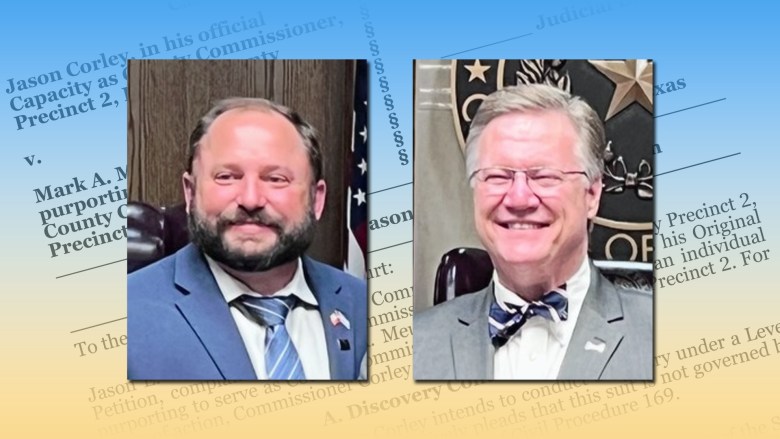
An appeals court Monday morning upheld a Friday ruling putting Jason Corley back in office as county commissioner for Precinct 2. Mark Meurer’s attorney filed an emergency appeal which was denied. So Meurer remains out and Corley is in, which was the result of Friday’s temporary ruling by Judge Patrick Pirtle.
The appeals court ruling was given in a single sentence from the clerk’s office, which said, “By order of the court, the relator’s motion for temporary relief and stay is denied.”
The issue was urgent for both sides before the Commissioners Court meeting which started Monday at 10 a.m.
Background
On December 8, County Judge Curtis Parrish declared Corley resigned his seat automatically by running for Congress with more than one year and 30 days left in his current term. Corley denied it – saying he waited until the right time.
Parrish administered the oath of office to Meurer less than two hours after asking Corley to clean out his office.
Corley sued that same day to get his seat back. State District Judge Les Hatch stepped back from the case and retired judge Patrick Pirtle took over. District Attorney Sunshine Stanek also stepped back with Potter County Attorney Scott Brumley taking her place. Brumley, on behalf of the State of Texas, filed a petition in favor of Corley.
Meanwhile, Meurer’s attorney, Kristen LaFreniere, challenged Corley’s original lawsuit on a technicality. Only a county attorney, district attorney, or the attorney general can file this kind of lawsuit. Pirtle held a hearing Friday to sort through the issues.
Update – Corley restored, Meurer out by temporary court order but case moves to appeals court
December 19, 2025

December 16, 2025
December 12, 2025
December 10, 2025
December 9, 2025
December 8, 2025
At Friday’s hearing, Pirtle had to first decide if Corley had the right to file a special kind of lawsuit called quo warranto. That’s where trouble began.
Pirtle ruled Corley’s lawsuit could stay on the books. Meurer’s attorney, Kristen LaFreniere, had a notice of appeal ready to go on her laptop computer in the courtroom. She filed it electronically at the moment of Pirtle’s ruling.
Here’s why that’s important. State law puts the case on hold (technically a “stay”) during this kind of appeal.
When she told Pirtle, he responded, “I would prefer to proceed today.”
The judge then called a 15-minute recess. When he came back he changed his mind and decided Corley could not proceed.
Only Potter County Attorney Scott Brumley, acting for the State of Texas, could go forward with the quo warranto.
Pirtle said, “In light of the conundrum presented, the Court is going to withdraw its prior order. … At this time, we will proceed.”
LaFreniere objected. She said state law (Texas Civil Practice and Remedies Code) calls for all proceedings to stop until the appeals court looks. She said the judge cannot just change his mind to get rid of the appeal.
“… The reason for the change of mind is simply so we can move forward …,” she said.
LaFreniere filed two more documents on Friday.
“Counsel strenuously objected to this violation of the automatic stay but was overruled repeatedly,” she wrote in an 11-page request to the Seventh Circuit Court of Appeals in Amarillo.
Just before midnight, she filed another request “overruling all actions of the trial court” and “overturn each of the trial court’s void orders.”
“… The hearing should have been over. … Instead, inexplicably, the trial court then proceeded hearing the merits,” her petition stated.
Both documents requested action before Monday at 9 a.m. – one hour before the start of a commissioners court meeting.
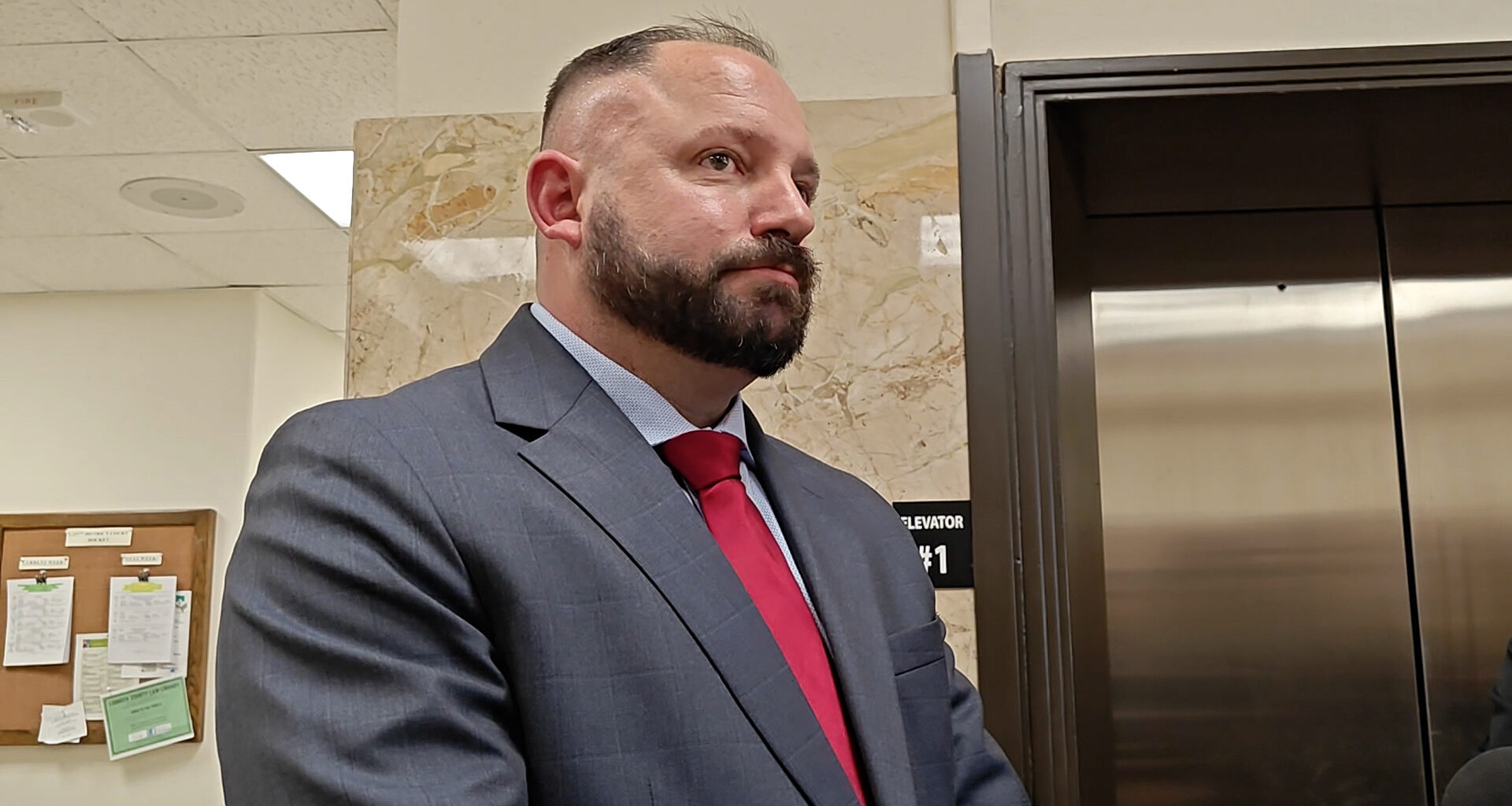
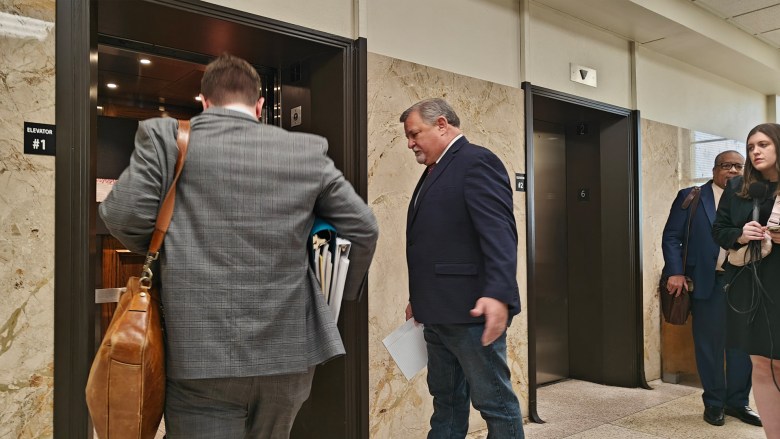 Mark Meurer enters an elevator with his attorneys after a court hearing in the Lubbock County Courthouse. Credit: Staff photo.
In the courtroom
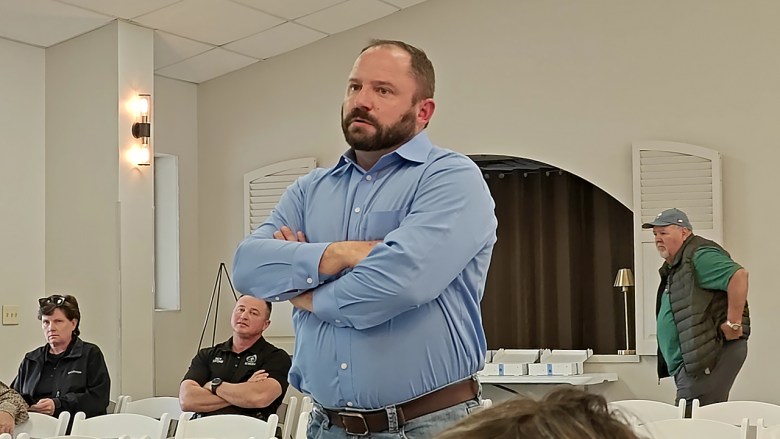
During the hearing, Brumley called Parrish to the stand. He asked when, in Parrish’s view, Corley automatically resigned his seat.
Parrish said it was November 12 – the same day Corley announced via email he formed an exploratory committee. That email included a “Corley for Congress” logo and email address. It also included a “Corley for Congress” P.O. box – although Corley later said the box office address was sent out by mistake.
Parrish also testified that Corley sent a text message to former Texas Tech Chancellor Kent Hance saying, “I am running for Congress.”
Brumley asked, “You determined Mr. Corley automatically resigned?”
Parrish answered, “I just announced it.”
Brumley asked, “Would it be fair to say that based on … the Local Government Code, you assumed the authority to appoint his successor?
Parrish answered, “Yes, sir.”
Brumley asked, “Had any court or other body declared a vacancy?”
Parrish responded, “No”
Brumley also called Corley to the stand. He testified he only announced an exploratory committee – not an actual candidacy before December 2.
Then LaFreniere cross examined Corley. She asked about a long list of people including other commissioners and soon-to-be local Republican chair Ken Adams about his intention to run for Congress.
“I never stated my intention to run,” Corley said.
At one point Corley said he told commissioner Cary Shaw he intended to run but then clarified that he meant, “I launched an exploratory committee.”
She asked if he told Justin Martin, a candidate in the March Primary for commissioner in Precinct 2.
Corley said no. But LaFreniere followed up wanting to know if Corley told Martin he was not running for reelection. Corley said yes.
She asked, “What reasoning did you give for why you wouldn’t be running for reelection?”
He answered, “Eight years was long enough.”
In the Friday hearing, Brumley said, “Judge Parrish did not have authority … to declare that Mr. Corley automatically resigned from office. Thus he lacked authority to appoint his successor.”
She showed a text where he said, “I’m running for Congress in District 19,” and asked if that’s a definite statement of becoming a candidate.
“Private,” Corley responded.
But when pressed if he agrees that’s a statement of intent, he said, “I do.”
Corley’s legal argument is a private statement does not count.
Case law
Brumley and LaFreniere both agreed the legal precent for quo warranto is Lewis v Drake. It says in part:
“The general rule that the issue of whether a public officer has vacated his office may be raised only by an information in the nature of quo warranto is not a petty legal technicality. The principle is of great public importance. Public officers should be free to perform their duties without having their authority questioned incidentally in litigation between other parties. They should not be called on to defend their authority unless a proper legal officer of the State has determined that the question raised is serious and deserves judicial consideration.”
The ruling
In his ruling from the bench, Pirtle said the purpose of a quo warranto is for the state to protect itself.
“I think that’s relevant,” Pirtle said.
He called Corley the “chosen agent” of the people of Precinct 2 “barring his automatic resignation” because he was elected in 2018 and reelected in 2022.
But Pirtle also said Brumley, acting for the state, established he will “likely” succeed on the merits of the case.
“I’m going to order that Jason Corley continue to serve. He is the lawful party holding that office,” Pirtle said.
Related

Related posts