
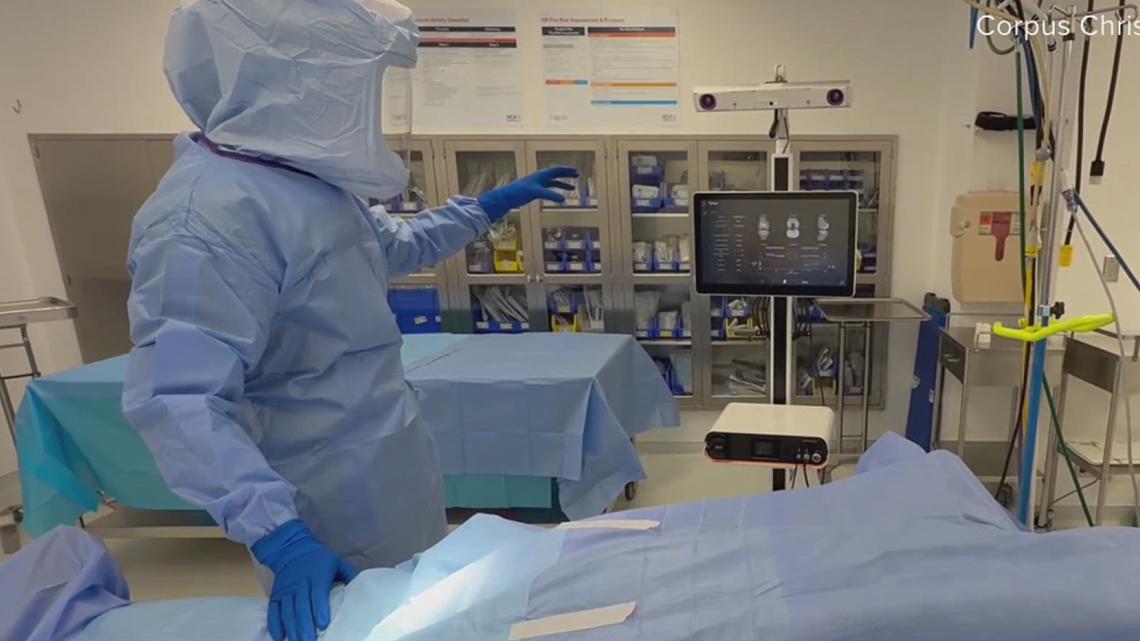
Doctors said the technology represents a major advancement in orthopedic care, allowing surgeons to create detailed, 3D digital models tailored to each patient.
CORPUS CHRISTI, Texas — Corpus Christi Medical Center is using new robotic-assisted technology to perform knee replacement surgeries, a move doctors say is improving precision and recovery for patients across the Coastal Bend.
RELATED: Mother Teresa Shelter hosts winter outreach event
Center leaders said the technology represents a major advancement in orthopedic care, allowing surgeons to create detailed, 3D digital models tailored to each patient before surgery begins.
Doctors said knee and hip pain are common conditions in the Coastal Bend, making joint replacement surgery one of the most frequently performed procedures both locally and nationwide.
“Hip arthritis, knee arthritis, knee pain in general and hip pain, are very common in the Coastal Bend community,” said Dr. Connor Armstrong, an orthopedic surgeon at Corpus Christi Medical Center.
Dr. Armstrong said the robotic system does not perform the surgery itself, but instead serves as a planning and precision tool that is there to assist.
“A lot of people get confused when I say robot and knee replacement because they think a robot is actually doing their surgery, which is not true,” Armstrong said.
The system allows surgeons to plan the procedure in advance, better fine-tuning details beforehand.
“It essentially allows me to plan the surgery beforehand in three dimensions so I can fine-tune the implant position and the implant sizes before the patient even rolls back into the room,” Armstrong said.
Doctors said the added precision can lead to a smoother recovery for patients.
“Being able to use robotics in surgery allows me to fine tune implant position down to the 0.5 millimeter or 0 degree,” Dr. Armstrong said. “Just being able to fine tune implant position and customize knee replacements for each patient’s deformity.”
According to the American Academy of Orthopaedic Surgeons, knee and hip replacement surgeries have increased over the past two decades. The organization also reports a rise in joint replacement procedures among younger patients, particularly those ages 45 to 64.
Corpus Christi Medical Center leaders said the technology supports, but does not replace, the medical teams performing the procedures.
“Ultimately, it’s about the physician, the techs and the nurses in the room that make the difference,” said Corpus Christi Medical Center CEO David Irizarry. “This is an additional tool to help provide even greater care, more precise care for our patients.”
For Dr. Armstrong, the benefits go beyond getting new technology.
“You see patients showing up in wheelchairs or having debilitating hip or knee pain, and being able to get patients back on their feet and allow them to do the things in life that they want to do is very rewarding,” Dr. Armstrong said. “And it’s why I show up to work every day.”
Armstrong said he is currently using the robotic-assisted technology for all of his knee replacement surgeries. While the system is not yet being used for hip replacements at the medical center, he said it has that capability and could be expanded in the future.