
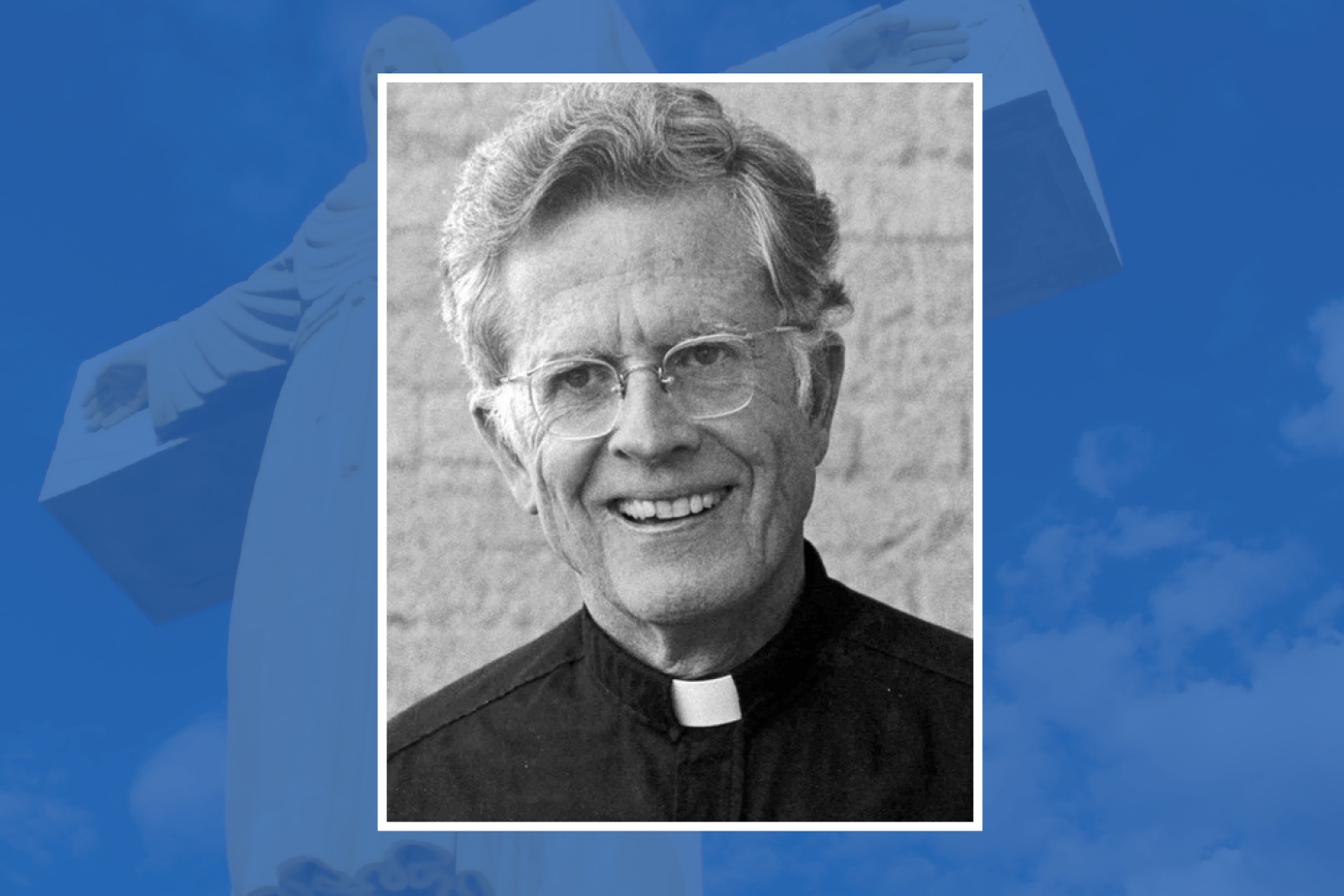
Fifty-three years ago this week, a group of El Pasoans led by the Rev. Richard “Rick” Thomas believed they experienced a miracle. That phenomenon and a life of service are among the reasons that Thomas is under consideration for sainthood.
On Dec. 25, 1972, Thomas and members of his prayer group decided to take food to residents who lived near a garbage dump in Ciudad Juárez. They thought they had enough to feed about 150 people. Instead, the group fed more than 300 people and had enough leftovers to provide food for two orphanages.
Thomas, a member of the Society of Jesus, served in the dioceses of El Paso and Las Cruces from 1964 until his death at 78 in 2006. That event in Juárez emboldened him to expand ministries that assisted and advocated for the disenfranchised throughout the Paso del Norte region.
Those who knew him or worked with him considered him a saint on Earth, and many have petitioned since 2011 to make the title official. The U.S. Conference of Catholic Bishops voted overwhelmingly, 206-4 with one abstention, in November to start an investigation into Thomas’ life for the purpose of possible sainthood.
Las Cruces Bishop Peter Baldacchino presented the request during the conference of bishops business meeting in Baltimore. He did not return a request for comment.
The Rev. Mike Lewis, director of the Office of Divine Worship for the Diocese of El Paso, said saints are the heroes of the church who intercede on a person’s behalf to share their petitions with God, who is the only one who can answer prayers. He said the canonization process is a way to hold up Thomas’ life of virtue and his struggles for justice through his ministry.
 The Rev. Michael Lewis, director of the Office of Divine Worship for the Diocese of El Paso, said the process to be considered for sainthood “takes as long as it takes.” (Courtesy of the Diocese of El Paso)
“Sometimes that’s its own reward,” he said.
A spokeswoman for the Jesuits’ USA Central and Southern Province, to which Thomas belonged when it was part of the New Orleans Province prior to 2014, said the Jesuits appreciated the deep affection and respect that former collaborators had for Thomas.
“They are happy to allow the Diocese of Las Cruces to continue to lead the efforts to promote his cause for canonization,” said Therese Fink Meyerhoff, provincial assistant for communication.
But the road to sainthood is long, hard and can be expensive. Here’s some information to help you understand the process.
What does it mean to be a saint in the Catholic Church?
Unofficially, a saint is anyone who makes it to Heaven. Officially, the title belongs to those who have died and have had their lives scrutinized by the Catholic Church and found to be worthy of veneration through martyrdom and heroic virtue. Those people are canonized. The church does not have an official list of saints, but the estimate is well over 10,000. The reason for the uncertainty is because some received the title before the formal process started in the 10th century.
What roles do saints play in the church?
Saints are role models and intercessors. They were flesh-and-blood humans who showed a strong devotion to God. Catholics ask the saint to intercede on their behalf to help with different trials or situations. People often call on their patron saint – St. Jude for lost causes, St. Anthony of Padua for lost objects, St. Christopher for travelers, and St. Peregrine for cancer patients, to name a few.
Lewis likened it to when a policeman issues a traffic ticket. The offenders have cousins in the legal system and ask them to see if they can get someone to write off the offense. That is similar to when people ask a patron saint to intercede on their behalf for assistance. The saint does not grant the request, but, as someone closer to God, submits it for God’s review.
How does the process start?
There usually is a five-year waiting period after the death of a candidate before consideration for sainthood can begin. The request often starts with a group of people who worked with the person and is familiar with the person’s ministries. They usually petition the leadership of the diocese where the person died, or the candidate’s religious order, to carry the request.
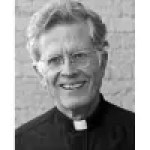 The U.S. Conference of Catholic Bishops have approved the request to consider the Rev. Richard Thomas for sainthood. He lived a humble, spiritual life that focused on helping the borderland’s poor. (Courtesy photo)
Thomas died at The Lord’s Ranch in Vado, New Mexico, which is part of the Diocese of Las Cruces. That is why Baldacchino shepherded the request. The conference of bishops’ decision was needed to formally open the investigation into Thomas’ life.
The Bishops’ Conference will form a team that will collect what Thomas wrote, preached or shared in recordings, and conduct interviews with people who knew him and worked with him. The team will include a representative from the Las Cruces diocese. Part of the team’s mission is to ensure that the candidate did not promote views contrary to the Catholic faith.
In an April 4, 2012, message to Thomas’ followers, Ellen Hogarty shared some information from the Jesuit provincial of the New Orleans Province. The provincial said that the province would gather archived materials related to Thomas, and would have them ready if they were needed for a sainthood request.
The information, which often takes years if not decades to compile, will become part of the packet that will be delivered to the Dicastery for the Causes of Saints in Rome, which oversees the complex process of beatifications and canonizations.
Who was Fr. Richard Thomas?
Thomas was born March 1, 1928, in Seffner, Florida, near Tampa. He was ordained a priest of the Society of Jesus, or a Jesuit, in 1958 in San Francisco. He served the borderland until his death on May 8, 2006. He is buried in the Jesuit section of El Paso’s Concordia Cemetery.
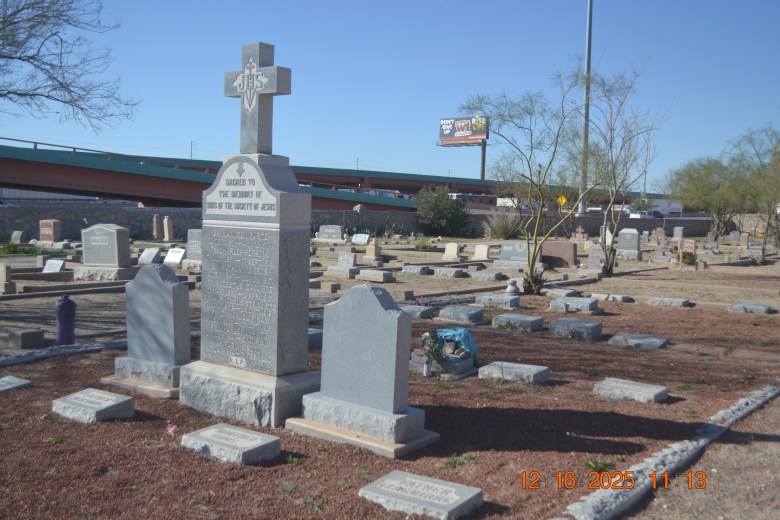 The Rev. Richard “Rick” Thomas is buried in the Jesuit section of Concordia Cemetery near its south wall. He was executive director of Our Lady’s Youth Center near Sacred Heart parish, and opened The Lord’s Ranch near Vado, New Mexico, in 1975. (Courtesy Concordia Heritage Association)
Thomas was executive director of Our Lady’s Youth Center in El Paso, which was part of the Sacred Heart parish. Under his leadership, the center expanded ministries that served the poor in Juárez. These included work with schools, food banks, medical and dental clinics, as well as services for prisons and mental hospitals. His ministry focused on the needy, oppressed and marginalized. People considered him a gifted teacher and preacher.
The priest started the Lord’s Ranch in 1975. The center, located about 30 miles northwest of El Paso, was a retreat complex for needy youth.
In 2012, the Jesuit provincial of New Orleans Province approved the creation of prayer cards where people may ask privately for Thomas’ intercession the same way they ask friends and family for prayers.
What are the different stages on the road to canonization?
There are four official steps to sainthood: Servant of God, Venerable, Blessed (Beatification) and Canonization.
The candidate earns the title of Servant of God after the Dicastery accepts the diocesan investigation. One may ask for the candidate’s intercession publicly at this point. The faithful ask the person to intercede on their behalf, and if something miraculous occurs, it is added to the candidate’s report.
In the second stage, a panel of scholars familiar with divine matters will examine further the candidate’s materials to confirm he or she lived a virtuous life. If the pope approves, the person is declared “Venerable” and can be acclaimed publicly.
A miracle, usually a scientifically unexplainable healing of a terminal condition, tied to the candidate’s intercession is needed for the candidate to achieve the “Blessed” status. Doctors and theologians will study the possible miracle. If it makes it to the pope and he approves, the candidate becomes “blessed” or beatified, and can be celebrated at Mass in their region or their religious order.
An exception to the “miracle” rule would happen if the person was killed for their faith. Martyrs may be beatified without a miracle.
The last stage is the canonization, which takes a second miracle to be attributed to the candidate after their beatification. After even more study of the candidate, the pope makes the final call for sainthood after which the candidate can be celebrated with universal adoration.
Who keeps the application process on track?
Early in the process, the diocese or the group of followers will hire a postulator, or “project manager,” whose job is to gather evidence and guide the application from the diocese level to the Vatican. If the cause reaches Italy, a Roman postulator, usually a canon lawyer, takes over the case. The initial postulator often will stay on to assist.
“You bring in someone who knows what they’re doing,” Lewis said. He added that a postulator’s job can be long and difficult because it involves a lot of research and interviews.
What is considered a miracle?
The U.S. Conference of Catholic Bishops website states that a miracle is something that has occurred by the grace of God, usually a healing, through the intercession of a Venerable or Blessed person, and is scientifically inexplicable.
What is the job of the ‘Devil’s Advocate’?
The person’s job is to thoroughly investigate a candidate to search for a candidate’s flaws in character and to question proposed miracles. Pope Sixtus V established the job in 1587 to ensure that beatifications and canonizations were not based on fraud or weak claims. Pope St. John Paul II reformed the process in 1983. The job’s official title is Prelate Theologian.
How long does the process take?
In general, the process takes anywhere from decades to centuries. Since the reforms of St. John Paul II, the mandatory wait time after death was cut to five years from 50 years. St. Benedict XVI waived the entire waiting period for John Paul II, who died in 2005 and became a saint in 2014.
Among those who had to wait the longest to become a saint is St. Juan Diego, the Aztec peasant who saw the Virgin Mary in her guise of Our Lady of Guadalupe in 1531 on Tepeyac Hill near Mexico City. He had been venerated for centuries, but the canonization process did not begin in earnest until the 1970s. The church named him a saint in 2002. St. Peter Martire of Verona claims the quickest road to sainthood at 10 months. The prominent Dominican preacher was martyred in 1252 and canonized by Pope Innocent IV. In modern times, St. Carlo Acutis was canonized 18 years after his death in 2006. He is the first millennial saint and the patron saint of the internet.
Lewis put it simply. “The process takes as long as it takes,” he said.
How much does it cost to shepherd the candidacy of a possible saint?
A lot. A May 2023 story in the Hawaii Catholic Herald reported the average cost of everything from the initial stages to the canonization ceremony could cost around $250,000 with some finishing at more than $1 million. Some expenses include travel, research and translation. The Dicastery for the Causes of Saints is testing a “Solidarity Fund” that Pope Francis started around 2016 to help applications that do not have wealthy backers beyond a diocese, religious order or nonprofit lay group.
The Diocese of Las Cruces did not respond to questions about the projected costs of Thomas’ application.
Lewis said that a lot depends on how long it takes to gather the materials and interview witnesses. He used St. Juan Diego as an example of a long process.
“(He) took so long because he was poor, he’s from Mexico and because the (apparition) happened 500 years ago,” Lewis said.
Related
LISTEN: EL PASO MATTERS PODCAST