
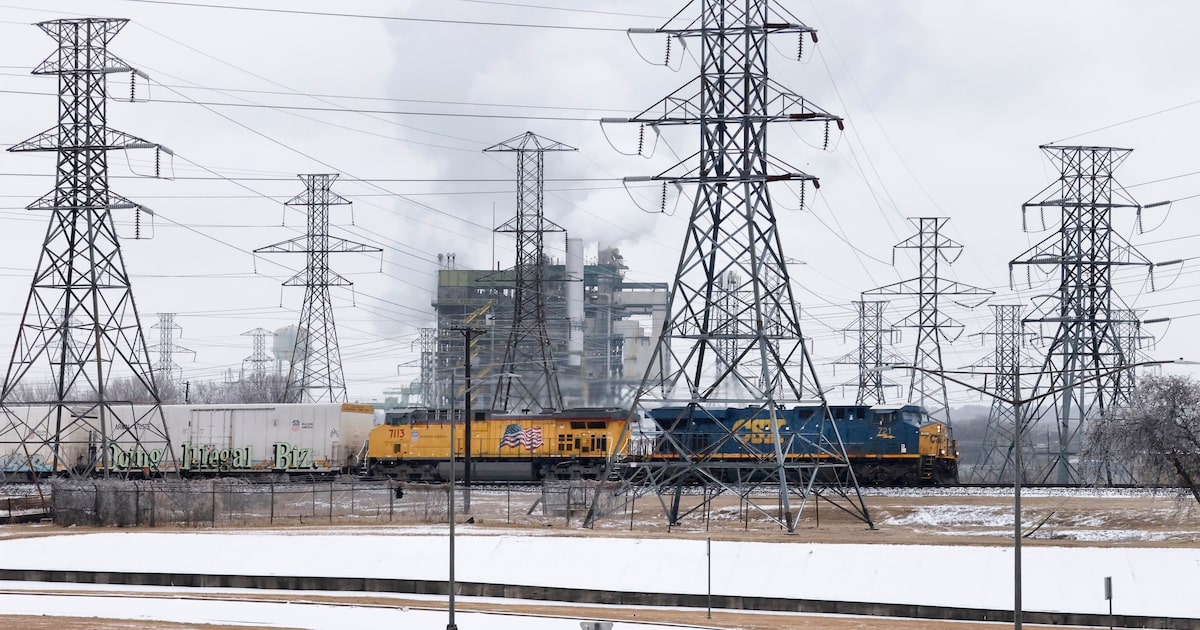
AUSTIN — The weather outside is far from frightful this Christmas week, but winter still carries echoes Texans haven’t forgotten.
Nearly five years after a devastating, nearly weeklong freeze, grid officials say the chances of blackouts this season are low, though not eliminated.
ERCOT, the state’s power grid operator, has projected about a 1% chance of ordering rolling blackouts in January and February, a last-resort move to keep the system from failing when demand overwhelms supply.
The outlook is improved from recent winters, though a 2021-style freeze would again push outage risks sharply higher.
Business Briefing
That’s when an extreme winter storm blanketed the state in snow and ice for days.
It overwhelmed power plants, fuel supplies and equipment, forcing grid managers to cut electricity to prevent a grid collapse. Millions of Texans lost power, many for days. More than 200 deaths were later linked to the prolonged cold and loss of heat. Billions of dollars in economic damage were reported statewide.
After years of reforms and investment, ERCOT says the grid is better positioned, even as it forecasts a colder winter than the last four years but warmer than average overall.
Independent analysts largely agree. “Looking at the numbers that ERCOT put out, it looks pretty good,” said Joshua Rhodes, a research scientist for the Webber Energy Group at the University of Texas at Austin. “But there’s always a chance that something goes awry.”
The Christmas Day outlook offers little hint of that. Thursday in Dallas is expected to be near-record mild, with highs in the upper 70s.
Lingering risks
Still, uncertainty remains over the coming months, with volatility in polar weather patterns making winter conditions harder to gauge, according to a Dec. 9 ERCOT report. Officials cited recent instability in the Polar Vortex, an Arctic stream of cold air that can push south when it weakens.
ERCOT CEO Pablo Vegas said at a recent ERCOT board meeting that while renewable energy generation – mainly solar power – has grown rapidly in recent years, its unavailability during the hours of highest winter demand creates a vulnerability.
“Winter still represents the higher risk period in the ERCOT market, because fewer of these resources that are being added are available during the winter peak periods, which tend to be in the mornings, before the sun rises, or in the early evenings, right after it sets,” Vegas said.
The rise in battery capacity over the last two years is perhaps the most significant factor affecting grid stability. The storage capacity of large-scale batteries has nearly quadrupled since December 2023, and recently overtook coal power.
Rhodes said that while solar generation generally diminishes during peak hours in winter, batteries are well-positioned to pick up the slack. Those generally occur in the morning hours in winter, when people wake up and begin consuming more electricity before solar power can generate significant power.
“They’re dispatchable. They can be called on whenever,” Rhodes said.
The Legislature enacted weatherization rules after the 2021 freeze. ERCOT has seen compliance with its weather-hardening rules jump since the program was implemented.
Now, few power plants are found out of compliance, and Vegas said that most of those can correct issues quickly.
“The weatherization program is one of the best defenses we have against extreme weather, and the industry has been responding to those requirements very well,” Vegas said in an interview.
Winter fixes
After the 2021 freeze, Texas lawmakers passed measures aimed at reducing cold-weather failures across both the electric and natural gas systems, which nearly collapsed together. The key requirements:
Mandatory winterization standards for power plants and certain natural gas facilities.Identification of critical gas infrastructure needed to keep power plants running.Expanded inspection and enforcement authority for regulators.