
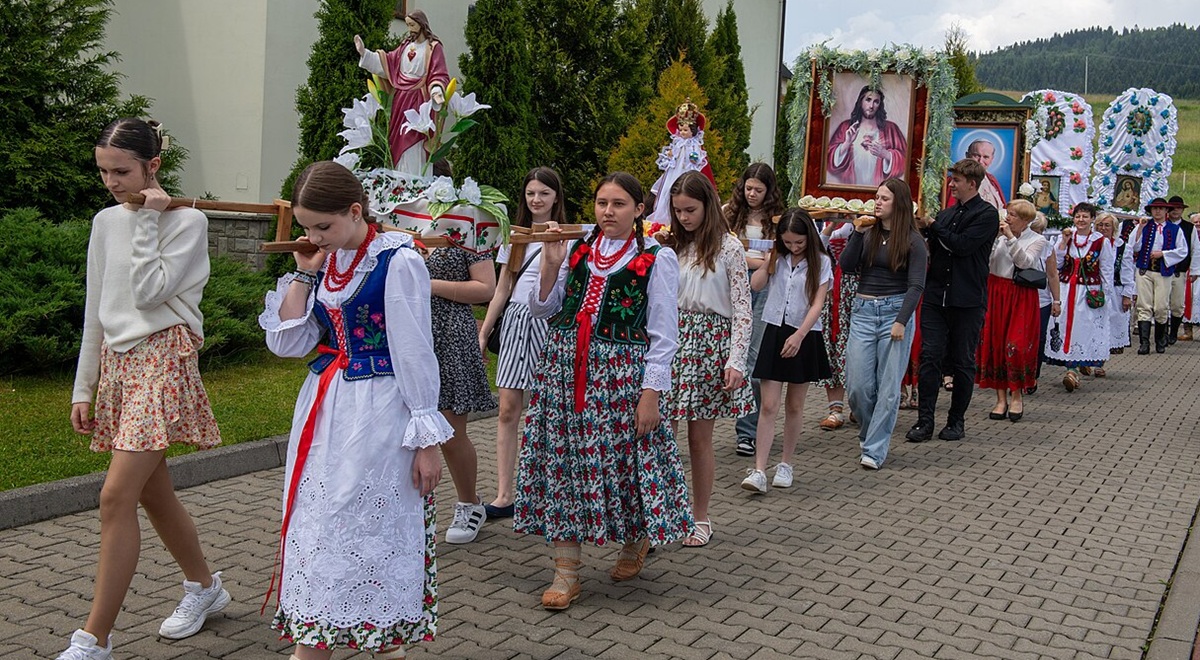
The new entries come from communities in western and eastern Poland and include traditions linked to major Catholic holidays that remain strongly rooted in village life.
One of the newly listed customs is the “Easter bears” procession from the village of Góra in the Greater Poland region, a tradition dating back to 1913. During Easter, a costumed parade moves through the village featuring characters such as an old woman and old man, two “bears,” their handlers, chimney sweeps, and a musician. The ministry noted that the figures wear elaborate outfits, including straw costumes for the bears.
Also added is the Corpus Christi procession in Skęczniew, also in Greater Poland, which includes the making of flower carpets. The practice began shortly after World War II and, according to the ministry, grew as a form of gratitude that the locality survived the war. In the days leading up to the feast, residents gather flowers and other materials, and prepare designs. On Corpus Christi, children, adults, and seniors create long arrangements from natural materials along the procession route, with religious, floral, and geometric motifs.
A third entry is the early-morning “Emmaus” procession and the “Turki,” a traditional Holy Sepulchre Guard, in the parish of Dobra in Greater Poland. The Emmaus procession begins on Easter Monday at 5:30 a.m. and involves a 12-kilometer walk around the area, with stops at 18 roadside crosses for prayer, ritual gestures, and singing, drawing on the Gospel story of the road to Emmaus. The “Turki” group, active locally since 1882, keeps watch from Good Friday until the Easter Resurrection service, wearing distinctive red uniforms modeled on historical Turkish-style military dress.
The fourth new entry recognizes the skill of making “kraski,” scratch-carved Easter eggs from Krasnystaw and surrounding areas in the Lublin region. The eggs are dyed, often using an onion-skin decoction that produces red, brown, and cherry tones, then decorated by scratching patterns with small blades. The ministry said the tradition is passed down in families and communities, with motifs ranging from geometric and solar symbols to plant and religious designs.
Poland’s National List of Intangible Cultural Heritage has been maintained since 2013 by the National Institute of Cultural Heritage. Entries are approved by the minister of culture and national heritage, following applications from communities and recommendations from the Council for Intangible Cultural Heritage.
(rt)