
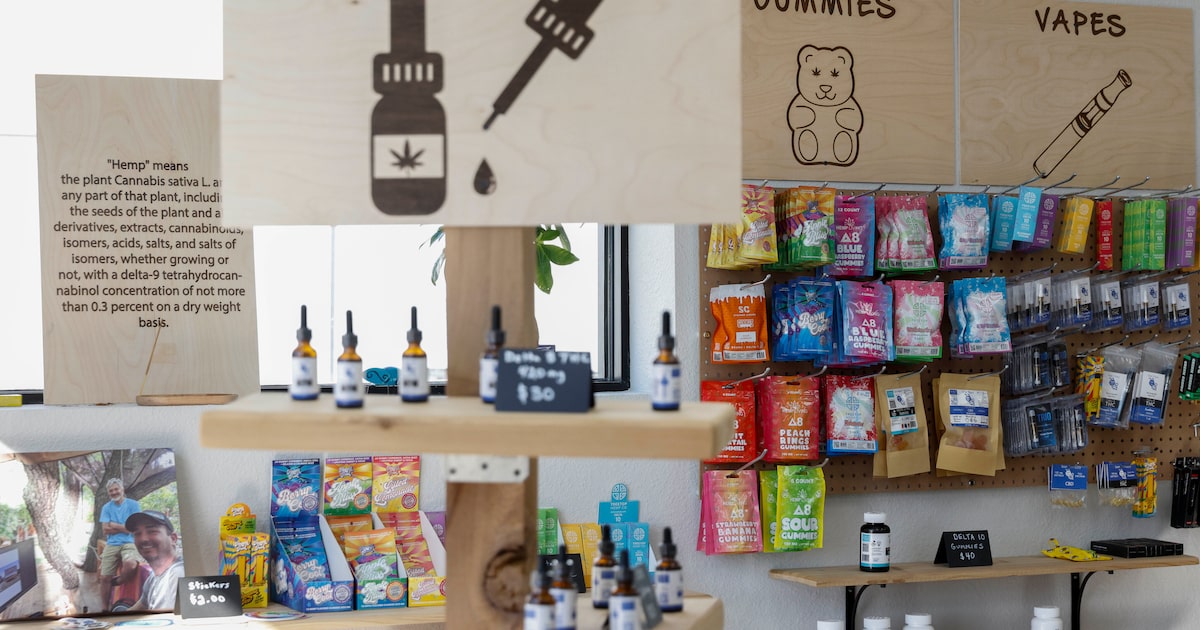
AUSTIN — As the smoke clears in Washington after Congress voted to ban all consumable hemp products nationally starting next year, state regulators in Austin have begun taking opinions from the public on how to move forward with new rules for retailers of gummies, drinks, snacks and smokeable flowers that contain intoxicating levels of hemp-derived THC or similar compounds.
The executive order to forge ahead in support of the state’s burgeoning hemp retail market comes from Republican Gov. Greg Abbott in September, who at the beginning of the summer vetoed a statewide ban on intoxicating products containing tetrahydrocannabinol — the compound found in marijuana, a sister to the hemp plant.
And while Abbott appears to be in direct opposition to those in Washington who voted to shut down the industry he helped save, that could change if Congress manages to craft and pass a more structured regulatory system for the products before the ban begins in November 2026.
That gives hope to retailers in Texas who still see the potential for doing business in the future if the state can stabilize its regulations, and as politicians in Washington — who include U.S. Sen. Ted Cruz, R-Texas, and U.S. Rep. Dan Crenshaw, R-Houston — rail against efforts to shut down the entire industry.
Political Points
“Should we really be regulating this from the federal level? We’ve had the debate already in Texas. I’m sure we will continue to have it,” Crenshaw posted on X after the federal vote.
John Lutz, vice president of food and marketing at Toot ‘n Totum Food Stores, a family-owned convenience store chain that serves West Texas, told Texas Alcoholic Beverage Commission members last week that his company plans to start selling THC products — betting on the increasing awareness and acceptance of the hemp products even amid the uncertainty.
“We have a year,” Lutz testified at a hearing in November. “I’m sure there are people that have far more influence than we do in terms of influencing what could happen within the year. What we know is that THC is a huge industry in Texas, and there are a lot of consumers who use THC in Texas. … We are confident that we can be a highly responsible channel to distribute these products in the most effective and protective way.”
Abbott’s office did not respond to multiple requests for comment.
The hearings by the TABC began less than a week after President Donald Trump signed a package of budget bills on Nov. 12 that restarted the federal government after a 43-day shutdown — a deal that ended the historic stalemate but included a total ban on the consumable hemp products that had been legal since a 2018 federal farm bill.
Texas has seen the number of licensed hemp-based THC retailers grow to 9,218, which include not just convenience stores and smoke shops that sell edibles and drinks, but also salons that use lotions and products made with hemp-derived compounds, according to the Texas Department of State Health Services.
In September, Abbott directed the TABC to create permanent rules for the retailers under their direction — those that sell or serve alcohol — who have added or plan to add the other products to their shelves.
State officials immediately issued emergency rules requiring every retailer in Texas to begin verifying the ages of their hemp consumers to make sure they are 21 or older. Violations could result in suspension of their retail license or revocation or their TABC license — which would also prohibit them from serving alcohol. Many bars and restaurants serve THC-infused drinks, subject to the same age limits as alcohol under the new rules.
During a TABC meeting on Nov. 17, commissioners voted to take public input on a permanent version of those rules through Jan. 4, after which the commission would vote on formal adoption. Another public hearing was held on Dec. 11.
The main sticking point on the new rules was the current “one-strike” provision that could result in a retailer losing their entire business over a single violation. The new proposal removes that and institutes a more graduated system of penalties based on number and severity of the violations.
“I’m looking forward to seeing what you have proposed as a veteran, as a constituent,” Shaun Salvaje, a pro-hemp activist, told commissioners. “I’m really looking forward to seeing Texas do this completely differently from any other state. I think we can actually get it right.”