
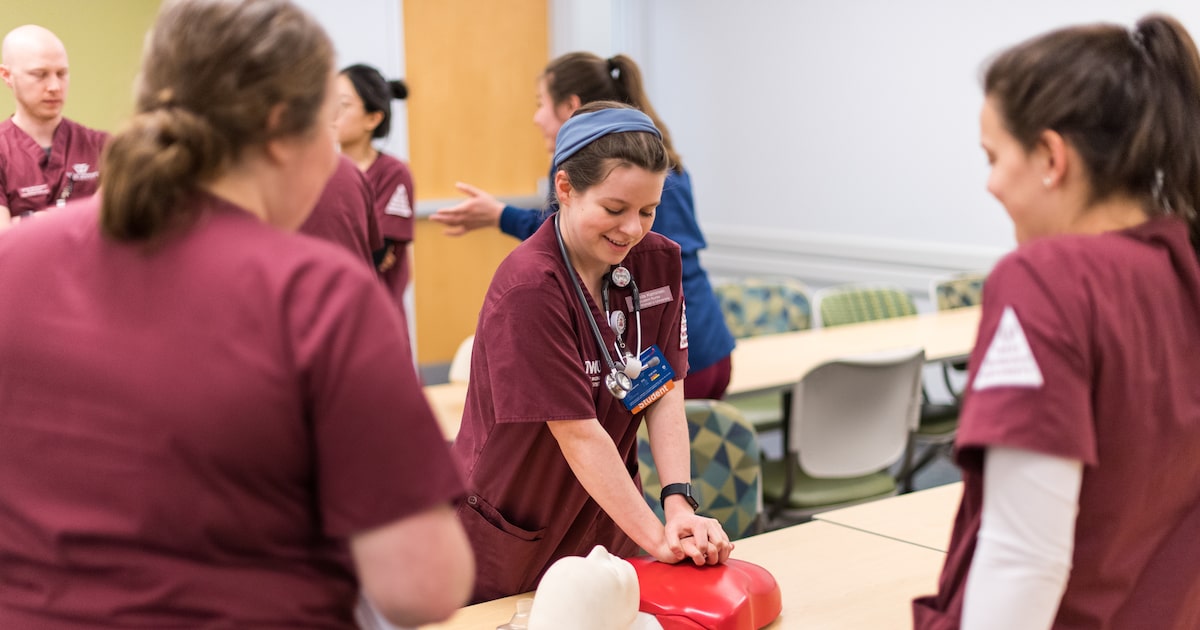
For many North Texans, finding fast and affordable ways to learn new skills can make or break their chances of earning enough money to live in Dallas-Fort Worth.
Dallas County’s living wage level ranges from $23.06 an hour for a single adult to $30.78 per hour for a two-parent household of five, according to data sourced from the MIT Living Wage Calculator.
That’s about $47,964 to $64,000 a year.
Amy Glasmeier is a professor of economic geography and regional planning at MIT’s Department of Urban Studies. She runs the living wage calculator, and she told The Dallas Morning News their data review was completed and posted on Feb. 10, 2025.
The Education Lab
Related

But Dallas-Fort Worth’s median income for a person is about $51,000, according to Upgraded Points, a travel and financial advice company that analyzed data from the Economic Policy Institute and U.S. Census Bureau. Median family income is under $114,000 in the region.
Education and workforce development advocates say short-term training programs can help people obtain the new skills needed to make more money. These opportunities include, but aren’t limited to, free programs for high school students and community college courses for older workers seeking new skills.
Here’s a look at some programs that could put residents on the path to earning more money.
Health care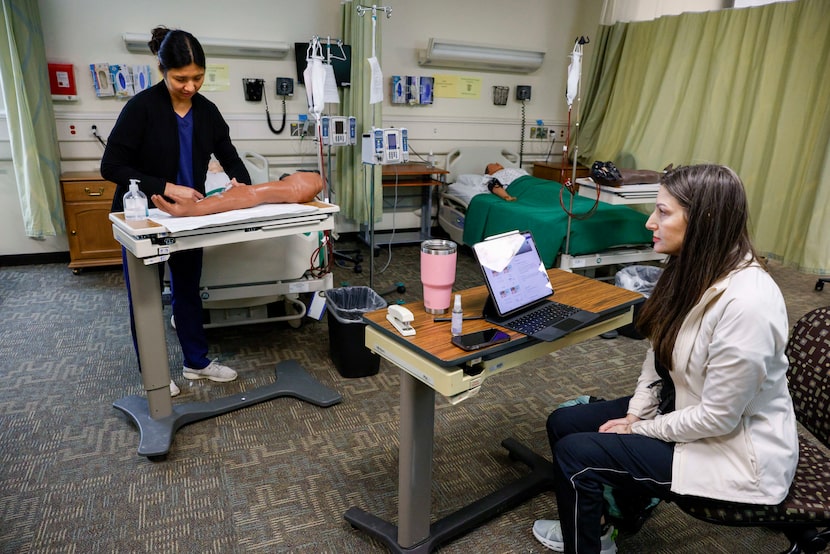
Leslie Johanson (right), an academic pediatric nursing coordinator and pediatric nurse practitioner, assesses Cheryl Robin (left), second semester student, as she demonstrates placing an IV in a mannequin arm at the Dallas College Brookhaven Campus in Dallas, on Thursday, Feb. 27, 2025.
Liz Rymarev / Staff Photographer
The demand for medical care is expected to skyrocket due to the region’s aging population. Rapid growth in artificial intelligence will also likely create new health care jobs.
Registered nurses in D-FW made $47 per hour last year, according to data from the U.S. Bureau of Labor Statistics’ Occupational Employment and Wage Statistics (OEWS) program, obtained via the Texas Workforce Commission.
Wages for nursing occupations can vary widely, said Sarah Fischer, a press officer for the Texas Workforce Commission. Licensed practical and licensed vocational nurses in the D-FW area made approximately $29 per hour, nursing assistants made $17 to $18 per hour and nurse practitioners made $62 to $63 per hour, Fischer said.
Dallas College and Tarrant County College each offer two-year associate degree programs for nursing, according to the schools. Dallas College students may require one additional semester for prerequisites.
There are also several health-related roles outside of nursing.
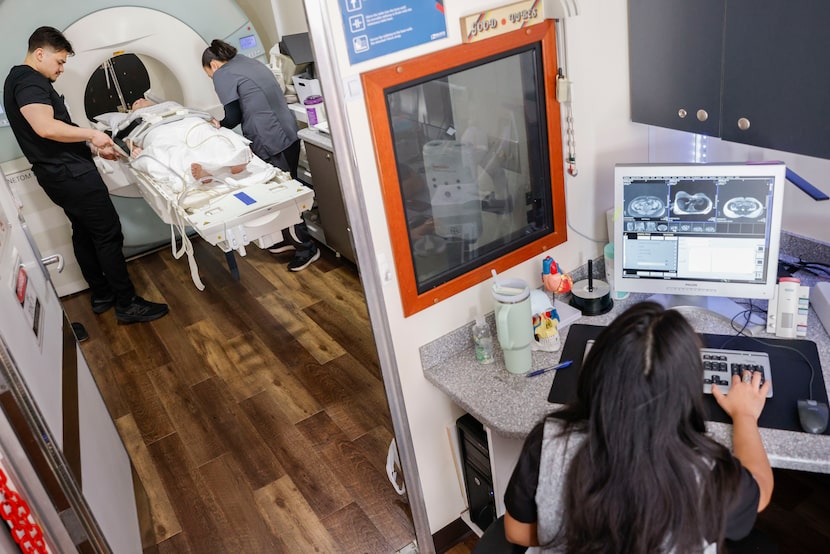
Raymond Marroquin (left) and Maggie Ortiz-Munoz (center) adjust Rylie Baker (center left), volunteer, as she gets scanned by Carina Garcia (right), all MRI students, at the Dallas College Brookhaven Campus in Dallas, on Thursday, Feb. 27, 2025.
Liz Rymarev / Staff Photographer
Medical imaging-related roles, such as radiologic technologists and technicians, made around $38 an hour last year, according to the workforce commission, citing BLS OEWS data. Diagnostic medical sonographers made between $44 and $45 an hour.
Medical equipment preparers earned about $23 to $24 per hour or more last year, according to the workforce commission. Medical records specialists made around $24 an hour last year.
At Dallas College, students can get a certification in sterile processing for a medical equipment preparation career or a medical billing certificate for medical records work in four months, according to the college. Dallas College also offers a one-year medical coder program that typically commands a higher median rate than medical billing specialists, according to a college spokesperson.
The college also offers students a two-year associate degree in radiologic technology, and one possible additional semester for prerequisites. Students who complete the program can also work toward advanced certifications in computer tomography within eight months, or magnetic resonance imaging (MRI) and vascular interventional, which are both yearlong programs.
Cybersecurity
Some local colleges offer cybersecurity training programs, which can lead to jobs paying $62 to $63 per hour in D-FW, according to the Texas Workforce Commission.
Bloomberg Creative Photos / Bloomberg Creative
Cyberspace protection will be invaluable as companies continue to build advanced technology.
Information security analysts in D-FW made $62 to $63 per hour last year, according to the workforce commission, citing BLS OEWS data.
North Central Texas College offers several training programs for cybersecurity that can be completed within weeks to two years, depending on the certification.
Dallas College offers similar cybersecurity programs, including two two-month programs, two eight-month programs and a two-year associate degree in cybersecurity, according to the college’s website.
Trades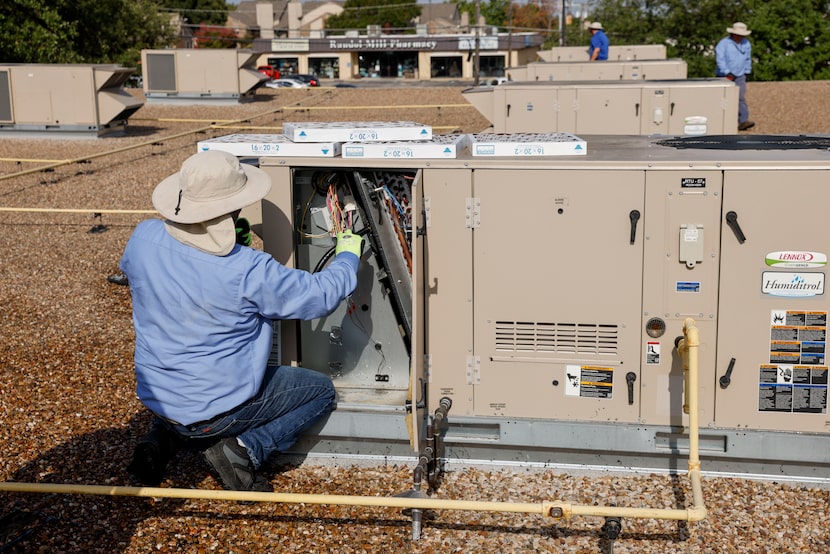
An HVAC mechanic cleans an air conditioning unit on the roof of Wimbish World Language Academy in Arlington on Friday, July 22, 2022.
Elias Valverde II / Staff Photographer
It’s not cool when one’s fridge stops working, and that’s certainly true for air conditioning, too.
That’s where HVAC mechanics and technicians come in, making about $27 an hour to bring relief to Dallasites, according to the workforce commission, citing BLS OEWS data.
Residents can get the skills for this industry by completing Dallas College’s two-year air conditioning and refrigeration technology program. North Central Texas College’s HVAC program is also offered at various levels, from 16 weeks to two years, according to the school.
Electricians in the D-FW area made about $27 to $28 per hour last year, according to the workforce commission. Meanwhile, electrical and electronics repairers for commercial and industrial equipment made $31 an hour last year.
Dallas College’s robotics, electronics and automation program prepares students for the electrical and electronic engineering technician field within two years, according to the college.
Final thoughts
No matter what job is available, salaries will always vary due to location, the employer, competition and experience.
For the occupations mentioned above, for instance, the statewide hourly, median wages differ from their D-FW counterparts by approximately $1 to $5 per hour, if at all, said TWC’s Fischer.
But workforce advocates say residents can put themselves on the right path by gaining new skills.
This reporting is part of the Future of North Texas, a community-funded journalism initiative supported by the Commit Partnership, Communities Foundation of Texas, The Dallas Foundation, the Dallas Mavericks, the Dallas Regional Chamber, Deedie Rose, Lisa and Charles Siegel, the McCune-Losinger Family Fund, The Meadows Foundation, the Perot Foundation, the United Way of Metropolitan Dallas and the University of Texas at Dallas. The News retains full editorial control of this coverage.