
Dec. 28, 2025, 5:01 a.m. PT
The Oregon Ducks are back in the College Football Playoff Quarterfinals once again, and they’re preparing for another New Year’s Day game in a win-or-go-home scenario, this time against the Texas Tech Red Raiders. It won’t be an easy jump down to the Rose Bowl this year for Dan Lanning and his team, but rather a cross-country trek to Miami for a spot in the Orange Bowl on January 1.
After easily getting past the James Madison Dukes in the first round of the playoffs, Oregon has had a chance to knock the rust off and get back into game mode after a long three-week break at the beginning of December. However, they will face one of their toughest tests of the season in a few days, with the No. 4 seed Texas Tech Red Raiders waiting for them in Miami.
While Oregon has faced talented teams like the Indiana Hoosiers, USC Trojans, Iowa Hawkeyes, Washington Huskies, and Penn State Nittany Lions, few compare to Texas Tech, both on the offensive and defensive side of the ball. It may be fair to question some of the numbers that the Red Raiders have produced so far this year due to their level of competition in the Big 12, but you can also make that argument about the Ducks, who have boosted several stats against the bottom-feeders of the Big Ten as well.
So what can we expect to see from this Texas Tech team, and in particular, what type of challenges will they present? Let’s dive in.
What do the Texas Tech Red Raiders do well on offense?
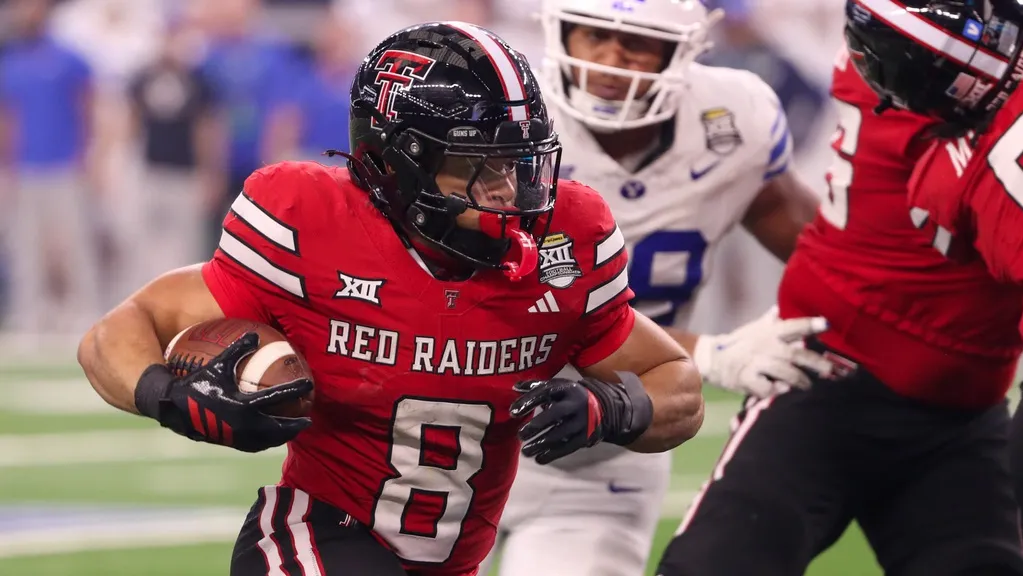
The more straightforward answer to this question is to list what the Red Raiders don’t do well on offense. So far this year, Texas Tech has had one of the most prolific offenses in the nation, coming in at No. 2 in scoring at 42.5 points per game. They have a relatively balanced attack, coming in at 27th in rushing (190.9 rush yards per game) and 11th in passing (289.4 pass yards per game).
Need a news break? Check out the all new PLAY hub with puzzles, games and more!
While they have struggled a bit when they get into the red zone, the Red Raiders are among the top teams in the nation when it comes to converting on third down, and they rank No. 2 in the nation in terms of explosive plays, behind only the Ducks, who are at No. 1.
Who are the top players to know about?QB Behran Morton
Morton doesn’t have the biggest arm and is far from a dual-threat with negative -81 rush yards this season, but he does enough to fuel this Red Raiders offense with the way that he distributes the ball accurately. He’s a sound decision-maker, throwing just four interceptions versus 22 touchdowns. His experience has done him well, as Morton has been at Texas Tech for five years and started the majority of the last three seasons.
RB Cameron Dickey
Just a true sophomore, Dickey has burst onto the scene this season, emerging as the team’s No. 1 back after seeing little time a season ago as Tajh Brooks received a lion’s share of the carries. But with Brooks moving on to the NFL, Dickey has stepped in and ran for over 1,000 yards and 14 touchdowns, being named a first-team All-Big 12 selection. At 5-foot-10 and 215 pounds, he’s is a bruising runner, averaging 5.5 yards per carry. Dickey and J’Koby Williams, who bring the speed, form arguably the best 1-2 running back duo in the country.
The WR Trio
Texas Tech boasts a trio of wide receivers who all work cohesively in the passing game and need to be accounted for. They are all big-bodied players who have the ability to out-physical average-sized cornerbacks in the secondary. Reginald Virgil stands at 6-foot-3, Caleb Douglas is 6-foot-4, and Coy Eakin is 6-foot-2.
All three receivers have over 600 yards and six touchdowns this year, with Douglas leading the way at 846 yards and seven touchdowns. These guys are big, fast, and physical, and will pose a major challenge to Oregon’s secondary on Thursday.
Are the Oregon Ducks built to stop Texas Tech?
Slowing down Tech’s offense is not going to be easy, by any stretch of the imagination, but the Ducks’ defense is no slouch. They have the No. 3 passing defense, and should be able to sit back in a two-deep zone, much like they did against the Washington Huskies, for much of the game, encouraging the Red Raiders to run the ball early and often, trying to limit explosive plays. Should they have success with this, it will all be about what the defense can do in the redzone, and that’s where this game is going to be won or lost. While Tech doesn’t have a great red-zone offense, scoring touchdowns just 56% of the time they get inside the 20, the Ducks also have a porous redzone defense, giving up points on 89% of drives in the redzone, which is No. 120 in the nation.
What should we expect on Thursday?
I think that Oregon will have a good game plan for this matchup, and they will rely heavily on their newish “4-down, 3-back” defensive scheme that they took from the Ohio State Buckeyes in last year’s Rose Bowl. Virtually, expect to see a lot of two-high safety looks with Dillon Thieneman acting as a rover in the middle, playing a deep middle-linebacker role that allows him to be versatile against the run and the pass. This is what the Ducks did against Washington so effectively, and it projects to work well against the Red Raiders as well.
Completely shutting down Texas Tech’s offense is not going to be easy to do, but If Oregon can try to limit explosive plays and keep the ball in front of them, it’s not out of the question to see them keep the Red Raiders in the high teens or low-20s when it comes to scoring in this game, which should give Dante Moore and the Ducks’ offense a mark to shoot for on the other side.
Contact/Follow @Ducks_Wire on X (formerly Twitter) and like our page on Facebook to follow ongoing coverage of Oregon Ducks news, notes, and opinions.