
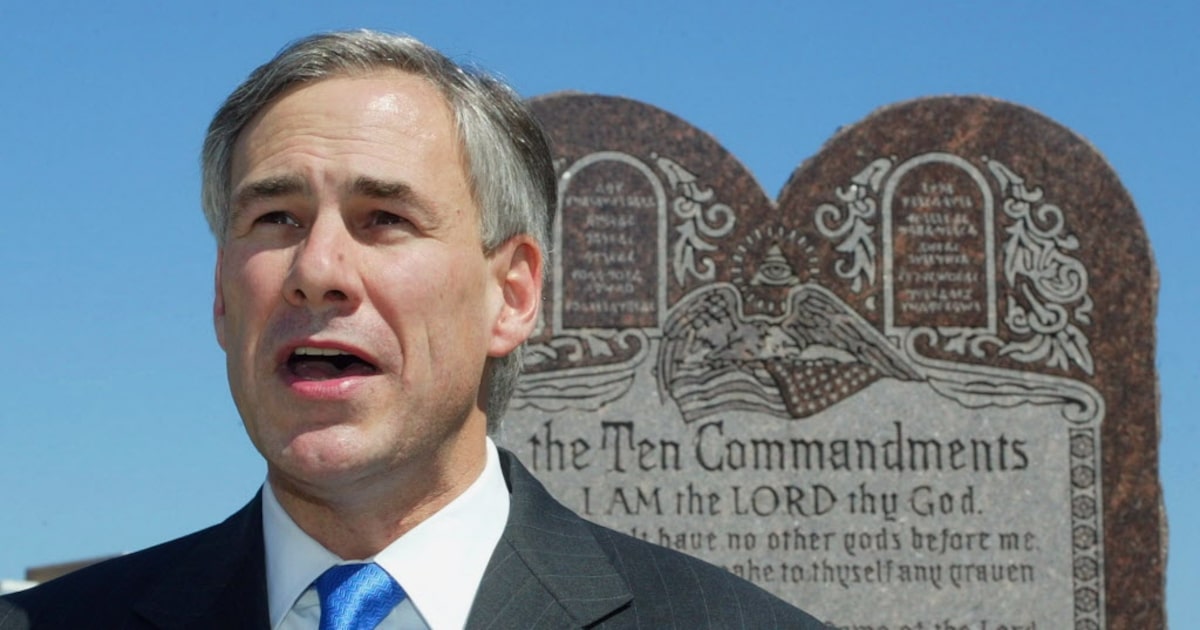
A state law directing Texas school districts to display the Ten Commandments in classrooms has faced a flurry of legal challenges since Gov. Greg Abbott signed it in June.
Proponents of the law say Christianity is central to American history and honors the country’s heritage. Families and organizations like the ACLU of Texas say the law violates the First Amendment’s protections for the separation of church and state and the right to free exercise of religion.
Since the law went into effect Sept. 1, at least four lawsuits have been filed.
Two federal judges found the Texas law to be unconstitutional and temporarily prohibited a combined 25 school districts from implementing the policy. Attorney General Ken Paxton ordered the rest of Texas’ more than 1,200 school districts to put up the posters and sued three that did not follow the law. In early December, 18 families filed a class-action lawsuit to block all Texas school districts from displaying the Ten Commandments.
The Education Lab
Here’s how the legal battles have unfolded.
What does the law say?
Under SB 10, public schools must clearly display a durable or framed copy of the Ten Commandments in classrooms. The text, which should be at least 16 inches wide and 20 inches tall, must be readable by anyone with average vision from anywhere inside the classroom.
Schools must accept privately donated posters. While districts may buy posters with their own funds, the law does not require them to.
Related
 Dallas activist group and faith leaders file lawsuit
A Dallas advocacy group and faith leaders filed a civil lawsuit in the U.S. District Court for the Northern District of Texas in June. It listed Texas Commissioner of Education Mike Morath, the Texas Education Agency, Dallas ISD, DeSoto ISD and Lancaster ISD as defendants.
Christian and Muslim parents and faith leaders were named as plaintiffs, along with the Next Generation Action Network Legal Advocacy Fund. The lawsuit was dismissed Dec. 3.
Related
 Lawsuit against 11 school districts
Sixteen families — who hail from Jewish, Christian, Unitarian Universalist, Hindu or nonreligious backgrounds — filed a federal lawsuit to block the law in July. The plaintiffs were represented by Americans United for Separation of Church and State, the national American Civil Liberties Union, the ACLU of Texas and the Freedom from Religion Foundation.
In a motion to dismiss the lawsuit, the state argued the Ten Commandments posters are a “passive display.” SB 10 does not require the Ten Commandments to be discussed or incorporated into classroom activity, wrote Assistant Attorney General William Farrell.
In August, U.S. District Judge Fred Biery of the Western District of Texas in San Antonio temporarily prohibited 11 districts from displaying the Ten Commandments, including Plano ISD, Austin ISD and Houston ISD.
Biery determined the law “officially favors Christian denominations over others” and “crosses the line from exposure to coercion.”
“S.B. 10 is not neutral with respect to religion,” he wrote in his ruling. “The displays are likely to send an exclusionary and spiritually burdensome message to the child-Plaintiffs.”
Related
The defendants in the lawsuit appealed the decision. Judges in the U.S. Court of Appeals for the Fifth Circuit will hear the case, along with another case challenging a similar Louisiana law, on Jan. 20, 2026.
Another 14 districts sued
Fifteen multifaith and nonreligious families filed another federal lawsuit in September. Like the previous lawsuit, they asked the U.S. District Court for the Western District of Texas to find the law in violation of the First Amendment.
In November, U.S. District Judge Orlando Garcia of the Western District of Texas in San Antonio sided with the families, temporarily blocking the law in 14 districts. Among those named were Fort Worth ISD, Arlington ISD, McKinney ISD, Frisco ISD, Northwest ISD, Azle ISD, Rockwall ISD, Lovejoy ISD and Mansfield ISD.
He wrote that the law violates the First Amendment’s establishment clause, which safeguards a separation between the church and state.
“It is impractical, if not impossible, to prevent Plaintiffs from being subjected to unwelcome religious displays without enjoining Defendants from enforcing S.B. 10 across their districts,” he wrote.
Related
 Paxton sues three districts
In August, Paxton ordered all Texas schools not tied up in ongoing litigation to display the Ten Commandments. He said the Ten Commandments are “irrevocably intertwined” with American heritage.
In November, Paxton sued three school districts — Round Rock, Leander and Galveston ISDs — for not putting up the posters.
“Round Rock ISD and Leander ISD chose to defy a clear statutory mandate, and this lawsuit makes clear that no district may ignore Texas law without consequence,” he said in a statement.
Families file class-action lawsuit
A group of 18 multifaith and nonreligious Texas families filed a class-action lawsuit in December. While federal judges have ordered 25 districts to take down the Ten Commandments, this lawsuit named another 16 school districts as defendants, spanning the Austin, Dallas-Fort Worth, Houston and San Antonio metropolitan areas. Plaintiffs are aiming for a similar outcome.
They also asked the judge to prohibit any Texas school district not involved in the litigation from displaying the Ten Commandments.
Related
Like the other lawsuits, this one was filed by the ACLU and religious freedom organizations. The document states the law is the state’s attempt “to impose religious beliefs on public-school children.”
“Politicians in Texas should know by now that public schools aren’t Sunday schools,” said Daniel Mach, director of the ACLU Program on Freedom of Religion and Belief, in a statement.
What happens next?
For now, the court injunctions remain in place, meaning 25 school districts are still blocked from putting up the posters.
The case could reach the U.S. Supreme Court, which has ruled on the issue before. In 1980, justices determined a Kentucky law requiring the display of the Ten Commandments in classrooms was unconstitutional.
GOP supporters say that case was wrongly decided. In 2022, the Supreme Court ruled a high school football coach could not be disciplined for praying at school football games.
The DMN Education Lab deepens the coverage and conversation about urgent education issues critical to the future of North Texas.
The DMN Education Lab is a community-funded journalism initiative, with support from Bobby and Lottye Lyle, Communities Foundation of Texas, The Dallas Foundation, Dallas Regional Chamber, Deedie Rose, Garrett and Cecilia Boone, Judy and Jim Gibbs, The Meadows Foundation, The Murrell Foundation, Ron and Phyllis Steinhart, Solutions Journalism Network, Southern Methodist University, Sydney Smith Hicks, and the University of Texas at Dallas. The Dallas Morning News retains full editorial control of the Education Lab’s journalism.