
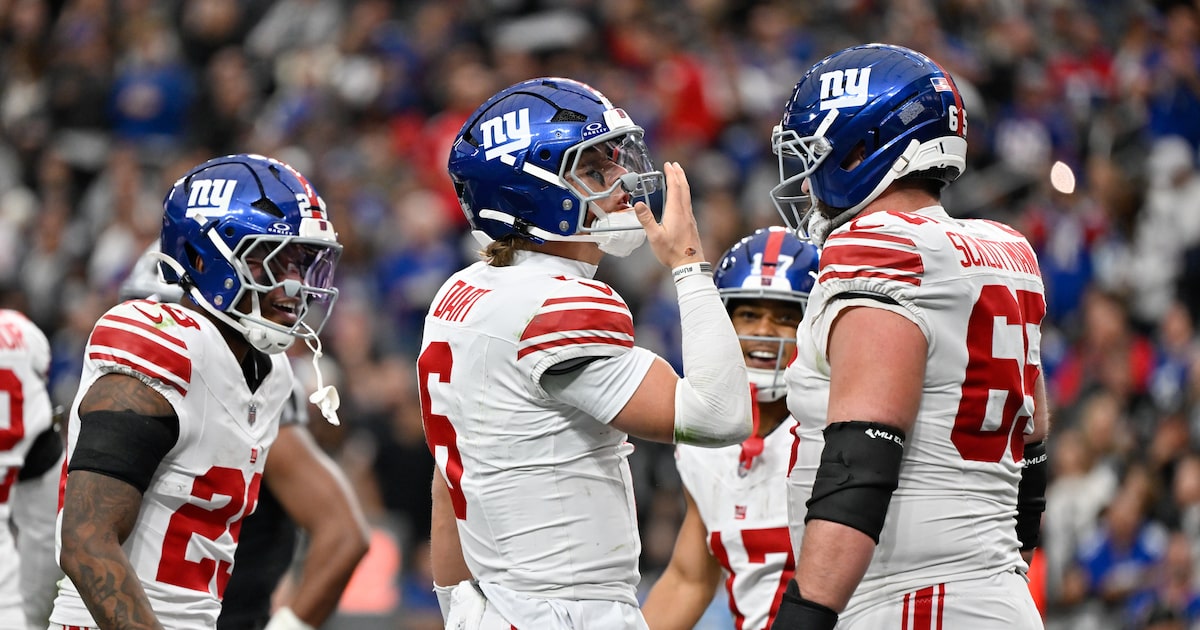
It has been a nightmare season for the New York Giants, a team that fired its head coach midseason, was plagued by injuries and has only three wins.
The 2025 Giants are not just bad, they are historically bad, ranking among the three worst seasons the franchise has ever produced.
Here are five things to know about the Dallas Cowboys’ Week 18 opponent:
Giant mess
Cowboys
How bad has the Giants’ 2025 season been?
Bad enough that it sits alongside the darkest chapters in franchise history. Their 3-13 record places them among the Giants’ worst seasons:
1966: 1–12–1 (–238 point differential)
1973: 2–11–1 (–136)
1974: 2–12 (–104)
2024: 3–14 (–142)
2025: 3–13 (–75)
Injuries have been a defining theme of the Giants’ most disastrous years, and 2025 has followed the same script. Week after week, the team has lost key starters, including:
– Andrew Thomas (LT)
– Cor’Dale Flott (CB)
– John Michael Schmitz Jr. (C)
– D.J. Davidson (DT)
– Brian Burns (LB)
– Tyler Nubin (S)
– Malik Nabers (WR)
– Kayvon Thibodeaux (LB)
– Cam Skattebo (RB)
The season unraveled quickly. After a 2–8 start, head coach Brian Daboll was dismissed, and offensive coordinator Mike Kafka was elevated to interim head coach. Daboll arrived in 2022 and initially looked like the franchise’s long‑awaited stabilizer. His Giants opened 7–2, their best start in a decade, and a 38–10 win over the Colts clinched their first playoff berth since 2016. He was named Coach of the Year that season. But the momentum evaporated. The roster regressed, injuries piled up, and the franchise spiraled back into instability.
Next season, the Giants will once again start over. Their next hire will be the seventh head coach the team has employed since 2016.
Sharp Dart
The Giants opened the season with Russell Wilson under center before eventually turning the offense over to Jaxson Dart, their first‑round pick in the 2025 NFL draft. Dart’s rookie campaign has been a mix of raw talent, chaotic circumstances, and flashes of genuine star potential. Thrown into action, he stepped into a broken roster, operated behind an injury‑ravaged offensive line, and played long stretches without his top playmakers. Yet despite the turmoil, Dart never appeared overwhelmed or lost confidence. Dart consistently displayed the traits that NFL executives now point to when calling the Giants’ job appealing to future head‑coaching candidates. Still, concerns remain.
Dart has a tendency to abandon the structure of a play and take off running rather than working through his progressions. His 39.4% success rate outside the pocket ranks ahead of only Dillon Gabriel, Cam Ward, Russell Wilson, and Shedeur Sanders among quarterbacks with at least 100 pass attempts this season, according to NFL Next Gen Stats. For Dart to take the next step, he’ll need to sharpen his defensive reads and make quicker, more decisive throws before relying on his legs as a bailout option. Heading into the matchup with the Cowboys, Dart arrives with 2,042 yards (27th in the league), 13 touchdowns and five interceptions.
Defensive collapse
The Giants’ defense has been characterized by instability, attrition, and a notable lack of continuity. What was supposed to be a unit built around young talent quickly unraveled under the weight of injuries and constant lineup shuffling.
Week after week, the Giants were forced to rely on backups, practice squad call‑ups and emergency starters, creating a defense that struggled to generate pressure, stop the run, or hold up in coverage. The result has been a group that spends far too much time on the field and gives up far too many explosive plays.
The Giants field one of the league’s weakest defenses, surrendering an average of 364 yards per game, the third-worst mark in the NFL. They also allow 26 points per game, ranking 26th, and opponents convert an alarming 75% of their fourth‑down attempts, another 30th‑place figure. The unit gives up three touchdowns per game, making it the third-worst scoring defense in the league. Their struggles are even more glaring on the ground, where they allow 5.3 yards per carry, the worst rate in the NFL. Through the air, the Giants give up seven yards per reception, placing them 22nd and underscoring a defense that has been unable to stop much of anything this season.
Lost identity
The Giants’ offense has been a portrait of instability, defined by a constant shuffle of personnel and an ever‑changing lineup. What was supposed to be a steady transitional year with the veteran Wilson guiding a young roster quickly unraveled when the team turned to the rookie Dart. Behind an offensive line battered by injuries and weekly reshuffling, the Giants struggled to establish any rhythm or offensive identity. Drives sputtered, protection collapsed, and the unit repeatedly found itself playing from behind, forcing a young quarterback into predictable, high‑pressure passing situations.
Their most reliable weapon this season has been Wan’Dale Robinson, who leads the team with 1,014 yards, 92 receptions, and four touchdowns. In the backfield, Tyrone Tracy Jr. has emerged as the most productive runner, posting 575 rushing yards on 158 carries with two touchdowns.
The Giants’ offense averages 330 total yards per game (15th in the NFL) and 21.7 points per game (21st). The ground game has been the lone bright spot, producing 127 rushing yards per game (5th), while the passing attack lags behind at 203 yards per game (21st). This unit has no cohesion and is searching for direction and identity for next year.
Odds and series history
For Sunday’s matchup, sportsbooks list Dallas as a 5.5-point favorite. The over/under is set at 52.5 points. The Cowboys lead the all-time series with a 78–47–2 record – it includes one postseason meeting, which the Giants won in 2007. Dallas has been on a nine‑game winning streak vs. the Giants (2021–present). According to Dimers’ NFL model, which ran 10,000 simulations, the Cowboys have a 64% chance to win the matchup. The projected score is Cowboys 23, Giants 20.
Find more Cowboys coverage from The Dallas Morning News here.