
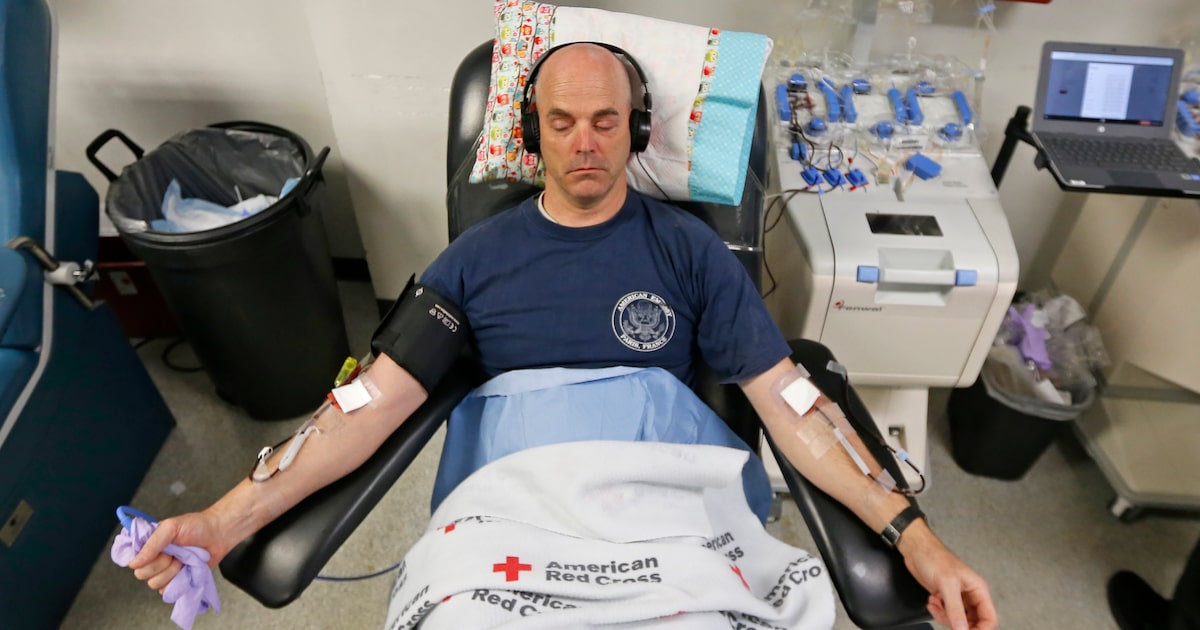
Each holiday season, blood supplies tend to drop. A combination of factors — fewer school blood drives, holiday commitments, increased travel, circulation of more illnesses — all contribute to a dip in donations.
This poses a problem for blood banks, which are responsible for maintaining an array of blood products to support the treatment of medical and trauma patients.
Here’s everything you need to know about donating blood, and how to do it in North Texas:
Why is it important to donate blood?
Breaking News
Blood products are used for a wide range of medical treatments. Blood components such as platelets are often needed in the treatment of cancer patients. Plasma can be used to treat autoimmune conditions or bleeding disorders. Red blood cells can be administered in the management of severe anemia and sickle cell disease.
Any of those components, as well as whole blood, are frequently transfused into patients with massive blood loss from traumatic injury (think car crashes and shootings) or medical conditions (such as postpartum hemorrhage or gastrointestinal bleeds) who need a significant portion of their blood volume replaced.
Where can people donate blood in North Texas?
Two major blood banks — Carter BloodCare and the American Red Cross — supply blood to health care providers and institutions across North Texas.
Carter BloodCare has 26 fixed donation sites across the region.
The North Texas Region of the Red Cross operates two fixed donation sites in the area: the Irving Blood and Platelet Donation Center, at 2511 W. Lyndon B. Johnson Freeway, and the Plano Blood and Platelet Donation Center, located at 741 N. US-Central Expressway, Suite 1000.
How do blood types work?
A person’s blood type depends on the combination of antigens and antibodies present in their blood. The four major blood groups — A, B, AB and O — are categorized based on whether a pair of antigens, A and B, and their corresponding antibodies are present. Blood types are further determined by whether they are “positive” or “negative” for the Rh factor, a protein.
Type O negative blood is universal, meaning it can be given to recipients with any blood type. Because only 7% of people have this blood type, O positive blood, at 37% of the population, tends to be the most commonly transfused blood type. O positive blood can also be given universally if testing measures antibodies at a low enough level. For plasma specifically, type AB is universal.
Other rarer blood types are determined by more than 300 other antigens, some of which are linked to certain racial or ethnic groups.
To maintain a robust blood supply, donations are needed from people with all blood types.
Who is eligible to donate blood?
Eligible whole blood donors must generally be in good health and not be sick on the day of donation. They also must be at least 16 years old and weigh at least 110 pounds.
Different requirements apply for those donating specific blood components.
For double red blood cell donations, women must be at least 19 years old, 5’3” or taller and weigh at least 150 pounds. Men must be at least 17 years of age, at least 5’1” and weigh a minimum of 130 pounds.
Those donating platelets and plasma must be 17 or older and weigh a minimum of 110 pounds.
How often can you donate different types of blood products?
Whole blood can be donated every 56 days, or up to six times annually.
Red blood cells can be given every 112 days, or up to 3 times per year.
Platelets can be donated weekly, or up to 24 times each year.
Plasma can be donated every 28 days, or up to 13 times annually.
What requirements prevent some people from donating?
To avoid donation-related anemia, donors undergo hemoglobin testing via a finger stick. If iron levels are not acceptable, the donation will be deferred until a later date.
Some health conditions preclude people from donating blood, including: actively treated cancer or a history of blood cancers, congestive heart failure and symptomatic heart valve disease, chronic obstructive pulmonary disease or emphysema with oxygen support, asthma that is symptomatic at the time of donation, blood clotting disorders, acute infections, a history of Ebola infection, diagnosis of and treatment for HIV or AIDS, active tuberculosis, symptomatic hepatitis, a history of hepatitis B or C infection and unexplained jaundice.
Other conditions require a waiting period: recipients of a blood transfusion, transplant or graft; heart attack or bypass surgery; completed treatment for certain cancers; treatment for syphilis or gonorrhea; Zika infection; Monkeypox exposure or infection; and treatment for malaria and residence in or travel to an area where it is present.
Some medications can prevent or delay blood donation. Patients on anticoagulants, also known as blood thinners, are not advised to donate, as they can experience excessive bleeding from needle pricks. Anyone on antibiotics should finish their course and be symptom free prior to giving blood. Carter BloodCare provides a full list of specific medication waiting periods on its website.
Certain vaccines — including live immunizations for measles and chicken pox — may also require a waiting period.
Women are not allowed to donate during pregnancy. New mothers must wait until they are at least six weeks postpartum to begin donating again. While breastfeeding mothers are generally permitted to give blood in the U.S., doing so can affect milk supply due to loss of fluids. The World Health Organization does not advise donating blood until at least three months after significantly weaning.
A comprehensive list of blood donation limitations, categorized by condition, is available through the Red Cross.
What requirements around blood donation have changed in recent years?
For many years, federal health officials prohibited donations by people who had lived in or visited parts of Europe, including the United Kingdom and France, during the 1980s, 1990s and early 2000s. The restriction was related to concerns over transmission of mad cow disease, a fatal brain infection that can lay dormant for years before the onset of symptoms. The Food and Drug Administration lessened restrictions before fully lifting the ban in 2022.
Similarly, gay and bisexual men had been banned from donating for decades, as part of an effort to reduce the risk of HIV transmission.
After exposure to HIV, there is a period of days to weeks during which an infection cannot yet be detected by testing. After the total ban was lifted in 2015, this group of donors still faced additional restrictions compared to the general population until 2023. That’s when the FDA announced it was updating its screening guidelines to collect the recent sexual history of all potential donors. This allowed gay and bisexual men to immediately donate blood if they did not have new or multiple sexual partners and had not recently taken medications to treat or prevent HIV infection.
In some cases, people with recent tattoos or piercings have to wait to give blood due to the potential risk of hepatitis infection. More recent guidelines allow immediate donation after a tattoo, so long as it was applied in states that regulate tattoo parlors, which includes Texas.
Donation can also happen immediately after ear or body piercings completed with single use, sterile tools.
Donations will be deferred for three months for those whose tattoos or piercings were self-applied or performed in states with unlicensed parlors: Georgia, Idaho, Maryland, Massachusetts, New Hampshire, New York, Pennsylvania, Utah, Wyoming and Washington, D.C.
How should donors prepare before giving blood?
People who are expecting to donate blood can prepare by eating a diet rich in iron, including foods such as eggs, spinach and other leafy greens, beans, lentils, red meat, fish and fortified cereals.
They should also plan to get adequate sleep and additional hydration, including on the day of the appointment. Dehydration can make it more difficult for phlebotomists to find and access veins.
Immediately prior to the donation, avoid meals that are high in fat.
What does recovery from donating blood look like?
After a blood donation, eating snacks with iron and a higher water content can help replenish what is lost from the body. Alcohol should be avoided. Multivitamins are recommended for frequent donors.
Strenuous exercise and heavy lifting should be avoided for the remainder of the day. Athletic performance, particularly with high-intensity activities such as running, may be impacted for several weeks due to decreased blood volume and aerobic capacity. During the first week after a donation, it’s common for donors to experience elevated heart rate and decreased endurance during workouts. Discontinue any activity that causes dizziness or lightheadedness.