
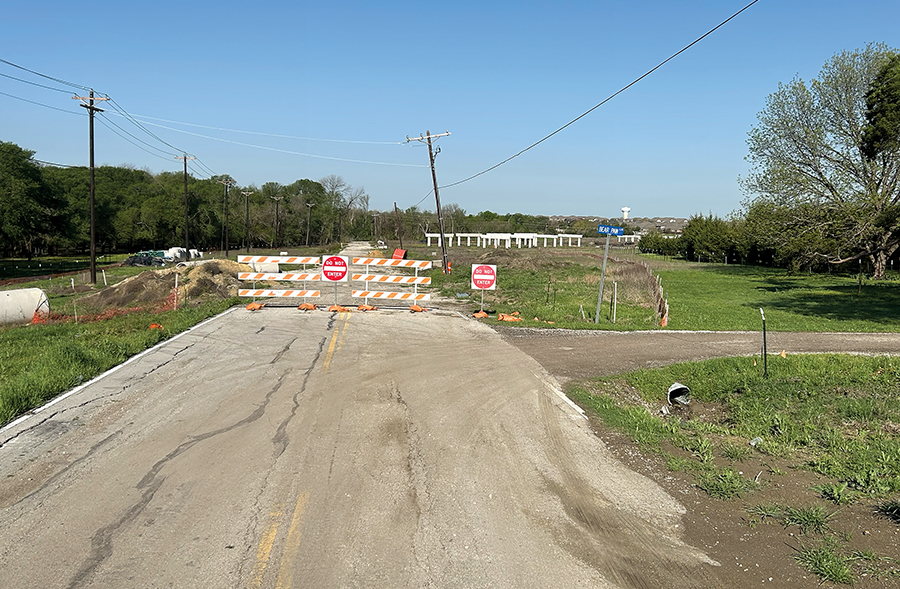
Portions of the $23 million in funding approved in 2025 by city council included repairs to McMillen Road.
Murphy closed out 2025 with steady leadership at City Hall, major investments approved for infrastructure and public safety, and long-planned projects — including a permanent home for the city’s Veterans Tribute — moving closer to reality.
Voters returned four members of the Murphy City Council to office in the May 3 general election, signaling continuity as the city addressed growth pressures, rising costs and long-term planning needs. At the same time, city leaders advanced projects aimed at improving traffic flow, updating aging infrastructure and expanding public engagement.
Those priorities were reflected in the city’s FY26 budget, which increased 10% to nearly $63.1 million and was supported by an ad valorem tax rate of $0.3575 per $100 of assessed valuation — a 1% decrease from the prior year. The average market value of a single-family home in Murphy was $611,297.
The maintenance and operations portion of the tax rate was $0.266, while the interest and sinking rate remained flat at $0.091. City staff said personnel costs rose 5% as Murphy planned to add a fire inspector, an administrative sergeant and a part-time animal control care technician.
Utility costs also rose during the year. Water rates increased by 7.3%, while sewer rates went up 7.6%. Natural gas customers served by Atmos Energy saw a base rate increase of 68 cents to $23.68 per month — about a 3% increase — along with a commodity charge hike of nearly 16 cents per CCF, or 100 cubic feet.
City Council also approved issuing up to $23 million in tax and revenue certificates of obligation to fund a slate of public works projects and to purchase new communications software for the police department. Portions of the funding were earmarked for repairs to McMillen Road, replacement of water service lines and other infrastructure upgrades aimed at keeping pace with the city’s growth.
Long-term planning was another focus in 2025, as council members approved a $125,000 contract with LJA Engineering of Houston to overhaul Murphy’s Comprehensive Plan. The document was first adopted in 1973 and last revised in 2008. Reagan Rothenberger, director of community and economic development, said best practices call for a review every three to five years.
Leadership continuity was reinforced in the May 3 general election, when four councilmembers won re-election. Place 1 Councilmember Elizabeth Abraham received 68.61% of the vote against challenger Nadeem Khan, while Place 4 Councilmember Ken Oltmann earned 76.41% against Chris Stout. Mayor pro tem Jené Butler secured 78.61% of the vote in her Place 6 race against Qasim Rasul, and Place 2 Councilmember W. Scott Smith was unopposed.
The city also saw a leadership transition in its fire department. Fire Chief Perry Elliott was sworn in as successor to Chief Del Albright, who retired at the end of 2024. Elliott began his career as a firefighter-paramedic with the Sherman Fire Department and later served as fire marshal and assistant chief. His career also included service with the Kerrville and Melissa fire departments. Elliott joined the Murphy Fire Department in 2011 and most recently served as fire marshal, a role now held by John Grant.
Several traffic-related changes were implemented during the year, including a restriction aimed at improving safety along North Murphy Road. Effective in June, southbound motorists were prohibited from turning left into the PSA parking lot, and vehicles exiting the lot were no longer allowed to turn left to head south. Police Chief Jeff Gibson said the “No Left Turn” signage was installed to improve traffic flow and reduce collisions.
Community engagement remained a priority as well. Fourteen residents completed Murphy University, the city’s Citizens’ Academy, which ran from June through August. The program is designed to foster trust, transparency and involvement by giving participants a behind-the-scenes look at city operations and services.
One of the city’s most anticipated milestones came after years of planning and fundraising, when the Murphy Veterans Tribute was approved for a new permanent location. The tribute will now be situated on a boulevard island within the City Hall Complex, replacing its previous planned site near the Central Park amphitheater. The centerpiece of the tribute will be a bronze, life-sized World War II GI statue, scheduled to be installed in the spring.
Not all issues were resolved as the year came to a close. Legal battles continued over a proposed high-density development on 102 acres between Parker and Murphy, with multiple cases moving through the courts. An internet influencer’s proposal to create a suburban-style community for urban residents failed to gain traction, while residents remained opposed to the creation of a municipal utility district and the construction of a wastewater treatment plant permitted to discharge up to 200,000 gallons of treated effluent into Maxwell Creek daily. The Restore the Grasslands project was tied to family trusts associated with Dallas developers Phillip and Don Huffines.
As Murphy looks ahead to 2026, city leaders and residents face a familiar balancing act: maintaining the character of a growing community while managing rising costs, infrastructure demands and development pressures. With major projects advancing, leadership largely unchanged and key debates still unfolding, the year ended much as it began — focused on planning for what comes next.
For more stories about the Murphy community see the next print or digital edition of the Murphy Monitor. Subscribe today and support local journalism.