

If you grew up in church, you may have been taught to hate the world. Or at least mistrust it. Many a sermon, and the Bible itself, uses “the world” as shorthand for sin and temptation. The world stands opposed to the other moral realm: the church. The world will corrupt you; the church will sustain you. The world is dangerous; the church is safe. Worldly people are bad; church people are good.
That’s too simplistic, of course. Upstanding atheists and abusive pastors prove it every day. Nonetheless, the trope persists.
If you didn’t grow up in Sunday school, you may have another stereotype of church: full of haters and hypocrites, the creepy and credulous, radicalized and retrograde. That seems to be the prevailing view in much of the country, especially Hollywood. Rare is the film that doesn’t caricature people of faith.
So at the movies, the faithful usually have to choose between sappy, preachy morality plays and high-budget mainstream films that badly mishandle religion. You can have Touched By an Angel or The Village. You pays your money; you makes your choice.
But that may be changing.
Over Christmas, my family watched the newest Knives Out movie, Wake Up Dead Man, which achieves something I haven’t seen on screen since Brendan Gleeson forgave a murderous Chris O’Dowd in the 2014 film Calvary.
Opinion
“God is great. The limits of his mercy have not been set,” Gleeson’s character Father James Lavelle said then. That line is not in the Bible but sounds as if it could be. Or at least, as if it were written by someone conversant in biblical themes.
That’s the feeling I got watching Wake Up Dead Man. Plainly, it was written by someone who speaks church — who understands the mysteries (or what detractors might call inconsistencies) of a life of faith, and who takes them seriously.
Writer and director Rian Johnson doesn’t consider himself a Christian. He chooses the popular and amorphous label “nonreligious.” But he grew up in church, he told Religion News Service. “I was very deeply, personally Christian. … My relationship with Christ was the lens I frame the world through, through my childhood, my teenage years, into my early 20s.”
That comes through in his film. I’m not the only one who noticed.
“Johnson’s writing feels genuinely wise and well-informed — well beyond typical Hollywood clichés” wrote New York Times film critic Alissa Wilkinson.
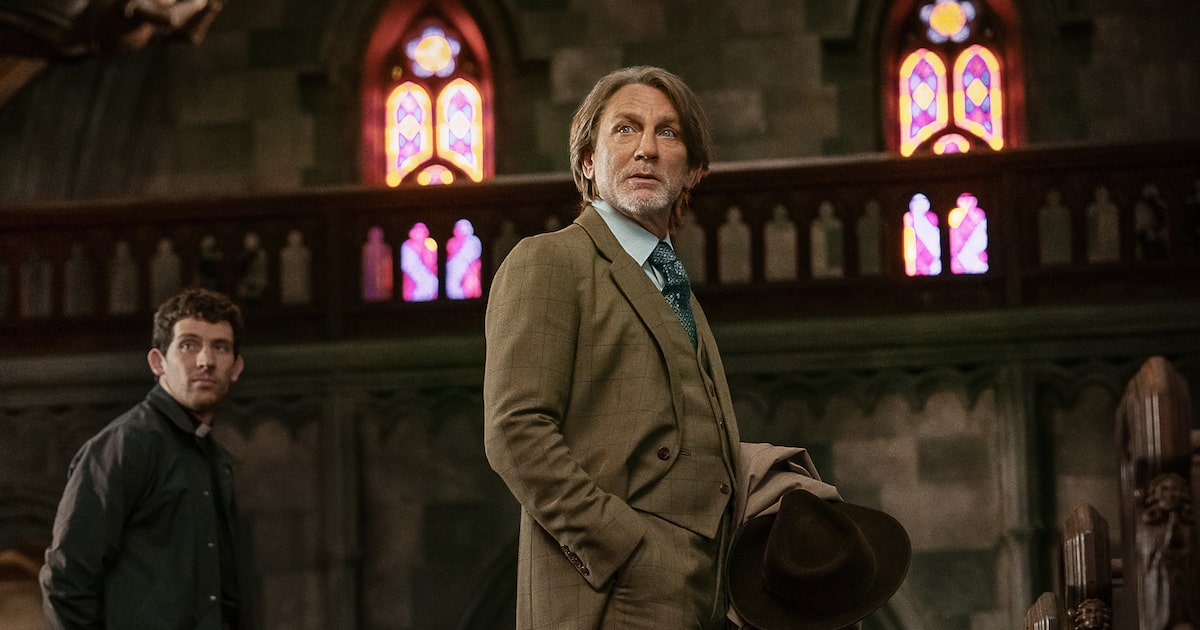
Start with the metaphors, which are blatant. Wake Up Dead Man is a murder mystery, set in a Catholic parish in upstate New York, and the murdered priest at the center of the plot is literally stabbed in the back by a betrayer. His church, which has strayed from the central teachings of Jesus, conspicuously lacks a crucifix. And in a few scenes, the lighting changes noticeably: cold and dark when the atheist detective Benoit Blanc preaches his cynicism; warm and sunlit when the young protagonist, Father Jud Duplenticy, speaks.
Even more on the nose, in one scene, a groundskeeper is literally whitewashing a tomb, a bald reference to Jesus’ words in Matthew 23:
“Woe to you, teachers of the law and Pharisees, you hypocrites! You are like whitewashed tombs, which look beautiful on the outside but on the inside are full of the bones of the dead and everything unclean. In the same way, on the outside you appear to people as righteous but on the inside you are full of hypocrisy and wickedness.”
Filmmakers often call such hints Easter eggs, which seems appropriate here, in a story that involves resurrection. To me, they came across as reassurances — tiny promises that the filmmaker wasn’t going to twist belief into a villain or a punch line. That’s a rare grace in Hollywood.
Sadly, it’s rare in the church too. As much as believers like to complain about being misunderstood, our sermons about “the world” give as much as they get. For every movie with a killjoy preacher (Footloose) or cruel Bible thumping prison warden (Shawshank Redemption), there’s been a preacher somewhere thundering on about loose morals in showbiz.
Not for nothing. Those pulpit pounding preachers aren’t wrong about moral decline. It would be hard to argue that America is more righteous now than in her past. Yes, the abolition, civil rights and women’s suffrage movements achieved Christian ends, mostly led by Christian clergy. But popular culture and daily life have gotten more coarse, more cynical. Immorality is commonly celebrated, addiction is excused, covenants are brushed aside, truth is watered down and outrage is the algorithmic order of the day. As Monsignor Jefferson Wicks, the antagonist of Wake Up Dead Man, rages: “Anger lets us fight back, take back the ground we’ve lost. And we’ve lost so much ground.” With Father Jud writhing on the ground, Wicks kicks him in the gut and shouts, “I’m the world! You’re the church!”
Wicks’ anger isn’t righteous, but it’s also not villainous. Johnson understands the motivation that has led so many Christians in our day, particularly evangelicals, to excuse immorality in the name of winning holy wars, just as Johnson’s characters do.
“It seems like you’re intentionally keeping them angry and afraid,” Jud says with prophetic clarity. “Is that how Christ led his flock? Is that what we’re supposed to do?”
Wake Up Dead Man is mediating that polarization. Others are too. In recent years, films such as Heretic, First Reformed, Conclave, and the aforementioned Calvary, along with TV shows like Rev and Fleabag, have offered nuanced depictions of religious folk, often conveying the message of the Bible more accurately than explicitly Christian bromides like God’s Not Dead or I Can Only Imagine.
These examples are also different from stories with biblical settings like The Chosen or House of David which have limited appeal outside the church.
As I’ve written before, Christianity has an uneven relationship with Hollywood — one in which both sides seem to be constantly trying to take advantage of the other. Studios have been happy to make bad art for Christians willing to spend big on it. Christians have been eager to enlist the machinery of La La Land in the Lord’s army.
What Johnson has done, conversely, is what Father Jud attempts to do: not to stoke culture war, but to offer a shepherding voice to all of us who need it, which, spoiler alert, is all of us. As Jud says in one of the very first scenes, he wants the church to be “this” (spreading his arms in a gesture of embrace) not “this” (putting up his dukes.)
Jud’s message is grace. And with an irony worthy of Jesus’ parables, the characters who need grace are inside the church; the character who offers it at the critical moment, Benoit Blanc, is the atheist.
That twist highlights another truth that few in the church or in the world grasp: Faith is a centered set, not a bounded set. The divisions that create religious in-groups and out-groups are largely man-made and unhelpful. A better conception is that we’re all defined by how close we are to the moral center of the universe: Jesus Christ. And all of us are either moving toward or away from that center. In and out doesn’t matter; trajectory does.
As the rocker Bono has preached for years, “There is no them. There’s only us.”
Here’s hoping more screenwriters, religious leaders, politicians and journalists — more influencers in the church and in the world — wake up to that idea.