
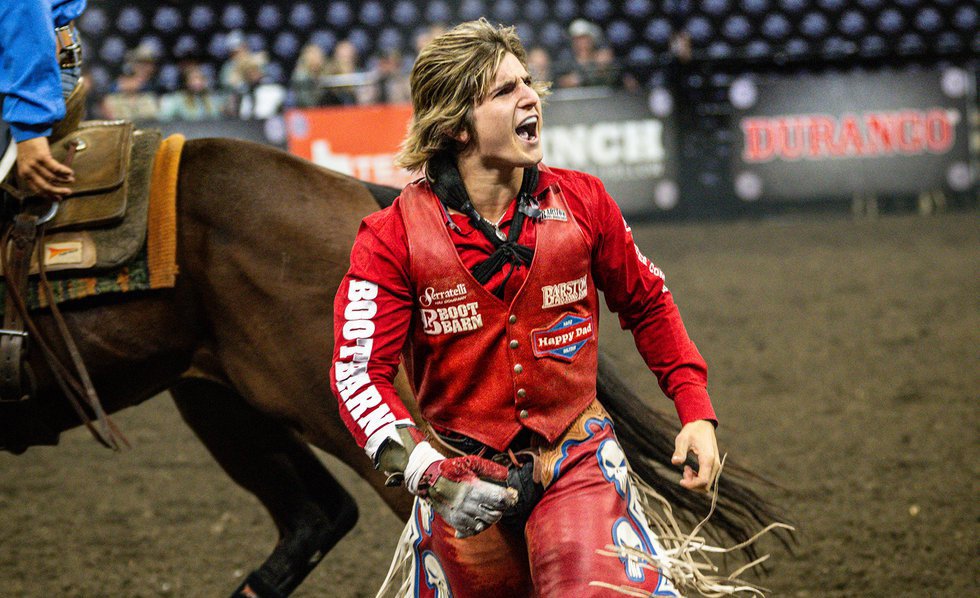
Things aren’t going according to plan. And, without even a verbal hint that someone’s hitting the skids, you can tell.
The blond-haired bronc rider, sporting shorts, socked feet, and a white tee, sits in a nondescript hotel-room armchair. With the curtains drawn and a single nightstand lamp providing the only light, the energy in the hotel room is pensive and solemn — a far cry from the activity occurring 15 stories down on the Las Vegas Strip, where a sea of cowboy hat-wearing folk are killing time by drinking booze and placing bets before the ninth round of the National Finals Rodeo.
Despite the room’s general atmosphere, the bronc rider, Rocker Steiner, is chatting away with his youthful rasp, cutting jokes and critiquing his last few rides — the horses, the judges, even himself.
“I’m sure they’ll (PRCA) fine me,” Rocker says, wryly, about his private criticisms.
“How many times have you been fined?” I ask.
“Just three or four,” he responds.
The 22-year-old is clearly at ease with his present company, which includes his father, Sid Steiner; fellow rodeo competitor Stetson Wright; a man with a portable massage bed who I’m told is “kind of a chiropractor”; me and my PR chaperone, Terran; and a couple of men wielding cameras — which are recording.
Wright, who on this day is in the lead for both the PRCA all-around and bull riding championships, is lying on the massage bed and getting “worked on” by, what we’ll call, the physical rejuvenation specialist. Between Rocker’s sentences, one can hear the grunts, cracks, and pops coming from Wright’s mouth, back, and legs, respectively, as the specialist pushes, prods, and pokes the rodeo star’s ailing muscles — taking the thorn out of his side, so to speak. Having gone eight straight days straddling tempestuous bulls and broncs, such therapy sessions, which look and sound almost as brutal as a bull ride to these eyes and ears, are a must. Rocker, casually sitting in the armchair with his left elbow resting on his bent knee, has already had his turn with the specialist and is loose and limber for tonight’s ride — the penultimate ride of the NFR. And, for Rocker, eight seconds of do or die.
He wasn’t expecting to be in this position — riding simply to keep his championship hopes alive. Rocker, who had held the No. 1 spot in bareback riding for much of the year and was on pace to smash the record for annual earnings, entered the NFR with a comfortable and sizable lead.
But, yesterday, the margin for error had disappeared, and for the first time in months, Rocker was no longer sitting atop the leaderboard.
Sin City
Of all the commercial airline trips in the world, which amount to over 100,000 daily flights, perhaps none are as exciting, boisterous, and flat-out fun as those that land in Las Vegas. There’s a specific energy about a person who’s an hour away from touching down in Sin City — at 30,000 feet above sea level, the devil on one’s shoulder pipes in, “Fun will be had, and dagnabbit, I’m the one who’s gonna have it.”
And on this particular flight from DFW, in addition to devil-clad shoulders, there’s a cabin full of cowboy hats, plaid collars, and calfskin boots with ornate stitchings. I wouldn’t be shocked if extra cups were requested to serve as dip spittoons. Yes, it appeared the majority of my fellow passengers were headed to the same place as me: the NFR, the crème de la crème of rodeo events.
Calling the Thomas & Mack Center home since 1985, the NFR is a 10-day competition that crowns the world champs of ProRodeo’s seven disciplines based on year-end earnings. The top 15 earners in each discipline get the invite and, unlike other rodeos, elimination rounds at NFR are nonexistent. All 15 cowboys ride all 10 days as the competition becomes a battle of attrition. It’s the Super Bowl, All-Star Game, and Tour de France all rolled into one, while also serving as a de facto conference for cowboys, cowgirls, and those pretending to be one or the other. According to the Las Vegas Convention and Visitors Authority, the event draws more than 340,000 people to the city each year, roughly half of whom attend at least one night of competition. The others? Well, there’s plenty at NFR to keep line dancers, compulsive shoppers, and country music listeners busy beyond the rodeo.
No doubt also headed to the NFR, on this its eighth day, were two young women sporting black cowboy hats — I would suspect in their early 20s — sitting in the row directly behind me on my flight. With my earbuds out after landing, I couldn’t help but overhear their conversation, especially upon hearing the name “Rocker Steiner,” the very man I was traveling to Las Vegas to see.
While my shoddy ears kept me from hearing the context of their back-and-forth, I did pick up the name “Rocker” repeated several times interspersed with giggles. Curious, I asked before I exited the plane if they were talking about Rocker Steiner, which they confirmed with the slightest bit of embarrassment, like revealing a tween crush.
This isn’t new or rare for Rocker; on rodeo culture’s barometer of attractiveness, he registers as a heartthrob. Go to an event where he’s competing, and you’re likely to hear the biggest — and perhaps even highest-pitched — cheers as an arena’s announcer calls his name. And in this world of bull riding selling out Madison Square Garden, rodeo entering the mainstream, and the Cowboy Channel’s growing national reach — on which Steiner has a reality show, “Hell on Wheels” — he’s a bona fide superstar.
“Somebody’s got to be the superstar,” Rocker says. “I guess it might as well be me.”
“So, what would be your superstar qualities?” I ask.
“Oh, man, I think I’m just going to let that speak for itself,” he says. “I guess I just do things a little bit different than everybody else. I’m not too afraid to voice my opinion, and I kind of just do whatever I want. That’s not meaning I’m going to go rob a bank, but I don’t accept people trying to tell me who or what to be.”
Such an independent, unfiltered, to-hell-with-it-and-the-haters attitude has also come with its fair share of criticism and controversy — the worst of which being an incident where he repeatedly yelled “What the f*** do you want from me?” during the 2022 NFR after he received a disappointing score from the judges. “Seemed like a good question to ask,” Rocker says, half-jokingly.
Ultimately, this has led to fines, fiery Facebook comments, and strange rumors concerning suspensions and arrests that never happened. But it also marshaled in his image as a maverick willing to buck the traditionalists. He became the Bad Boy of Rodeo, a moniker he now wears with pride.
“The best way to describe Rocker is loud,” Fort Worth writer, director, and producer Taylor Sheridan said during a talking-head segment on the first episode of “Hell on Wheels.” “And I don’t necessarily mean with his voice; it’s with his emotions … he’s incredibly exciting to watch, and the crowd goes crazy. They will not cheer louder at a rodeo than they do when Rocker Steiner gets on.”
While traditionalists may scoff, others love Rocker’s emotive and unfiltered nature. In a sport where men are hurled off raging animals 10 times their size, perhaps something more than a clutched fist in the air or a wave to the crowd should be considered appropriate. And, I can attest, any time Rocker completes a ride and exhausts the remainder of his adrenaline rush by remaining on the dirt and hyping up the crowd — a coda to his ride — it infuses energy into the building and into the competition. One could call it bad-boy behavior, and one could also call it showmanship.
And it also makes for great TV.
In early October, “Hell on Wheels,” a raw, no-holds-barred reality show that follows Rocker’s life on the rodeo circuit premiered on The Cowboy Channel. And viewer beware: The show, which wrapped up its first season in early December, contains more than its fair share of bruises, bravado, and four-letter words — rated G it is not.
Rocker, apparently as much a marketing whiz as he is a bronc buster, hatched the idea for the show a couple years ago with his father, Sid.
“I wanted a Prevost bus to go on the road and take my friends and some cameras and document [my life on the rodeo circuit],” Rocker says, explaining what would eventually become the show’s premise to a tee. And he understood that such a platform, putting his personality wouldn’t just bolster him, but the sport, as well.
“You ever watch college football?” he then asks me.
“Yeah, sure.”
“So, on ‘College GameDay’ (a Saturday-morning show hyping the upcoming games), they’ll do stories on guys who you’ve never even heard of,” Rocker continues. “These guys will have these crazy backstories, and you automatically become a fan and start pulling for their team just because they’re on it. And I’m like, ‘Man, rodeo doesn’t have that.’ There are so many different personalities and so many different people with great stories to tell, but nobody ever gets to see that. And it’s hard to be fans of somebody you don’t know. So I was like, ‘Man, I want to take a camera crew, and I want people to get to know me.”
If this is an abridged version of Rocker’s actual pitch to The Cowboy Channel, it’s easy to see why the ears of the channel’s head honchos perked up. “I told [the Cowboy Channel] how big I think I could get [rodeo] right now,” Rocker says. “I think this is the best era of cowboys and rodeo of all time. And I’m not shit talking to anybody, but I don’t think anybody can get this started like I can. I pretty much told ’em, ‘If you guys are going to do it with anybody, I think it needs to be me.'”
In retrospect, Rocker admits it was a blessing the show took two years to go from conception to being broadcast on over 40 million living-room screens.
“I probably wasn’t exactly the best person for people to get to know [at that time],” Rocker says. “And I’m not saying I was a bad guy, but I was probably not the smartest guy when I was 18.”
But it’s not just the TV show or the bad-boy image — or possessing thick blond locks and the square jaw of an A-list actor — that’s catapulted Rocker’s popularity; he’s also really, really damn good at riding bucking broncos. And this measly compliment doesn’t come close to appropriately lauding his natural talent at hopping on the bareback of an angry, 1,200-pound equine. After all, if you want to be the most popular, you also have to be the best.
“He’s a prodigy,” Rocker’s mom, Jamie Steiner, says. “What he’s been able to accomplish this year, at his age — it’s unheard of.”
And this isn’t a mom doting on her son. She’s absolutely right; it’s unheard of.
This year, Rocker broke the record for regular-season earnings in PRCA bareback riding, accumulating over $300,000 and, going into NFR, is on track to break the end-of-year earnings record for bareback. And over his career, which began in 2022 at the age of 18 — when he also qualified for his first NFR and won the Resistol Rookie of the Year Award in bareback riding — he’s earned over $1.1 million in PRCA competitions alone. At the age of 22, Rocker has already amassed enough records, wins, and accolades to be considered a future ProRodeo Hall of Famer.
Not shy about his ambitions or reminding one of his abilities, Rocker sees himself becoming a transformational figure in the world of rodeo. The sport’s Michael Jordan, Babe Ruth, or Muhammad Ali. Its GOAT.
“I’m a huge fan of all major athletes, everybody that’s taken their sport to the next level,” Rockers says. “I mean, I don’t even watch soccer, but I f****ng love David Beckham. He took soccer to the next level. Connor McGregor took the UFC to the next level. And I really think I’m the guy for rodeo.”
But needing the hardware to back up his confidence, there remains one massive, all-important title that has thus far eluded him: a PRCA World Championship.
By the time my American Airlines flight landed in Las Vegas on Thursday evening, Rocker had completed night eight of the NFR. And the results were not good.
For the first time in months, Rocker was no longer leading the field of bareback bronc riders. Jess Pope, the 2022 PRCA World Champion, placed first in Rounds 7 and 8 and, now controlling his own destiny, was in the driver’s seat to play spoiler and turn Rocker’s Hollywood ending into a tragedy. Rocker would need to bounce back in Round 9 to give himself a shot.
The Steiners
If genetics play any part in determining rodeo success, Rocker Steiner’s prodigious career was written in the family tree. Beginning five generations ago, Steiner is the descendant of rodeo producers Buck and Tommy Steiner of Steiner Rodeo Company. Tommy’s son and Rocker’s grandfather, Bobby Steiner, became a world champion bull rider and 2020 National Rodeo Hall of Fame inductee who also competed in bareback and qualified for the NFR three years. Then Bobby’s son and Rocker’s father, Sid Steiner, competed as a steer wrestler and took home the PRCA World Championship in 2002.
But not to be outdone by previous generations, Rocker also got a double dose of rodeo DNA courtesy of his mother, Jamie, who was an accomplished barrel racer and had also qualified for NFR a couple decades ago. Rocker’s sister, Steely, has followed in her mom’s footsteps and is also a barrel racer.
Whatever innate personality traits rough stock competitors must have to be successful — resilience, aggressiveness, perhaps even a little impatience — Rocker had from the get-go.
“He was just a little pistol from the beginning,” Jamie says. “I mean, once he finally got moving, it was a run.”
As his father, Sid, tells it, Rocker was partially named after his own nickname (Sid Rock) and partially named after the iconic and controversial Atlanta Braves closing pitcher, John Rocker. “I just remember [John Rocker] had a lot of passion,” Sid says. “He’d sprint out to the mound, and I remember seeing ‘Rocker’ on the back of his jersey and thinking, ‘Man, what a badass name.’”
Despite his lineage, Rocker grew up in a city that many a rodeo-attending Texan would consider the antithesis of cowboy culture: Austin.
And in Austin, he did what Austinites do: grow dreads and take up wakeboarding — only most don’t dive into aquatic sports at the age of 3.
“He was my little wakeboarder,” Sid says. “He and I were just river rats. He had his flat-rim hat and dreadlocks, and, man, he was just my little buddy.”
But his wakeboarding abilities were advancing at a Tiger Woods-like rate, and he’d participate in his first competition and complete his first flip by the time he was 8. In the competitive world of wakeboarding, it wasn’t a stretch to claim Rocker a prodigy.
“It’s the way it’s always been,” Jamie says. “Anything that he ever did, he was just always able to do and do well. We put him on the swim team and his first meet, when everybody else jumped in feet first, he did a perfect dive. I mean, hands touching straight ahead. A perfect little dive right in.”
Exceedingly talented yet so distinct from other children, Rocker was never destined for a normal childhood with classrooms, recesses, and homework. It’s not that school just wasn’t his cup of tee. Tee’s harmless. For Rocker, society’s rigid education system was a proverbial cup of poison. “He was going to be miserable [in school],” Jamie says. “We were going to have to torture him to make him do anything school related, and that just didn’t seem right.”
So, a decision was made when Rocker was in the fourth grade to begin homeschooling him. “But that didn’t work very good, either,” Sid admits. “About the fifth grade, I just took him with me everywhere. And the funny thing is, you’d never know it. No one would walk away from a conversation with Rocker and think he was a stupid kid that didn’t go to school.
“But I used to tell him all the time, this is kind of an experiment. I might be screwing your life up, so don’t let me down.”
Proof that Sid and Jamie weren’t clamoring to rebel against societal norms and tell the Department of Education to shove it, Rocker’s older sister, Steely, graduated high school as her class’ salutatorian. According to Jamie, “school is set for her. It’s perfect for Steely; she’s going to excel in that situation.”
Despite his early successes in wakeboarding, at 13, Rocker’s grandfather, Bobby, would show him a video of kids riding bareback horses, and, if you’ll pardon the cliché, it was love at first sight. From that day forward, like everything Rocker had pursued up to that point in his life, he would pour himself into bareback riding.
“Rodeo was never something I wanted to be a part of,” Rocker says. “I never wore a cowboy hat. I had a pony that I would ride maybe twice a year with my mom. I was just the kid that was a wakeboarder. I grew up on the lake, and I was just that guy. [Committing to bareback riding] really just snuck up on me one day, and here we are.”
The Steiners would move to Weatherford in 2020 when Rocker was 16 and the entire family has remained in this hub of rodeo and Western sports ever since.
They’re a close-knit group, the Steiners. One could argue Rocker’s nontraditional upbringing of foregoing schooling for a different kind of education has made him even closer to his family. And with this bond can come feelings of vicarious pain when a family member is hurting, stressed, or in trouble. This empathy is what has made the last few days in Las Vegas particularly difficult for the Steiners. When one of them is happy and joyous, or distressed and downtrodden, they all feel similarly. So, it’s been one heck of an up-and-down NFR for every member of the family.
A quick recap of how we got here: After failing to land a payoff in Round 1 eight days earlier, finishing 12 out of 15, Rocker rebounded by winning Round 2, earning $36,000 and adding a little cushion to his lead. He’d follow this up with two solid performances in Rounds 3 and 4, taking home third and fourth place, respectively, and adding nearly $40,000 to his total earnings. And another victory in Round 5 would serve as a giant step toward claiming his first Gold Buckle.
This is where things, or more specifically, the horses, would go sideways.
Over the next three rounds, no matter if it was deserved or not, Rocker failed to tally a ride that would give him a payoff, leaving the door open for others.
In this sport, there are no goals or baskets or touchdowns. Victory, in many ways, is a subjective outcome determined by two things that are — at least in part — outside of a rider’s control: judges and horse draws. The random draws decide which bronco gets assigned to which rider. And getting a bad bronco, one who doesn’t put on the right kind of show, can be devastating to a score, which is decided by two judges. Whatever these appraisers perceive in the chaos-filled eight seconds of a ride is, ultimately, the final word, which doesn’t always concur with the audience, color commentators, or the parents, siblings, and significant others of a rider. In these instances, one has a knee-jerk reaction to assume the best of anything a loved one does — a natural rose-colored tint to everything, including bareback bronc rides. So, the Steiners, understandably, are hurt and asking questions.
I met Rocker’s mother for an interview early Friday morning, the morning after three straight days of disappointment at the NFR, for a cup of coffee. She warned me right from the get-go, fighting back tears, that this conversation was going to be difficult for her.
“[The family] is always there when it’s hard and disappointing and dream crushing,” Jamie says. “There’s also the part of being positive when things are bad and you try real, real hard to do that. So, tonight we have to pray that he and his horse have the best trip, and the judges see it [positively].”
The Payoff
Rocker, still in his hotel room and not yet sporting his iconic red uniform for bronc riding — clad with logos from “The Punisher” on his chaps — slaps on a pair of black jeans, a black cowboy hat, and rings for five of his 10 fingers and makes his way to the elevator with his dad and Stetson Wright. Round 9 begins in just over two hours, and bareback always kicks off the rodeo — the perpetual premiere for rough stock.
At Thomas & Mack Center, the mecca of the NFR, there isn’t an empty seat to be found. And the energy, if we were to compare it to our own Stock Show & Rodeo at Dickies Arena, is in a class of its own. The people in this arena aren’t bandwagon fans of rodeo or johnny-come-latelies. No, they’re watching every rider of every event intently and cheering their asses off. And such attention and audience engagement brings an extra level of intensity to the atmosphere.
Rocker is riding last and will know precisely what he must do to either sink, stay afloat, or take command of the World Title. Riding a bronc named Café Risque, the crowd cheers loudly at the sound of the announcer calling Rocker’s name. The young, red-clad rider, leaning back — almost reclining — with spurs near Café Risque’s shoulders, gives an affirming nod, the chute opens, and Rocker and Café Risque are released onto the dirt of the performance area.
Unlike bull riders, bareback competitors don’t sport helmets and stick to the traditional cowboy hat as their headwear of choice, which, inevitably goes flying through the air as if collecting style points for accessory hangtime. Arguably the most physically difficult and demanding of all rough stock sports, the bronc’s violent bucking swings Rocker’s head to a point where it nearly clashes with the top of the horse’s hindquarters, something that happens so quickly and repeatedly that you could set its rhythm as a metronome on machine-gun mode. And Rocker, as if a glutton for punishment, continues to spur the bronco in its shoulders, causing him to buck even harder. It’s frantic and disorderly, but there’s also a rhythm to the madness.
Is Rocker doing well? Is his ride on Café Risque going better than the 14 that preceded it? If one were judging solely on the decibels emitting from the audience at Thomas & Mack, Rocker would no doubt be at the top of the heap. The eight-second timer buzzes, and Rocker soon after falls to the ground before the pickup man — those on tamed and saddled horses who assist riders off the bucking bronco — could arrive. As Rocker falls, the arena lets out a collective gasp cut short by the bronc rider quickly rising to his feet. With his red chaps dirtied and his blonde hair mussed, Rocker emphatically puts his hands up in the air, both as a sign of relief and exhilaration. He knows, with that ride, that he’s done it; he’s wrestled back control of the World Title. And the crowd, as if the Dallas Cowboys kicked through a last-second field goal, lets out a thunderous cacophony of hoots, hollers, and claps. No other competitor for the remainder of the night would receive such an ovation.
For the next 24 hours, commentators and Cowboy Channel talking heads would describe Rocker’s Round 9 ride as “gutsy,” “pressure-packed,” and “composed.” He’d score an 85.75 and end up tied for second on the round. But, most importantly, his closest rivals would finish outside the payoff positions, giving Rocker the lead.
The following day, Round 10, Rocker controlled his own destiny. Riding last again, he’d pull a horse called Disco Party, one with which Rocker had shared a positive history. And, with the title on the line, he’d outdo himself and score a 90.5 and again come in second for the round, securing the PRCA World Title and the gold buckle — the last vacancy on his stellar resume. Though one might still criticize Rocker’s unabashed confidence as hubris or vanity, Rocker now has the hardware to back it up. At this moment, he is the greatest.
Following his victory, Rocker said winning the title was “everything I’ve ever wanted, dreamt about, worked for, bled for, cried for. This is everything. But this wasn’t necessarily about the gold buckle (World Title), [I did] this for my family. I want my family to know their son is the best at something.”