

Third-grade students at Sgt. Roberto Ituarte Elementary School used colored pointers to guide their classmates through math problems, taking the role of teacher with a small group of their peers.
Their teacher, Carolina Gutierrez, said this helps students gain confidence in topics they struggle with.
“They love it,” Gutierrez said.
At Cactus Trails Elementary School, students in Nicky Cordero’s fifth-grade class broke out into groups and eagerly discussed how to use figurative language.
Both teachers are being recognized by the Education for All initiative by the Council on Regional Economic Expansion and Educational Development. The initiative honors educators at the county’s top five elementary schools, scored by combining the percentages of all students and economically disadvantaged students meeting or exceeding expectations on STAAR reading and math exams.
For its inaugural year, the initiative will recognize employees at six schools due to a tie for fifth place.
The schools recognized Tuesday under the initiative include Glenn Cove, Vista Hills, Sgt. Roberto Ituarte, Cactus Trails and Hawkins elementaries, as well as Harmony School of Excellence.
The CREEED initiative aims to prove that a student’s economic background does not predetermine their ability to succeed academically.
“We have a lot of economically disadvantaged or low-income students who go to our schools. And although that is true, that does not mean there’s a correlation between that and not performing at the high end of academics,” CREEED CEO Eddie Rodriguez said.
Across Texas, 60% of students are considered economically disadvantaged, meaning their families qualify for certain government assistance like free lunch, according to the Texas Education Agency. In El Paso County, 74% are considered economically disadvantaged.
 Fourth graders at Vista Hills Elementary School practice math skills on a computer game, Dec. 19, 2025. (Corrie Boudreaux/El Paso Matters)
All the schools being recognized, except for Hawkins Elementary, are among the 50% of schools in El Paso County with the least economically disadvantaged students.
Hawkins Elementary ranks 23rd of 147 schools with the most economically disadvantaged students in the county.
Most campuses are located in East El Paso, where the median household income ranges between $65,000 to $76,000 a year, according to U.S. Census data.
The Harmony School of Excellence in the Lower Valley and Hawkins Elementary in Central, are in ZIP codes with a median household income of about $42,000 and $25,500 a year, respectively.
Campus rankings
Glen Cove Elementary ranked in first place in the Education for All initiative, with 69% of its student population and 66% of its economically disadvantaged student population meeting or exceeding expectations in their reading and math STAAR exams, totaling to a score of 135.
Last school year, the campus had close to 540 students, 78% of whom are considered economically disadvantaged.
Sgt. Roberto Ituarte Elementary ranked in second place with 70% of students and 64% of economically disadvantaged students meeting expectations, coming to a total score of 134. The campus had about 660 students last year, 71% of whom are considered economically disadvantaged.
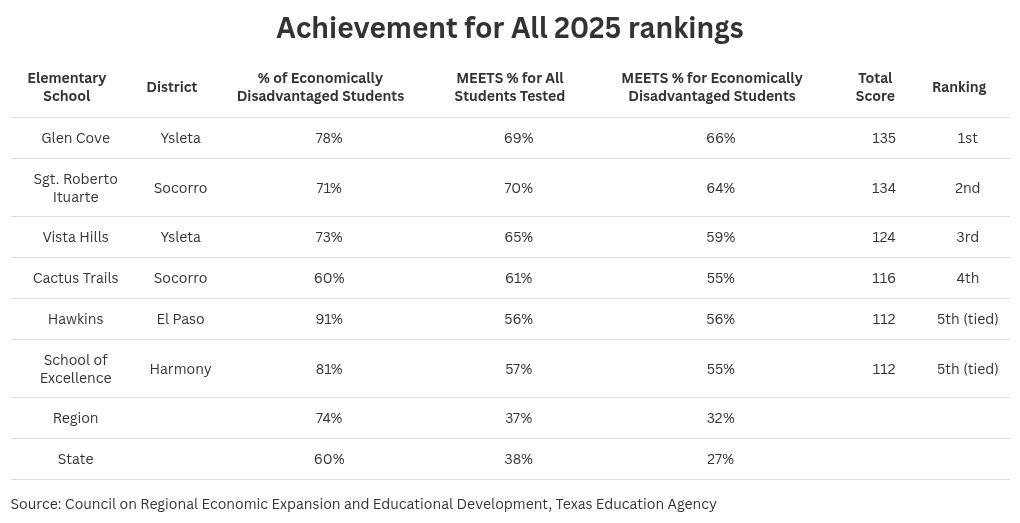
Vista Hills Elementary ranked third with 65% of its student population and 59% of its economically disadvantaged students meeting or exceeding expectations, with a score of 124. It had about 440 students last year, 73% of whom are economically disadvantaged.
Cactus Trail Elementary ranked fourth with 61% of its student population and 55% of its economically disadvantaged students meeting or exceeding expectations, totaling 116. The school had more than 1,000 students last year, 60% of whom are economically disadvantaged.
Hawkins Elementary and the Harmony School of Excellence tied for fifth place with a score of 112. At Hawkins Elementary, 56% of all students and economically disadvantaged students met or exceeded expectations. Ninety-one percent of its nearly 260 students are economically disadvantaged.
Fifty-seven percent of students at the Harmony School of Excellence and 55% of its economically disadvantaged students met or exceeded expectations. It had 680 students last year, 81% of whom were economically disadvantaged.
All the selected campuses got an A grade in 2025 in the state’s A-F Accountability rating system, which gives school districts and campuses a score based on STAAR test results and other metrics.
 Fifth-grade teacher Alina Baltazar reviews a science lesson with her students at Glen Cove Elementary School, which is set to receive an Education for All Initiative in recognition of its high achievement as a majority-economically disadvantaged campus, Dec. 18, 2025. (Corrie Boudreaux/El Paso Matters)
A well-seasoned teacher
Campus leaders credited their employees’ hard work, dedication and experience for their students’ high achievement.
“I do feel that our teachers are master teachers,” said Alicia Miranda, who became principal of Sgt. Roberto Ituarte Elementary in February. “They’re very competitive, and they know their craft. They also know what’s required from students.”
Vista Hills Elementary School Principal Karina Quinonez-Salgado said her teachers have become invested in the campus.
“People seek out Vista Hills not because of the building, or the history, or our programs. It’s because of them, their investment and their love for their kids,” Quinonez-Salgado said.
Leslie Thomas, principal of Cactus Trails Elementary, which opened in 2019, said she was able to hand-pick the best and most experienced staff in the Socorro Independent School District for the new school.
“I call them the unicorns, because they’re really an outstanding experienced faculty that we were able to select. In doing that, I think that we were able to really set the expectations of what we wanted the school to represent and what our goals were,” Thomas said.
Many of the schools selected have a large number of teachers who have been educators for over a decade, according to TEA data.
About 81% of teachers at Glenn Cove Elementary had 11 or more years of experience last school year. More than half had been teaching for 21 to 30 years.
 Teacher Ashley Vasquez of Iduarte Elementary School leads a lesson aimed at helping all students develop their skills and improve their grades, Wednesday, Jan. 2, 2026, in El Paso, Texas.
About 75% of teachers at Sgt. Roberto Ituarte Elementary had 11 or more years of experience. That number was 71% for Vista Hills Elementary, 62% for Cactus Trails Elementary, 51% for Hawkins Elementary and 13% for Harmony School of Excellence.
Glenn Cove Elementary Principal Margie Mendoza said she also encourages experienced teachers to mentor and share ideas with newcomers.
“Nothing replaces a well-seasoned teacher, but at the same time, we do have new hires, because people are retiring. So we are trying to make sure that our professional learning teams really work on sharing,” Mendoza said.
Tracking students, setting goals and interventions
Some of the schools recognized under the Education for All initiative set goals for their students beyond what the state requires, or have developed new ways to track students’ progress.
At Sgt. Roberto Ituarte Elementary teachers aim to get their students to the master’s performance category, which indicates students are expected to succeed in the next grade with little or no additional help, Miranda said.
The state only requires students to reach the approaches grade level performance standard to pass the STAAR exam, which indicates students are likely to succeed in the next grade with targeted academic intervention.
“We don’t focus too much on approaches; we focus more on the masters, moving those kids up,” Miranda said.
Last year, 40% of students met the master’s metric in both reading and math. This year, Miranda hopes to raise that to 45% in reading and 43% in math.
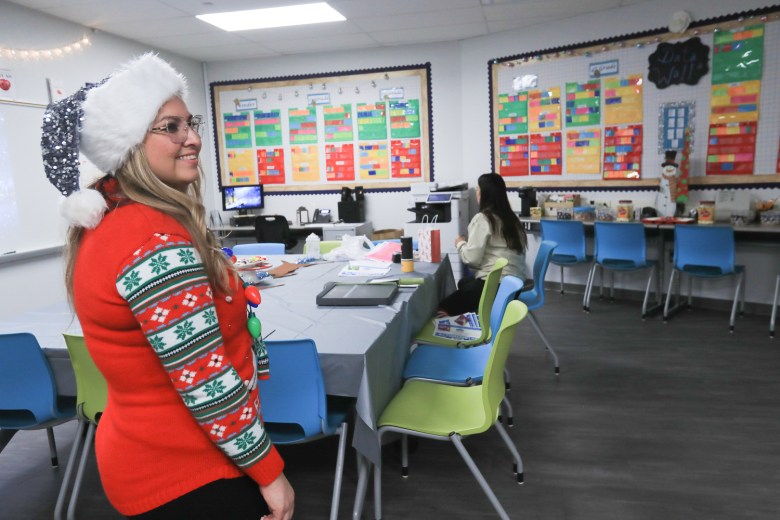 Teacher Nicky Cordero of Cactus Trail Elementary works with her students to help them strengthen their classroom performance and earn higher grades, Friday, Jan. 2, 2026, in El Paso, Texas. The improvement will qualify them for a reward recognizing their high marks.
At Cactus Trails Elementary, Thomas and her staff use a color-coded system that tracks students’ progress across the whole campus, with red indicating a student is struggling, yellow indicating they meet expectations and green indicating they have mastered a subject.
“It helps me identify quickly which teachers I need to offer more support to. If I see trends in different classes and I’m like, ‘OK, that’s a class where we as an instructional team may need to go in and give more support to the teacher,’” Thomas said
Thomas said the tracking system also allows teachers to see how they rank with their peers, encourages them to share resources and helps them identify students who need help.
Many of the schools selected under the initiative also have an intervention period during the school day meant to offer targeted help to students who are struggling or falling behind.
The Ysleta Independent School District requires all its schools to have a 45-minute intervention block for students every day.
“This is a dedicated, very specific and targeted time to really go into either small group instruction or one-on-one, to make sure that our students learn what they need to. Our teachers really scaffold the lessons as needed, and we make sure that their intervention lessons are different from their actual lessons throughout the day,” Miranda said.
Related
LISTEN: EL PASO MATTERS PODCAST