


El Paso, Texas (Credit: quiggyt4 on Shutterstock)
These insects are crossing the border, bringing yet another infectious disease to the USA
In A Nutshell
Infection rates jumped dramatically: 84.6% of triatomine “kissing bugs” collected near the El Paso-Mexico border tested positive for the Chagas disease parasite, up from 63.3% seven years ago.
Bugs detected near homes: Researchers found infected insects at residential properties in El Paso and Las Cruces, hiding under outdoor furniture, firewood, and wooden structures.
Border communities face unique risk: Mexico has 30+ triatomine species compared to 10 in the U.S., creating vulnerability for Texas, New Mexico, and Arizona border regions.
Disease remains underreported: Most U.S. states don’t require Chagas disease reporting, and many healthcare providers lack awareness, leaving the true infection burden unknown.
Parasite-infected insects are creeping closer to El Paso homes, with research now showing a sharp rise in infection rates among triatomine bugs collected near the U.S.-Mexico border.
University of Texas at El Paso researchers discovered that 22 of 26 triatomine insects, better known as “kissing bugs,” tested positive for Trypanosoma cruzi, the parasite that causes Chagas disease. That’s an 84.6% infection rate. Scientists found infected bugs near residential properties, hiding under outdoor furniture, stacked firewood, and wooden structures in El Paso County and Las Cruces, New Mexico.
The findings, published in Epidemiology and Infection, identify a worrisome shift for border communities. Seven years ago, a regional study documented a 63.3% infection rate among the same insect species. The new data represents a 21.3% increase.
“Infected vectors were identified at nearly all sampling locations,” the research team writes, “highlighting the encroachment of infected vectors into areas with direct human exposure.“
Border Geography Creates Health Vulnerability
Texas, New Mexico, and Arizona sit on the frontlines of an expanding public health challenge. While approximately 10 triatomine species have been documented in the United States, Mexico harbors more than 30 confirmed species of these blood-feeding insects.
The proximity creates vulnerability. Shared ecological corridors, human mobility across the border, and similar desert climates mean insects and parasites don’t respect international boundaries. Research has documented infected vectors across the southern United States, including Florida, Louisiana, Texas, Arizona, New Mexico, and California.
An estimated 6 to 7 million people worldwide carry the Chagas parasite, with over 300,000 infected individuals in the United States. Evidence suggests local transmission can occur in the U.S., and researchers have raised concerns about autochthonous transmission in border regions.
Despite this evidence, Chagas disease remains largely invisible to the American healthcare system. Most states don’t require reporting, and the disease often goes undiagnosed.
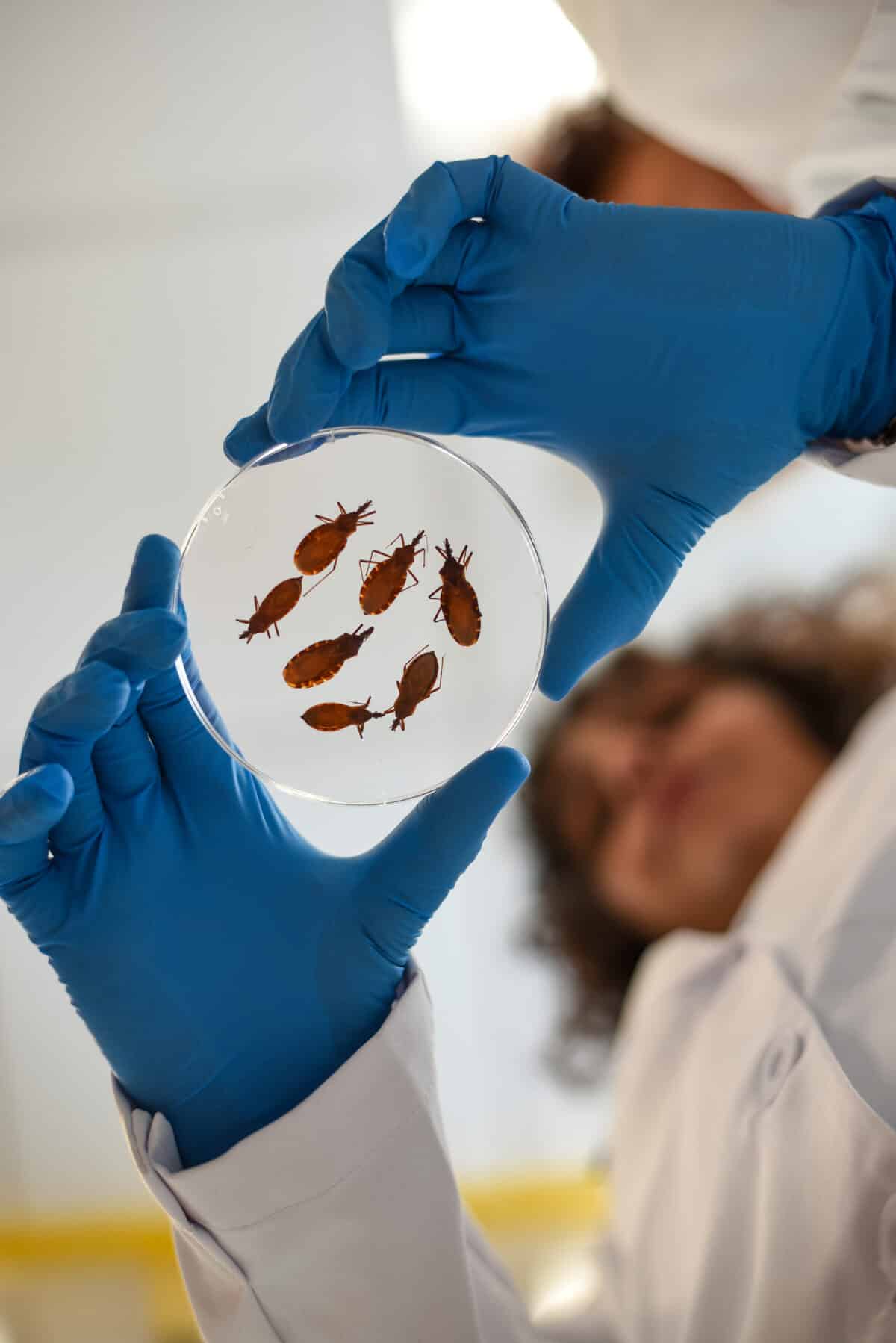
Researchers at The University of Texas at El Paso, led by Rosa Maldonado, Ph.D., professor of biological sciences, found unusually high levels of parasitic infection in the insects that transmit Chagas disease in the Borderland. The bugs were collected near homes and natural areas along the U.S.-Mexico border, raising concerns about the potential for local transmission of the disease in the Southwestern U.S. (Credit: The University of Texas at El Paso)
Kissing Bug Invasion: From Wild Mountains To Residential Perimeters
Between April 2024 and March 2025, researchers collected 26 adult triatomine insects from sites spanning wild parkland and urban neighborhoods. Every specimen was identified as Triatoma rubida, a species well-adapted to the Chihuahuan Desert’s harsh, arid environment. No nymphs were detected during this surveillance period.
Of those 26 bugs, 22 tested positive for T. cruzi using DNA analysis. Both male and female insects carried the parasite.
In Franklin Mountains State Park, infected bugs emerged from their typical wild refuges: rocky crevices, dry arroyos, and sheltered spots beneath desert shrubs like lechuguilla and creosote bush. These represent the insects’ natural habitat, where they normally feed on wild rodents, woodrats, and other small mammals.
The concerning discoveries came from urban areas. At two El Paso residential sites, bugs were found near building perimeters, concealed under garden debris and outdoor wooden structures. In Las Cruces, researchers collected an infected specimen from a semi-rural property near an open garage where wooden pallets had been discarded.
The presence of infected vectors in these peridomestic environments creates opportunities for contact with people and pets.
Genetic Analysis Points to Common Strain
Researchers dissected the bugs’ digestive tracts and extracted DNA for laboratory analysis. Using quantitative PCR, a highly sensitive molecular technique, they detected T. cruzi genetic material in the infected specimens.
Genetic sequencing matched various known parasite clones with similarities ranging from 96.95% to 100%. The results suggest the bugs likely carry the TcI lineage, the most widely distributed Trypanosoma cruzi strain in North and Central America.
However, complete genetic typing wasn’t possible because parasite concentrations in the samples were too low to amplify all necessary genetic markers. The satellite DNA target used for initial detection isn’t validated for definitive strain classification, so researchers couldn’t conclusively determine which specific variants are circulating in the region.
The research team reports that ongoing efforts aim to genotype T. cruzi isolates from collected vectors using multilocus sequence typing and other nuclear markers to better characterize the parasite strains circulating in the region.
What’s Driving The Increase In Chagas Infections?
The 21.3 percentage-point increase in infection rates raises difficult questions. Has the parasite genuinely spread more widely through insect populations over the past seven years? Are environmental changes pushing more infected bugs into areas near human habitation? Or have detection methods simply improved, revealing infections that were always there but previously missed?
The researchers acknowledge uncertainty. “This change may reflect improved molecular detection, ecological or climatic shifts, or a true intensification of T. cruzi transmission,” they write.
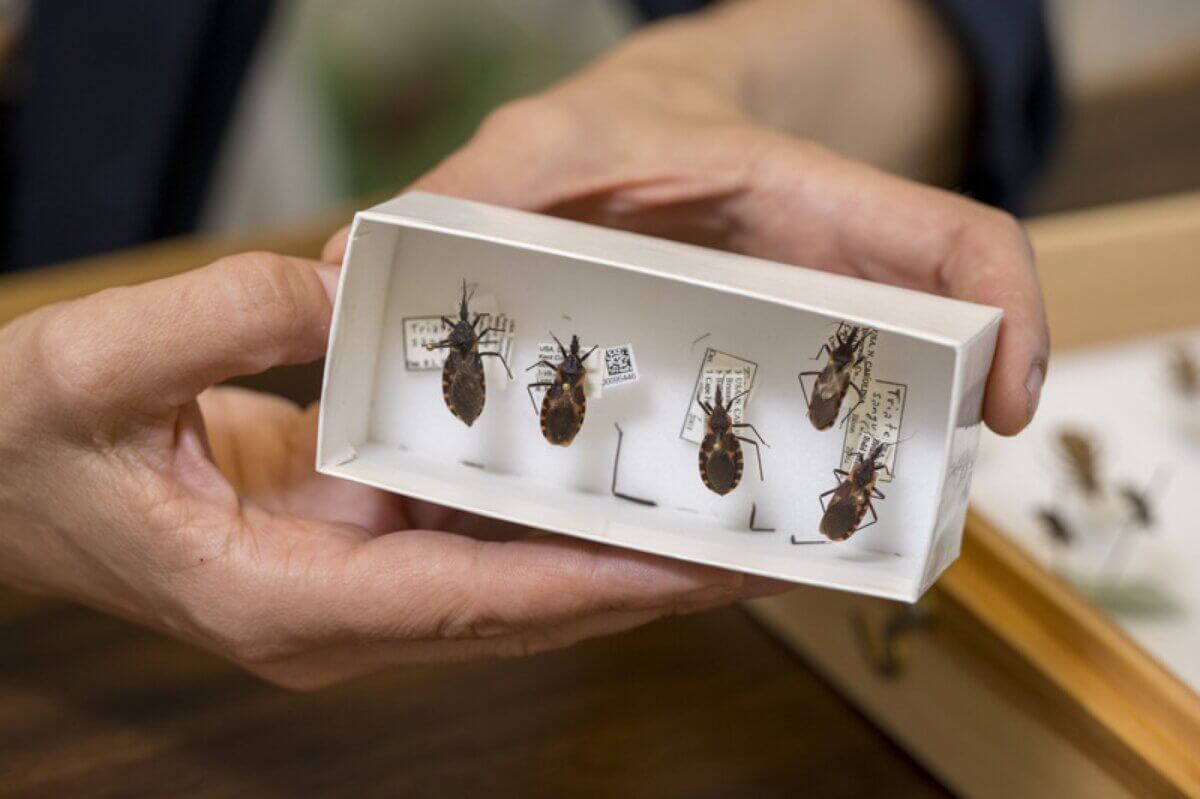 Kissing bugs are vectors of a parasite that causes Chagas disease, which can lead to serious heart problems. (Credit: Kathy F. Atkinson / University of Delaware)
Surveillance And Awareness Gaps For Chagas Disease
Chagas disease exists in a blind spot of American public health infrastructure. Most states don’t require reporting, limiting the ability to track the disease’s spread or prevalence.
The World Health Organization estimates approximately 6 to 7 million people are infected globally. U.S. figures are likely underestimated due to non-mandatory reporting, limited diagnostic testing access, and lack of awareness among healthcare providers and the general public.
Study authors call for sustained vector surveillance programs, advanced molecular characterization of circulating parasite strains, and focused public health interventions across the U.S.-Mexico border region.
Detection of infected T. rubida near densely populated areas demonstrates the need for monitoring at the urban-wildland interface, particularly in rapidly expanding metro areas like El Paso. The kissing bugs’ presence in peridomestic settings creates more opportunities for human and animal exposure.
The researchers argue that targeted outreach programs in high-risk communities should be essential components of local disease prevention strategies. As human development pushes further into wildlife habitats and cities continue growing outward, evaluating vector infectivity becomes necessary for understanding and monitoring local transmission potential.
Increased awareness of kissing bugs among healthcare providers and the public in affected border communities is absolutely needed. Local transmission cycles of Chagas disease exist in the U.S. Southwest, and border communities face unique exposure risks.
Disclaimer: This article is for informational purposes only and is not intended as medical advice, diagnosis, or treatment. The information presented is based on a peer-reviewed scientific study and should not replace consultation with qualified healthcare professionals. If you have concerns about Chagas disease or potential exposure to triatomine insects, consult your doctor or local health department.
Paper Summary
Limitations
The study was limited to adult T. rubida specimens collected over a 10-month period, with no nymphs detected. This may not represent the full range of vector populations or life stages in the region. Definitive discrete typing unit genotyping could not be performed due to low parasite DNA concentration in samples, and the satellite DNA marker used for detection is not validated for strain classification. The surveillance was confined to El Paso County, Texas, and southern New Mexico, which may not reflect conditions in other border regions. Sample size was relatively small at 26 specimens compared to previous regional studies. Additionally, the study could not definitively determine whether the increased infection rate represents improved detection sensitivity, ecological changes, or actual intensification of transmission.
Funding and Disclosures
This research was funded by the NIH National Institute of General Medical Sciences, grant number 1SC1GM139714, and NSF grant number 2122712. Sample collection and processing adhered to ethical guidelines and were conducted under protocol number 1608423-2, approved on May 5, 2023, by the Institutional Biosafety Committee. The authors declare no conflict of interest.
Publication Details
Farani, P.S.G., Fritz, A., Faier Pereira, A., da Silva Ferreira, M., de Melo Viana, S., Crews, C., & Maldonado, R.A. (2025). “Endemic potential of Chagas disease in the U.S. southwest: updated surveillance of infected Triatomines from the U.S.-Mexico border region,” is published in Epidemiology and Infection, October 28, 2025; 153, e132, 1-8. DOI: 10.1017/S095026882510071X. Department of Biological Sciences, The University of Texas at El Paso College of Science, El Paso, TX, USA; Department of Pharmaceutical Sciences, School of Pharmacy, The University of Texas at El Paso College of Science, El Paso, TX, USA; Platform of Molecular analysis, Laboratory of Molecular Virology and Parasitology, Oswaldo Cruz Institute, Oswaldo Cruz Foundation, Rio de Janeiro, Brazil.