
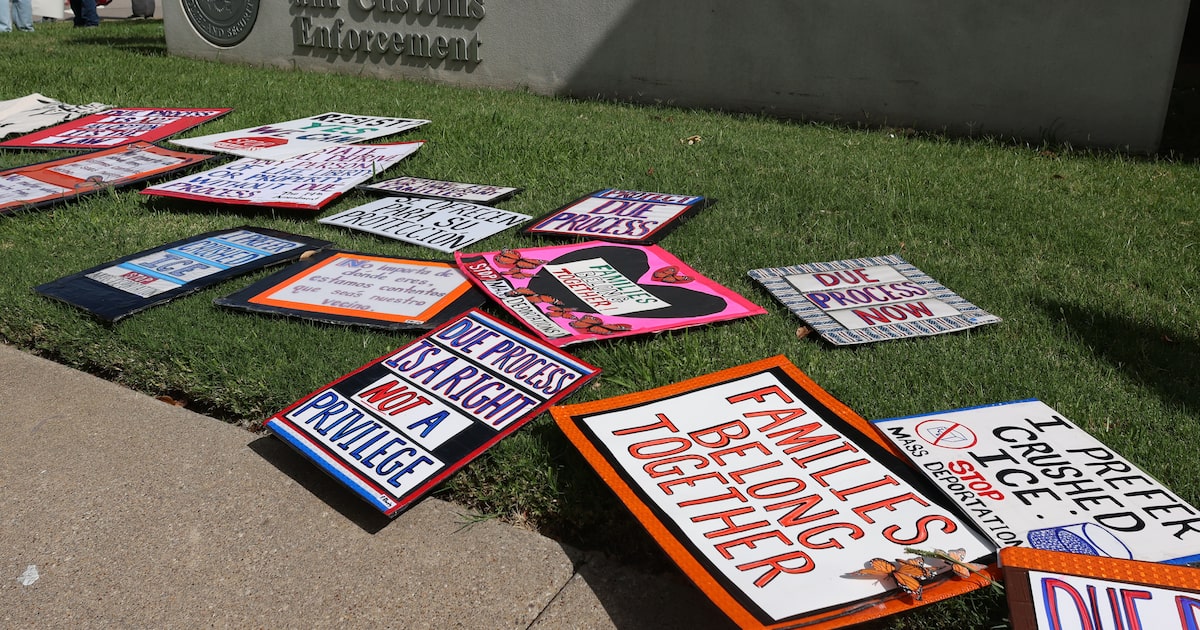
On the day that Brian Ernesto Villalta-Ramos had a scheduled appointment at the Dallas Immigration and Customs Enforcement office in October, family members told him to skip the appointment to eliminate the risk of being arrested. He refused.
He had arrived in Dallas from El Salvador in 2024 – along with his girlfriend and her two daughters – and all of them filed for asylum less than a year after arriving, as generally required by federal law.
While he was at the office, Villalta-Ramos called his girlfriend, Danisela Gaitan. She said he told her he had been arrested. Villalta-Ramos did not have a criminal record or any pending criminal charges.
He has been at a detention center in Georgia since.
Breaking News
Villalta-Ramos was one of the more than 12,000 people arrested by Dallas ICE officers in 2025 after President Donald Trump took office. His detention also reflects a key finding of a Dallas Morning News analysis of immigration enforcement data: During the first nine months of Trump’s second term, 62% of those arrested by agents in the Dallas office had not been convicted of crimes.
In addition, those deported involuntarily after being arrested by Dallas-based agents were significantly less likely to have been convicted of a crime. Those who did have criminal records were more likely to have been convicted of a non-DUI traffic offense.
The News examined both ICE arrests and involuntary deportations data nationally and in the ICE Dallas area of responsibility, which includes 128 North Texas counties and the entire state of Oklahoma. The analysis is based on data obtained from ICE by the Deportation Data Project through a public records lawsuit.
Related

The News compared similar date ranges for ICE arrests and deportations under former President Joe Biden and in Trump’s second term.
The Trump administration’s crackdown has had a particularly disproportionate impact on Venezuelans. In the Dallas area of responsibility, arrests of Venezuelans have increased by more than 400% this year when compared to 2024, due in great part to the administration’s focus on the criminal gang Tren de Aragua.
Related

For arrests by ICE, The News analyzed data from Jan. 20 through Oct. 16 of both 2024 and 2025. It reveals that:
At least 150,000 individuals were arrested nationally in 2025 – a 132% increase for the same time frame in 2024.In the Dallas area of responsibility, agents arrested about 12,100 individuals – a 108% percent increase over the prior year. About 60% of migrants arrested nationally in 2025 had not been convicted of a crime, up from 47% in 2024. Arrests in the Dallas area of responsibility show an even larger shift toward people without criminal convictions — from 44% in 2024 to 62% in 2025. Following an ICE arrest in the Dallas area of responsibility, involuntary deportations jumped 59% in 2025 from the year prior as of July, the most recent data available. They spiked by 94% for the number of people with no criminal convictions.
Immigration attorneys who reviewed The News’ findings were not surprised at the data based on what they have experienced. But to some, the data makes clear the administration is not prioritizing what Trump has repeatedly called the “worst of the worst.”
“How can anybody look at (those numbers) and not realize that they’re not going after ‘the worst,’” said Dan Gividen, an immigration attorney and former deputy chief counsel at the Dallas ICE office.
Tricia McLaughlin, a spokesperson for the Department of Homeland Security, the agency that oversees ICE, did not respond to specific questions for this story and instead issued a statement saying that 70% of those arrested by ICE have been charged or convicted of a crime.
“This statistic doesn’t even include the human rights abusers, wanted fugitives, and gang members who lack a rap sheet in the U.S.,” the statement said.
McLaughlin also noted six individuals ICE officers in Dallas have arrested with criminal convictions such as sexual exploitation of a minor, rape and drug trafficking.
In ICE’s arrest data from Trump’s inauguration through mid-October, just more than 70% of those arrested had a previous conviction or pending criminal charges, down from 74% a year earlier.
In the Dallas office specifically, migrants with criminal convictions were no longer the largest group among ICE’s arrests. Migrants with pending charges — but no convictions — more than doubled in 2025 and represented the largest group.
For those with pending charges, ICE does not list them, whether for traffic violations or homicide. Any pending charges also might not have resulted in a conviction.
‘There’s no confidence for anybody’
When Villalta-Ramos was arrested by ICE, he was awaiting an immigration court date that was scheduled for August 2026. At that court date, he expected that an immigration judge would have scheduled the trial date for his asylum case, though it likely would have been scheduled years later due to the immigration court backlog.
His court date is now scheduled for Jan. 14, immigration court records show.
Robert Armstrong, who is Villalta-Ramos’ immigration attorney, said his client’s arrest reflects the most dramatic shift he and other immigration attorneys have seen in the first year of Trump’s second term.
Previously, if someone did not have a criminal history and had been attending regular check-ins with ICE as part of their proceedings, Armstrong said, they could expect they wouldn’t be arrested.
“Now,” he said, “there’s no confidence for anybody.”
Related

The dramatic increase in arrests by ICE came in a year during which White House officials reportedly asked the agency to arrest as many as 3,000 undocumented migrants a day. As a result, Gividen said, officers and ICE officials are not able to exercise any discretion when they encounter an individual who is still in immigration proceedings.
“There is no ‘well maybe we don’t arrest this person,’” Gividen said. “Their criteria is this: “Hey, are you here without legal status? We’re done. You’re arrested. You’re in detention.’”
Some support the administration’s more aggressive immigration enforcement campaign that includes new methods to increase the number of people ICE agents arrested.
In May, ICE agents began arresting migrants at the Dallas Immigration Court under an operation targeting individuals who entered the country in the previous two years. By arresting people who had entered the country within the previous two years, the administration can deport individuals before they have to go in front of an immigration judge – known as expedited removal.
ICE has also increased the arrests of people who show up at ICE offices for immigration check-ins.
Ammon Blair, a former Border Patrol agent who serves as a senior fellow with the Texas Public Policy Foundation, an influential conservative non-profit in Austin, said the second Trump administration’s mass deportation agenda is the first time a presidential administration has truly worked to protect the country’s sovereignty.
ICE agents, Blair said, are the “frontline effort” on protecting the concept of citizenship and sovereignty.
Blair believes the administration can and should target migrants who are public safety threats as well as those who are in the country without legal documentation.
“It must be bifurcated,” he said, “meaning that you must target the worst of the worst at the exact same time as targeting those that are illegally present.”
Related
 Ex-ICE director critical of Trump administration
Sarah Saldaña, who served as the former director of ICE from 2014 to 2017 during President Barack Obama’s administration, called the significant shift toward those without criminal convictions “extraordinary.”
Saldaña said when she oversaw ICE the agency prioritized individuals who would be deemed public safety threats based on a prior criminal conviction. Criminal convictions for violent felonies would not be viewed the same as misdemeanors.
“The thought was, let’s use our money to take those off the streets that are true threats,” Saldaña said. “Even if we run into people who have violated immigration laws but who have not been convicted, we don’t need to be bothering them. This type of prosecutorial discretion is exercised by law enforcement every day.”
In 2024, ICE Dallas arrested fewer than 500 individuals who had no prior criminal convictions or any pending criminal charges. For 2025, that number jumped to over 2,400.
Americans have begun shifting their views on Trump’s immigration enforcement, polls show. An October survey by the Pew Research Center revealed that 53% believe the administration is doing “too much” in its attempts to deport undocumented migrants. That share is up from 44% in March.
“The question is: Is that what, as a country, we want to be doing?” Saldaña asked. “Because many of these people who don’t have convictions have very productive lives here and are contributing, so why not find a path for them.”
Related

Over the two months Villalta-Ramos has spent in detention, Gaitan, his girlfriend, tries talking to him daily. It depends on whether he has money in his account to make a phone or video call. Going back to El Salvador, she said, is not an option; they fled the country due to her boyfriend’s political beliefs. They will see what happens with their asylum case.
Gaitan can’t help but think back to Trump’s messaging during the campaign, where he promised to arrest and deport people with serious criminal convictions.
She agrees with him. But that’s not what’s happening, she added.
“Even if they are my fellow countrymen, if they have committed a crime, it’s OK to deport them because they are doing something that could be harmful to society,” she said in Spanish. “But now imagine seeing all of the contradictions that they are doing.
“Someone is going to be afraid because when you’re leaving for work, you don’t know if you’re gonna come back home.”