
There are only so many ways a college mascot knows it has truly arrived, and one of them involves a spring-loaded neck and a head that never stops nodding.
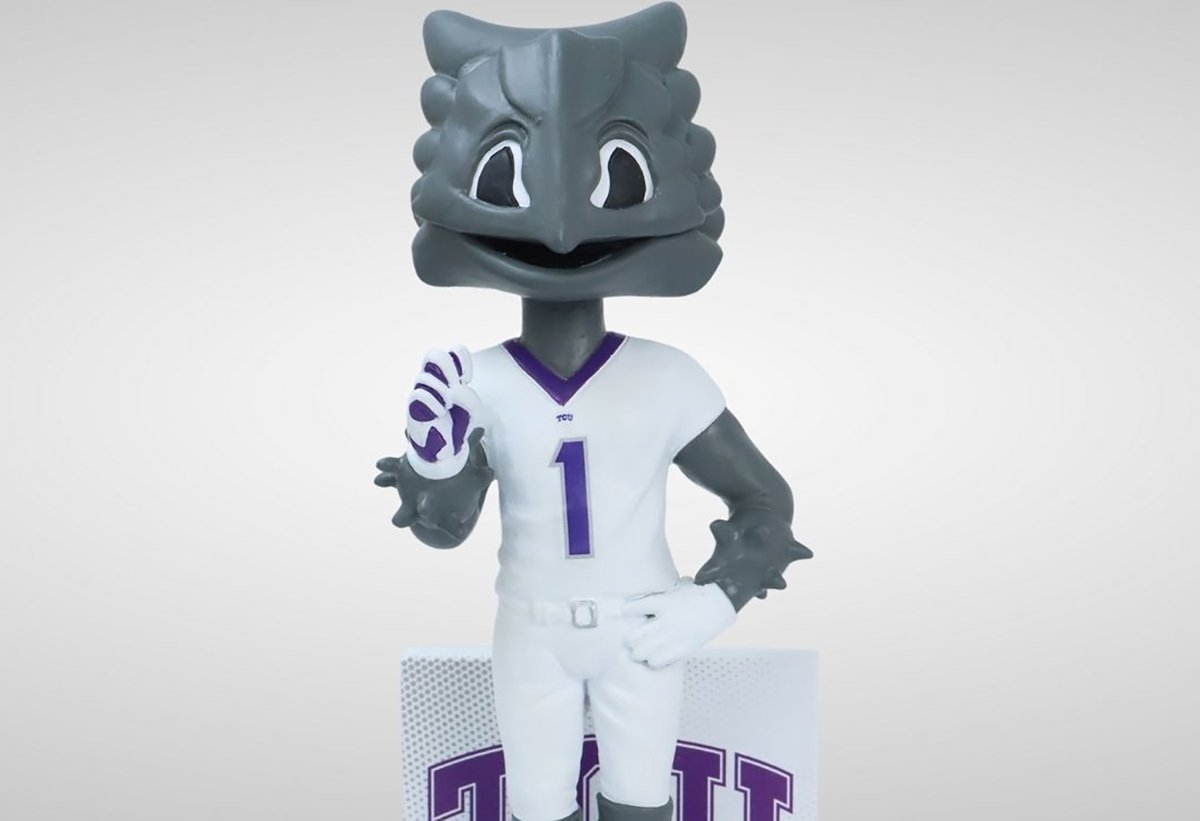
The SuperFrog bobblehead has arrived at TCU, a seven-inch, purple-and-white monument to a banner year and a century-plus of carefully cultivated oddity. Released in conjunction with National Bobblehead Day on Jan. 7, the officially licensed figure is limited to 2,025 units, priced at $35 plus shipping, and already flirting with the kind of scarcity that turns desk toys into keepsakes.
The timing feels deliberate. TCU is coming off an overtime Cinderella win in the Alamo Bowl, and its campus has spent the past year playing a supporting role in Paramount+’s “Landman,” where fictional characters turned the university into a familiar backdrop for viewers far beyond Fort Worth. In a season when the Horned Frogs kept finding themselves in the national conversation, it only made sense for SuperFrog to receive the collectible treatment finally.
The idea for this design began far from Texas. Phil Sklar, co-founder and CEO of the National Bobblehead Hall of Fame and Museum in Milwaukee, has built a career identifying figures worthy of a perpetual nod. “We saw an opportunity,” Sklar said. “There was a lot of people and characters who hadn’t had bobbleheads or hadn’t had them in a long time and we thought, ‘Hey, we could make some fun, unique bobbleheads.’”
That’s right: in addition to collecting rare and sought-after bobbleheads, the museum produces high-quality, customized bobbleheads for retail sale and for organizations, individuals, and teams nationwide.
TCU, he said, stood out immediately. Among nearly 250 colleges now licensed by the museum, the Horned Frog occupied rare air. “We started focusing on schools with live mascots,” Sklar said, “and then we sort of branched out into other schools that people were requesting and then schools that have unique mascots, and obviously the Horned Frog qualifies in those categories.”
Unique is a polite understatement. The Horned Frog, a once-plentiful Texas lizard, first appeared on the cover of TCU’s inaugural yearbook in 1897. By 1915, it had claimed a place on the school seal. In the postwar years, it spread everywhere, from class rings and stationery to bass drums, before taking human form in 1949 as Addie the All-American Frog. By 1979, it had become SuperFrog, and in 1999, the mascot underwent the modern redesign fans know today, equal parts amphibian and attitude.
Capturing that attitude in bobblehead form proved trickier than expected. “This one did have more of a delay than a lot of the other ones that we’ve done,” Sklar admitted. “For some reason, the sculptor was having a hard time getting the head right. It’s a unique shape, with different angles and so forth. So it took a little bit longer than normal. We’ve been working on this one for, I’d say at least a year.”
That patience is part of the appeal. In an era dominated by digital ephemera, bobbleheads remain stubbornly physical, objects meant to sit on desks, wobble on shelves, and quietly mark allegiance. Sklar understands the impulse. “That’s how the museum started, with the collection that grew out of control,” he said. What began with a single minor league mascot bobblehead in 2003 has grown into more than 10,000 figures displayed inside the National Bobblehead Hall of Fame and Museum, a 4,000-square-foot space that draws visitors from all 50 states and more than 30 countries.
Sklar’s connection to TCU is more than professional. He has walked the campus, watched SuperFrog in motion, and attended a Horned Frogs basketball upset over Texas Tech that ended with a court storm. “You’re even more sort of tied to the project when you see the mascot in person,” he said.
For TCU fans, alumni, and collectors, the SuperFrog bobblehead is less a novelty than a punctuation mark, a nodding acknowledgment of a banner moment layered atop a long, strange, unmistakably Texan history. As Sklar put it, “It’s definitely one of the most unique mascots in sports and also a great school.”