
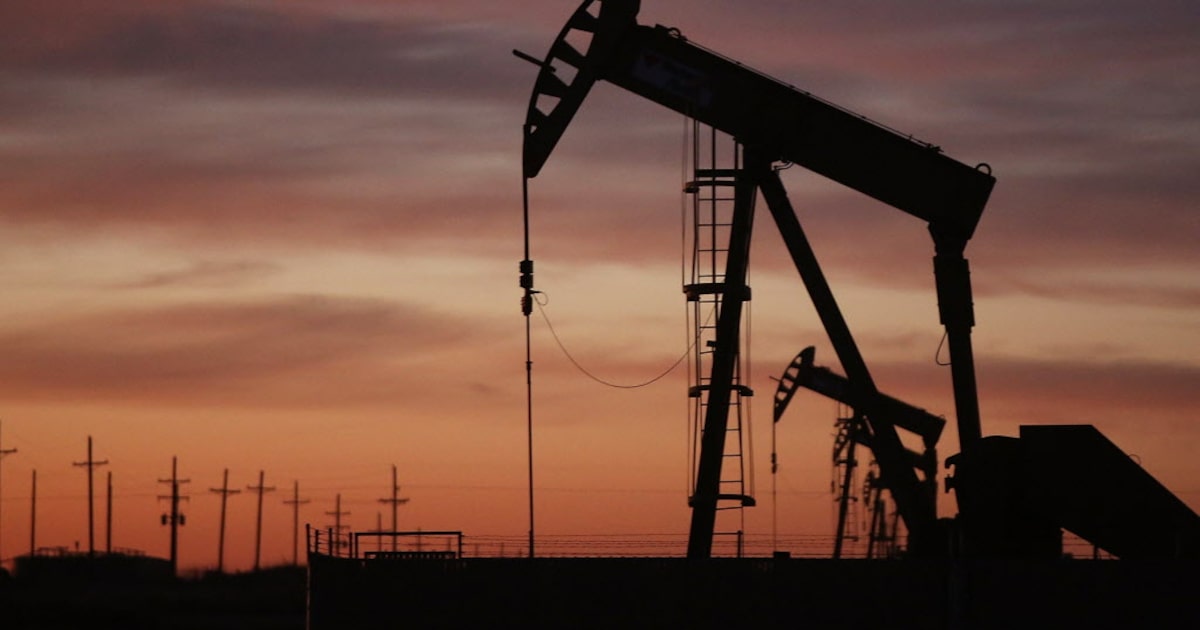
The Texas oil and gas industry had a record-setting year in 2025, both in production numbers and financial impact, according to data released Wednesday by the Texas Oil and Gas Association.
This feat was achieved despite market challenges but because of the Lone Star State’s innovation, investment and operational efficiency, TXOGA President Todd Staples said during a media briefing.
The industry paid $27 billion in state and local taxes and state royalties in 2025 — the second-highest total in state history, according to the group’s annual energy and economic report. That equates to roughly $74 million each day.
The tax impact, slightly less than the record-breaking $27.3 billion in 2024, contributes to essential services like public schools, roads and emergency response.
Breaking News
Related
Multiple new monthly production records were set: Texas crude oil production set a new record in July, reaching 5.85 million barrels per day, and marketed natural gas production reached 35.4 billion cubic feet per day in August.
Texas also set records for exports of crude oil and condensate, liquefied natural gas, and total natural gas, TXOGA data shows.
“At a time when energy debates are often driven by competing narratives, this report focuses on facts,” Staples said.
“It underscores a simple truth: Texas runs on oil and natural gas, made possible by hundreds of thousands of skilled men and women who rise before the sun to keep our economy moving and our communities secure.”
Texas is ‘uniquely positioned’
Looking ahead, Staples also spoke about the state of the industry, including potential impacts of U.S. involvement in Venezuela oil, and the power demand growth being driven by data centers.
Staples doesn’t agree with forecasts that have characterized 2026 as “the year of the glut,” citing projections that global supply could exceed demand.
“We do not see evidence of a disorderly oversupply,” Staples said. “What we see instead are markets adjusting, not breaking.”
Related
Much of the additional supply reflects long lead projects sanction years ago, not reckless new investment, Staples said. He added that global energy demand continuing to grow even amid economic uncertainty is being drive by productivity gains and efficient not unsustainable capital expansion.
“Texas energy is not disconnected from global markets, but it is more resilient,” Staples said. “Productivity, infrastructure, investment and export capacity all matter.”
On Tuesday, President Donald Trump said Venezuela would provide 30 million to 50 million barrels of oil to the U.S., and a day later, Energy Secretary Chris Wright said the United States will sell Venezuelan oil “indefinitely.”
Notwithstanding, Staples said he believed Texas will continue to be the dominant leader in the United States and the world.
Analysts note the Lone Star State refineries are particularly equipped to process the heavy type of crude that originates from Venezuela, once imports start flowing.
“We think that Texas is uniquely positioned — which is demonstrated by the fact that we’re producing 5.8 million barrels a day — with our infrastructure, with our geology, with our business environment, and with access to our dynamic ports that we’re not concerned about competition abroad,” Staples said.
Related

Texas currently produces about 43% of the United States’ crude oil and almost 30% of the nation’s natural gas.
If Texas were its own country, it would be the fourth largest oil producing country in the world, the third largest natural gas producing country in the world. The state currently produces about 43% of the nation’s crude oil and almost 30% of the nation’s natural gas.
Staples said imports to Texas are the lowest they’ve been in years, perhaps ever, and it would take time to develop assets globally, particularly in the South American nation, where the industry has experienced decades of deprivation and underinvestment.
He called the situation two-fold, though, noting there could be benefits to Texas oil and gas companies exploring and developing resources globally. In addition, domestic refiners may opt to utilize the heavy crude that’s produced in Venezuela for blending instead of relying on other foreign sources.
Above all, Staples said, Texas energy remains productive, reliable, the cornerstone of the state’s economy and globally essential.
“We’re here and poised for the long haul,” he said.
Related

This reporting is part of the Future of North Texas, a community-funded journalism initiative supported by the Commit Partnership, Communities Foundation of Texas, The Dallas Foundation, the Dallas Mavericks, the Dallas Regional Chamber, Deedie Rose, Lisa and Charles Siegel, the McCune-Losinger Family Fund, The Meadows Foundation, the Perot Foundation, the United Way of Metropolitan Dallas and the University of Texas at Dallas. The News retains full editorial control of this coverage.