
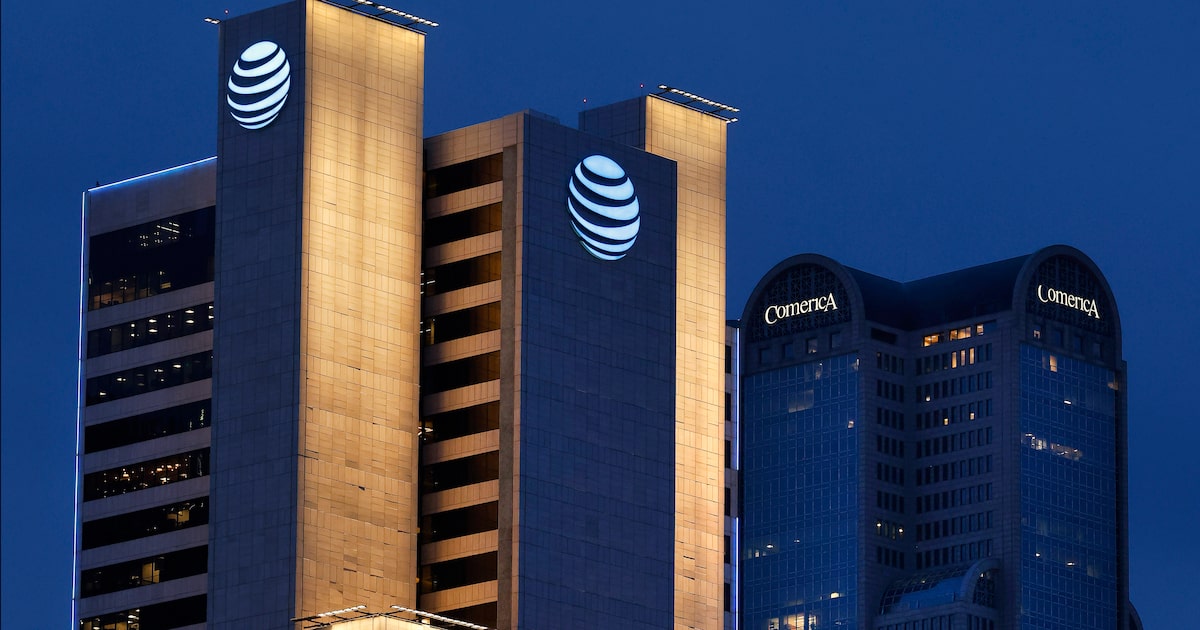
When the postmodern 60-story skyscraper now called Comerica Bank Tower opened roughly four decades ago, the law firm that would become K&L Gates LLP was one of its tenants.
Standing 787 feet tall, the tower was one of the last of the era — when downtown Dallas’ skyline was defined by highfalutin oil execs, bankers, financiers and the architects who used steel, concrete and glass to erect opulent monuments to their economic success.
Now those towers in Dallas’ central business district sit half empty, and K&L Gates is no longer here. In December, the firm moved its offices to 2828 N. Harwood, a 20-story office structure in the Harwood District built this century.
The firm left for many of the same reasons Fortune 50 firm AT&T is planning to — parking, public safety and the allure of shiny and new.
D-FW Real Estate News
“I just think [downtown] was no longer the hub of the legal or business world in Dallas,” said Beth Petronio, managing partner of the law firm’s Dallas office. “I just think that’s in Uptown now.”
Downtown Dallas has reached an inflection point.
AT&T plans to build its new global headquarters in Plano. The firm occupies more office space than any other private entity in the city. There’s no word on what sort of presence the telecom giant will keep in the city limits. AT&T CEO John Stankey declined to speak with The Dallas Morning News.
Comerica is weighing layoffs after shareholders approved a roughly $11 billion merger with Fifth Third. It’s unclear how many employees may be affected.
Comerica chairman, president and CEO Curt Farmer told The News in October that the bank will maintain a “very significant presence” in the city once the merger closes, whether it stays downtown is “yet to be fully determined.”
Downtown Dallas could lose two of the seven firms that employ more than 1,000 people.
If AT&T completely left, downtown Dallas’ office vacancy rate would rise to 33.7% — passing Seattle for the highest vacancy rate within a central business district in the country, according to estimates from real estate services firm CoStar.
Developers and major downtown landowners are attempting to remain optimistic. The glass is half full, they said, and large development projects like the $3.7 billion convention center will spur growth. The potential demolition of City Hall in favor of a new basketball arena and entertainment district will further transform the urban core, they said.
Related
Aging commercial high-rises will give way to even more apartments as downtown becomes increasingly residential — continuing a decades-long trend. But not all of the towers can become apartments.
Key downtown landowners argue that knocking down city hall for an arena and all that comes with it will soften the blow of AT&T’s exit.
“Did we go to the moon? Yes. [We] can figure this s— out.It’s not that complicated,” said real estate developer Ray Washburne. “Everything can get figured out. …The Band-Aid has been ripped off. The worst part has been waiting with anticipation as to what [AT&T was] going to do. … Let’s look at this glass half full rather than glass half empty.”
Others argue the blow is massive, and proposed projects are a bandage on a much larger problem. Large corporate tenants are staying within North Texas but are leaving Dallas — a sign the city itself is the issue.
“Downtown Dallas needs to have a reckoning. They need to have a come-to-Jesus moment,” said Steve Triolet, senior vice president of research and market forecasting at Dallas-based Partners Real Estate. “(Downtown) has a lot of issues and we really need to address them. AT&T leaving is just revealing that to the world.”
Empty towers and why they’re vacant
In terms of employees and office space within Dallas, AT&T and Comerica have few peers.
AT&T occupies more office space than any other private employer in Dallas, according to data from real estate information firm CoStar.
AT&T occupies nearly 3 million square feet of office space in Dallas. Roughly 2.4 million square feet in downtown Dallas is spread across four buildings and another 520,000 square feet is at the firm’s east Dallas training center.
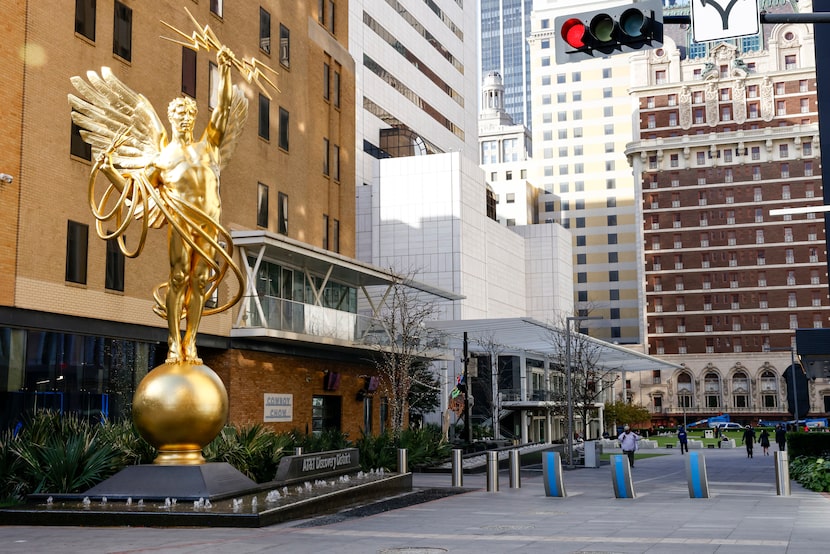
Golden Boy, the Spirit of Communication statue, greets people as they enter the AT&T Discovery District in downtown Dallas, Monday, Jan. 5, 2026.
Elías Valverde II / Staff Photographer
Parkland Hospital and Health System ranks second with nearly 2.7 million square feet occupied, and the U.S. General Services Administration has more than 1.2 million square feet.
Previous Dallas Morning News reporting indicated the AT&T had nearly 6,000 workers assigned to its downtown offices in 2022.
The Dallas Economic Development Corp. estimates AT&T has nearly 10,700 employees in Dallas city limits.
Comerica’s exact employee count in downtown Dallas is unknown. The firm declined to comment in previous stories. Data from Downtown Dallas Inc. shows the financial services company is one of seven firms with more than 1,000 employees downtown.
Comerica agreed in 2017 to rent 222,000 square feet in the tower through 2028, according to previous reporting.
Both firms have headquarters in downtown towers built in the mid-1980s — at the end of a real estate boom.
At the start of that decade, there were only 13 buildings more than 33 stories high downtown. Over the next several years, ten of Dallas’ tallest structures were constructed.
Flash forward several decades and those aging high-rises sit empty.
Late 1990 was the last time office vacancy rates in downtown Dallas were lower than the regional average, CoStar data shows.
At the end of 2025, the vacancy rate in downtown Dallas was 26.8%, up from 18.4% in 1990. That’s happened as the amount of office space has shrunk 20% over the last 35 years, with nearly 43 million square feet in 1990 compared to 34.3 million square feet in 2025.
In North Texas as a whole, which has seen a nearly 70% increase in office space over that period, the vacancy rate was 17.8% at the end of 2025 — down from 19% in 1990.
Certain office space downtown sits empty and is unappealing to corporate tenants for a variety of reasons, Triolet said.
Dallas-Fort Worth has suburbanized. The freeways and tollroads have expanded. To the north, Collin County has grown from 264,000 residents in 1990 to 1.25 million in 2024.
Then, there’s the perception of public safety issues in the city’s urban core. Data shows there’s been recent improvement after a major effort last summer to increase law enforcement in the central business district.
Data through Dec. 28 shows an 11% dip in total reports of violent crime in the central business district. Total reports of nonviolent crime saw nearly a 10% decrease in the same period. Burglary of a motor vehicle was up 22%.
A big issue holding downtown back, real estate professionals say, is the buildings are old. Nearly half of all office space in downtown Dallas was built in the 1980s.
“If you look at the average large building, like something over 50,000 square feet, the median age is roughly 45 years old,” Triolet said. “The problem is in the (Central Business District) in the ’80s — people wanted the biggest and most glamorous. So, they made the floor plates bigger, and they wanted to make it a contest of who could build the tallest buildings.”
Corporate trends have swung another way. Toyota, American Airlines and now AT&T are examples. Companies want shorter and more horizontal buildings. Skyscrapers give way to campuses. It’s easier to sell smaller separate buildings than large high-rises, Triolet said.
Prominent real estate developers differ on the approach to address the empty towers.
Some call for the towers to be turned into apartments and condos. Others call for some of them to come down.
Shifting to residential
Downtown Dallas has become increasingly residential as old office space is converted into apartments.
The number of people living downtown has more than doubled in the past 15 years, according to estimates from Downtown Dallas Inc., from roughly 6,900 people in 2010 to 16,000 in 2025.
Dallas is one of the nation’s top markets for apartment conversion projects. In 2024, North Texas added 698 apartments from adaptive reuse projects — the fourth most in the nation, according to a study from Rentcafe. Another 3,000 are in various stages of development.
Downtown has been an area of focus for these projects. Downtown Dallas Inc. estimates office space has been converted to almost 6,000 apartment units and nearly 4,000 hotel rooms.
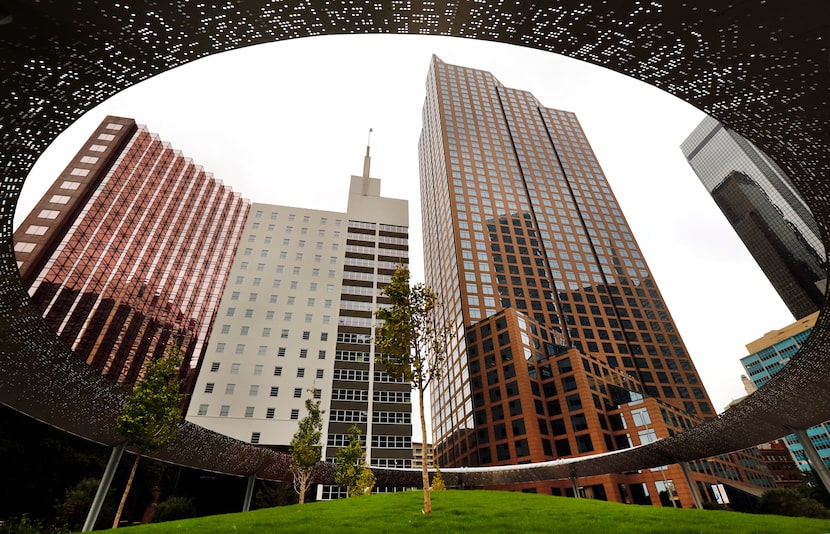
Downtown Dallas buildings are seen from Pacific Plaza on October 9, 2019.
Tom Fox / Staff Photographer
The most ambitious of current redevelopments is the work developers Mike Hoque and Mike Ablon have planned for Bank of America Plaza — Dallas’ tallest tower. The pair plan to trim office space from 1.8 million to 1.5 million square feet and add 275 hotel rooms. The $409 million redevelopment project will receive $103 million in city incentives.
Jennifer Scripps, CEO of Downtown Dallas Inc., points to reuse projects like this as an example of what downtown needs to do to be successful.
“We have some really important work that’s pending to try to get more tax credits for those buildings and rapidly rebalancing our mix,” she said. “We’re too heavily invested in office. We still have great office properties that are doing well.”
Washburne, who owns the former downtown Greyhound station and Founders Square, and other developers point to a future where downtown Dallas ditches its corporate identity for a residential one.
“People need to wake up and say OK [downtown is] not an office district anymore. We’re just not,” Washburne said. “What we are is a residential neighborhood. Turn downtown streets into two-way streets, widen the sidewalks, plant trees and do something like they did in Lower Greenville.”
Some of those improvements are already underway, said Scripps. The nonprofit has overseen the planting of 500 trees downtown, and needed intersection and pedestrian improvements are set to be finished before the FIFA World Cup comes to North Texas later this year.
Downtown property owners and market watchers differ on the ease and scale with which the towers can be converted.
For Washburne, there’s plenty you can do. You can start cutting chunks out of buildings to lessen the floor plan and create light wells — a roofed void designed to bring natural light and ventilation into the building. Work like this is being done in Washington D.C. and New York City.
“But it all comes down to … What do you pay for it? Well, these buildings are basically worthless. …There’s got to be some tax legislation (for) people to improve these buildings.”
For developer Jack Matthews, almost every building can be converted. An increase in residential will bring better retail and office demand could increase. But a few of the towers should come down.
Matthews and his firm have been the driving force behind some of the city’s most successful development projects — including the $500 million Omni Hotel and three decades of investments in the Cedars neighborhood.
His projects there include the Southside development that includes the preservation of the landmark Sears Roebuck buildings. The property was converted into a mixed-use project that includes lofts, hotel, retail and restaurants.
Matthews said negotiations are ongoing to bring a major grocer downtown.
“If they can’t be office, and they can’t be residential, And all you’re left with is street front, you have a problem. They either have to come down or be changed,” he said.
Continuing to increase residential density in downtown Dallas is key, said Mehrdad Moayedi, CEO at Centurion American Development. Best known for his single-family lot development in the suburbs, Moayedi was the driving force behind the redo of the Statler Hotel.
Moayedi has dipped his toe further into residential projects in downtown. His newly built Parc at Jackson apartment project (2013 Jackson St.) has begun leasing, and the developer told The Dallas Morning News that he’s working to acquire a tower currently for sale. If he completes the deal, he wants to build a few hundred condo units.
“Density is the only way to get us out of this properly,” he said. “Because if there are people there at night then hopefully there’s some restaurants and other things that are actually making some money for small businesses.”
Despite that, Moayedi said there are some buildings that need to be torn down.
Triolet isn’t convinced conversions are simply that easy. His analysis found roughly 3% of commercial space in the central business district could be turned into residential units.
Buildings must be larger than 20,000 square feet and have high vacancy to be considered for conversion.
“It’s helpful, but it’s not a game changer,” he said. “That’s not going to transform downtown.”
Even the most successful conversions in downtown have hit some issues.
Shawn Todd and his firm Todd Interests oversaw the $460 million redo of the First National Bank Tower on Elm Street.
The 52-story skyscraper sat empty for a decade before it underwent one of the largest urban restoration projects in the country, and the largest ever in Dallas. The 1.5 million-square-foot office tower became a combination of apartments, hotel rooms, retail and office.
Todd touted the deal in 2019 as the “largest historic tax credit deal in Texas.”
In 2026, Todd said he’ll hand the building back to lender Starwood Capital in foreclosure, citing the current interest rate environment and downtown property values.
“We don’t see the ability to recoup our remaining equity based on present debt levels,” he said. “The values aren’t there.”
Todd said the loss of the National doesn’t mean he’s out on downtown or Dallas.
Other developers are optimistic about the city, too. Some of them feel tearing down City Hall to build a new arena for Dallas’ NBA franchise may be part of the answer.
Is City Hall’s fate sealed? What’s next for downtown?
For Matthews, the decision by AT&T to leave its Dallas headquarters means city leaders must demolish City Hall for a new Mavericks arena and entertainment district.
Matthews and his firm were tapped to oversee the $3.7 billion convention center redevelopment. The arena and companion entertainment district would link downtown and the Cedars neighborhood immediately south of downtown, spurring economic development in that section.
Washburne, who owned the old Dallas Morning News property nearby, has promised an investment of at least $750 million to make the district happen. It would be anchored by a hotel with about 1,000 rooms. He increased the scope of the project after speaking with hotel chains.
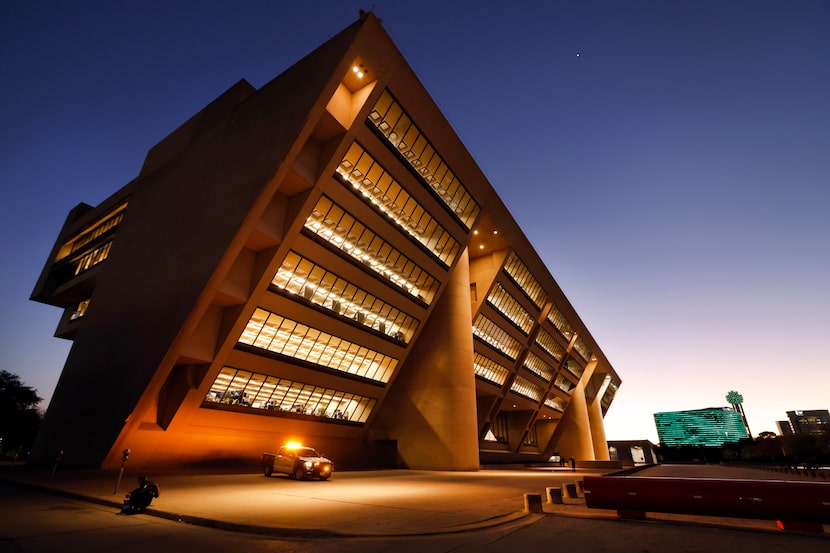
An exterior view of Dallas City Hall at sunset in downtown Dallas, November 4, 2025.
Tom Fox / Staff Photographer
For these things to happen, City Hall must go, Washburne and Matthews said.
“It’s become all the more urgent [to tear it down.] It’s a negative building,” Matthews said. “You know, I’m all into good architecture, and we’ve done buildings with different architects over the years. But just because this architect did it doesn’t mean it’s great.”
A decision of City Hall’s future is looming. The Dallas Economic Development Corporation and real estate firm CBRE have been commissioned to conduct an assessment on the 1978, I.M. Pei-designed building.
The group will present its findings to the City Council’s finance committee Feb. 23, with the report provided to the city manager by Jan. 19.
An arena and entertainment district could complement a series of other started or proposed projects — the expansion of Dallas College’s El Centro Campus, the convention center, 3,000 new hotel rooms, an Interstate 30 overhaul — and maybe a new city hall, Washburne said.
“We’ve got billions sitting on the doorstep,” he said.
Moayedi doesn’t think the answer is tearing down City Hall. He disagrees with the thought “100%,” he said. Instead, Moayedi proposed a series of smaller steps like bringing in smaller businesses, improving safety, keeping and incentivizing entertainment, and continuing to grow the residential base.
“It’s not going to be one thing that fixes everything,” he said. “But I think as a whole, we can fix things, and I think be a whole lot better.”
Sriram Villupuram, a professor of finance and real estate at the University of Texas at Arlington, argues the conventions and sporting events are seasonal. They won’t replace the economic impact of AT&T.
He points to Detroit as an example for Dallas.
As downtown emptied out and became a “doughnut hole” he said, the city turned its attention to landing a big tenant. In came Quicken Loans.
“Land one big tenant. Land one big corporation where you invest your resources and incentives,” he said. “That’s the anchor.”
“This isn’t a matter of [the suburbs] suddenly saying let’s fill our coffers at the cost of Dallas,” he added. “This has been slowly in the making. …We’ve really got to put our heads together and see who would be the big one that needs to come here.”
Not everyone is leaving downtown, Scripps said. Financial services firms are shopping for office space here. She declined to name them, but she hopes the continued success of Uptown and Victory Park brings some economic benefits to downtown.
“That is certainly our hope,” she said. “I don’t think the Y’all Street driver of office is over.”
 ‘The values aren’t there.’ The National skyscraper heads to foreclosure
Todd and his firm invested roughly $460 million into a redo of the former First National Bank Tower in downtown.
 With AT&T leaving, can ‘Y’all Street’ save downtown Dallas? Not on its own
City leaders touted Y’all Street as the future of Dallas’ urban core. The reality is more complicated.
 Harwood District’s tallest tower refinanced for $161 million and other real estate news
These are the latest sales, leases and deals in North Texas.