

Inside the TOCA Soccer Center at The Colony, men in blue, green and black jerseys are lining up for a pregame weigh-in. “You gained two pounds,” coach Anthony Williams, 49, tells the first man who steps on the digital scale. Williams, a nutritionist and personal trainer, offers a few suggestions as he scrolls through the man’s food log on his laptop. He pauses at one entry and cracks a joke: “Those fajitas do sound good.” The line laughs, and the energy of the room loosens.
Welcome to the world of Man v Fat Soccer, a men’s weight-loss program that blends fun and accountability to promote healthy, long-term change. The program began in the U.K. more than a decade ago and expanded to the United States in 2024, starting in Florida. The Colony’s league launched this summer. Other clubs are in Keller and Houston, and a Carrollton league is set to open soon.
For Clinton Warbington of Flower Mound, joining Keller’s Man v Fat Soccer league changed his life. The 40-year-old dad of two and American Airlines pilot was always active, but he gained weight while adjusting to fatherhood and a demanding schedule. He has since lost 20 pounds while adding muscle and now hopes to join the Army National Guard. “My resting heart rate has gone down to the low 60s,” he says. “It’s been such a drastic, dramatic change.”
Camaraderie builds accountability
News Roundups
Man v Fat Soccer’s premise is simple: play soccer and lose weight. Players weigh in before their 28-minute match — most clubs run three matches a night — and the scale becomes part of the scoring. Goals on the field still count, but weight loss adds bonus goals based on players’ weekly progress and consistency, while weight gain can give goals to the opposing team.
Gamifying wellness isn’t a new idea — think Duolingo streaks or closing activity rings on an Apple Watch. Research suggests that tying weight loss to small incentives can help keep people motivated. In a 2025 study of overweight and obese adults using a weight-loss app, participants who earned points for social support actions — such as “liking” another user’s workout or diet tracking — stuck with the program more. Among those who most consistently used the app, participants who earned points lost more weight than those who didn’t.

Men play in a Man v Fat Soccer game on Tuesday, Jan. 6, 2026, in The Colony.
Elías Valverde II / Staff Photographer
Man v Fat Soccer’s points system is what encouraged Jay Lundberg to stick with the program. Lundberg, a 32-year-old plumber from Carrollton, discovered The Colony’s league through social media. He joined in June and quickly set a simple target: lose at least a pound a week. “At least one pound, it’s tangible,” he says. “It has been hard at times to lose one pound, but at least you score your goal for your team.”
It’s this accountability to the team that drives many of the men, Williams says. When someone gains weight, it doesn’t just affect his own progress — it can cost the team a goal. “If I were losing weight on my own, it’s a lot more difficult because I’m accountable for myself,” says Troy Slinkard, a 32-year-old who lives in Prosper and works for Lockheed Martin. “You got your whole team to hold you accountable. You’re not only letting yourself down, you’re letting your team down.”
A safe space
Obesity affects men and women at similar rates in the United States — about 39.2% of men and 41.3% of women from 2021 to 2023, according to the Centers for Disease Control and Prevention. But the cultural conversation around dieting and weight loss tends toward women, and research suggests men are less likely to join weight-loss programs or studies.
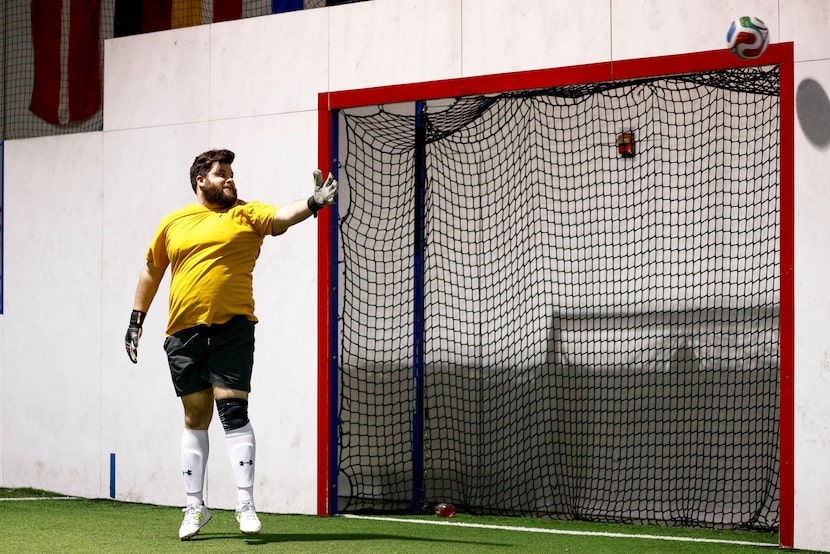
Goalie Daniel Rager watches as a shot just misses the goal during a Man v Half Soccer game, Tuesday, Jan. 6, 2026, in The Colony.
Elías Valverde II / Staff Photographer
A 2012 review of randomized trials found men make up only about 27% of participants in weight-loss trials worldwide — and roughly 22% in the U.S. Researchers say that gap may reflect differences in social pressure and dieting habits, and the fact that men are less likely to seek medical care, making up only about 20% of bariatric surgery patients and around 22% of people on anti-obesity drugs. Men who do go on anti-obesity drugs are more likely to discontinue them, according to a 2024 study.
But a weight-loss program designed with men in mind can have an impact, says Dr. Melissa Shoemaker, a preventive medicine physician at UT Southwestern Medical Center. Social support is often underestimated in sustaining weight loss. “It’s just such a win-win to have someone else to do it with,” she says. “I think there’s definitely a lot of pros for something like this.”
It’s that kind of camaraderie that Man v Fat Soccer tries to embody, Williams says. Men are often expected to handle their weight loss on their own — to just go to the gym, lift weights and figure it out without much guidance. Man v Fat Soccer, he says, aims to fill that gap, giving men a supportive, judgment-free place to work on their health alongside teammates pursuing the same goals.
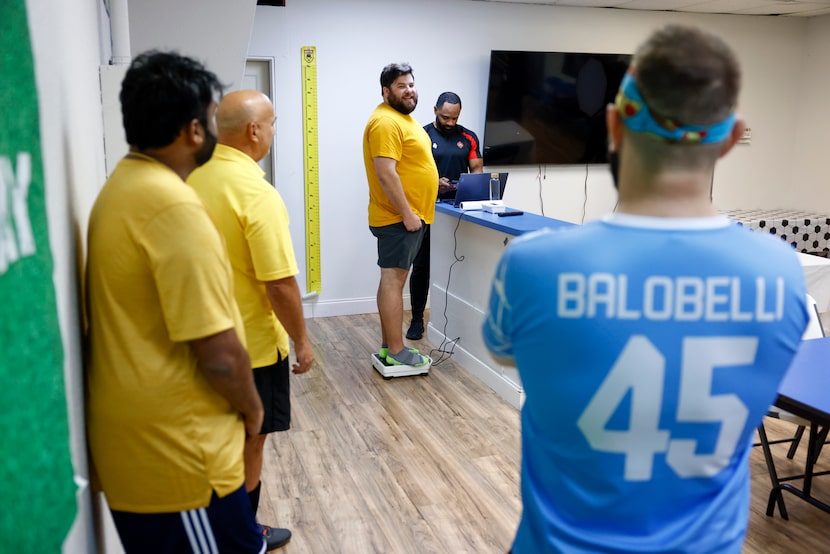
Daniel Rager weighs in with coach Anthony Williams as other players wait their turn before a Man v Fat soccer game on Tuesday, Jan. 6, 2026, in The Colony.
Elías Valverde II / Staff Photographer
That’s what Michael Alves, a high school teacher at the Ursuline Academy of Dallas, appreciates about the program. “I did Weight Watchers and over three years lost 70 pounds,” says Alves, who is 55 and lives in Plano. “I felt very much out of my peer group. It wasn’t that they were opposed to having me there. A lot of times, I was the only man in the sessions. I just really wanted something different.”
Research suggests the program can resonate with men. A 2022 study of Man v Fat Soccer in Australia followed 418 overweight men and found most participants viewed the program positively, with about 96% saying they would recommend it. Over a 15-week season, men lost about 4.6% of their body weight on average and reported being more physically active and feeling less depressed and stressed as well as more positive about their bodies.
Registration for the program costs $25, and monthly dues are $99. For Chris Alsip, the price is worth it. The 41-year-old father of one who lives in The Colony had read about the program before it came to the U.S. and signed up for updates so he would know when it finally arrived.
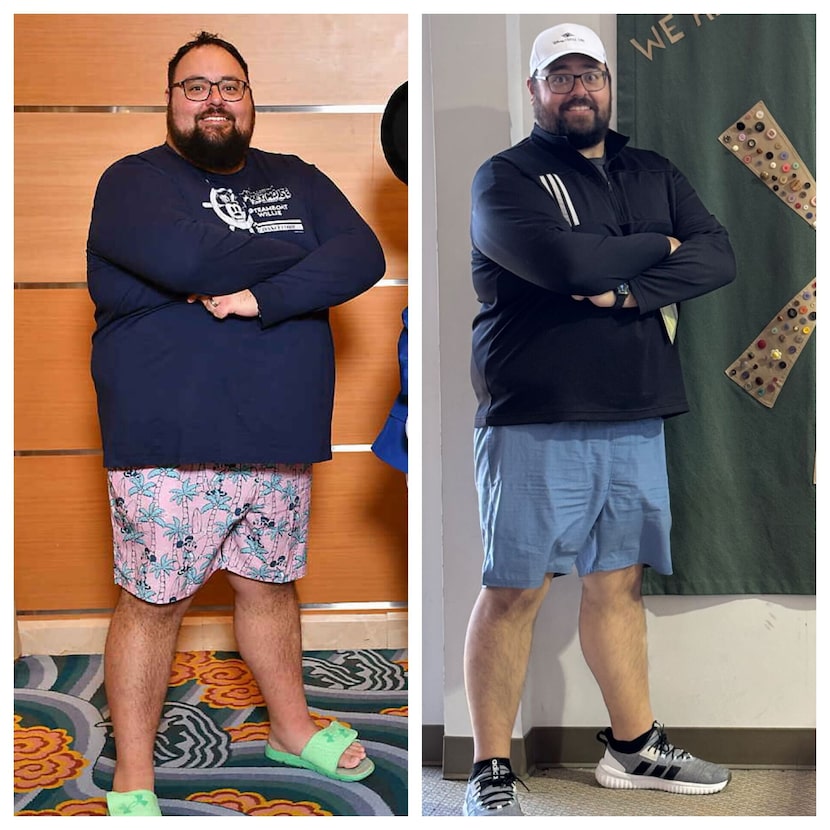
A picture of Chris Alsip before and after his 130-pound weight loss, 96 pounds of which have been since joining Man V Fat Soccer. The left picture is from Jan. 18, 2025, and the right from Jan. 4, 2026.
Chris Alsip
Since joining the league in June, he has lost more than 90 pounds and now weighs around 330 pounds. On his cellphone, a pair of before-and-after photos makes the change hard to miss. “I remember being able to sit in a chair, and it wasn’t squeezing me,” says Alsip. “That was really cool.”
The changes have rippled through his family, too. He says his wife, who was on her own weight loss journey, has lost 50 pounds since June. His 7-year-old daughter, Harper, began to play soccer because of him. “I try to recommend this to everybody,” he says. “There really is just a sense of fraternal friendship.”
In the end, it may not matter which team wins. “Whether you win or lose on the pitch,” Alsip says, “we’re all winning by losing.”
Miriam Fauzia is a science reporting fellow at The Dallas Morning News. Her fellowship is supported by the University of Texas at Dallas. The News makes all editorial decisions.