
Why did elected officials get pay raises while county employees did not in the current budget? And how can the county afford to repair or replace aging infrastructure if the county keeps setting property taxes at the “no new revenue” rate?
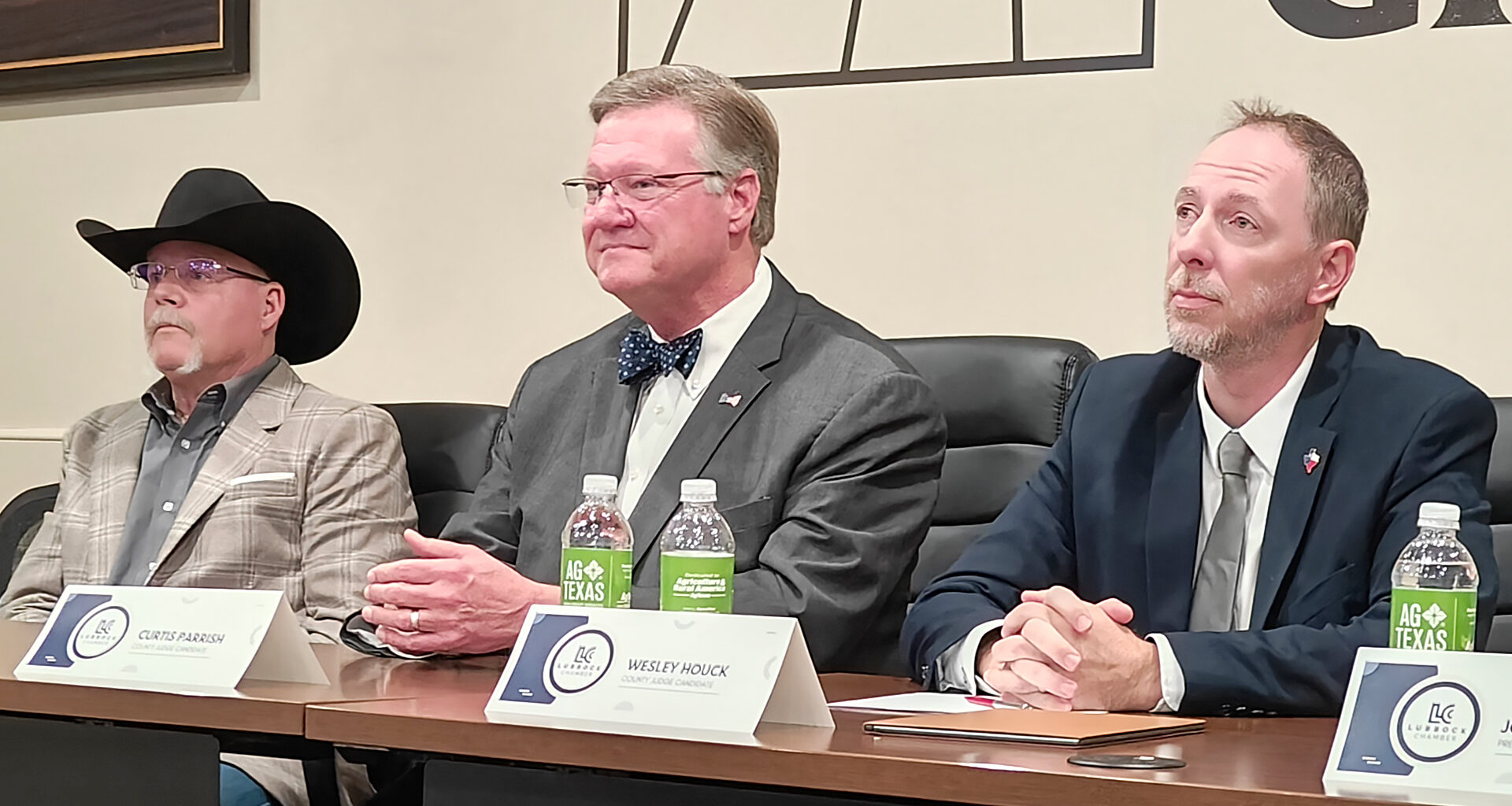
Two of the toughest questions in a county candidate forum came from audience members. The Chamber of Commerce and Plains Cotton Growers hosted candidates Friday for Precinct 2 and Precinct 4 commissioners and county judge.
Click here to watch the forum on our YouTube channel.
Kody Bessent with PCG moderated the forum. Twice he opened the forum for audience questions.
Candidates who participated
Precinct 2 County Commissioner
Justin Martin
Kevin Pounds
* Incumbent Jason Corley is not seeking re-election to Precinct 2 but running for another office. Candidate Trey Newton did not appear in the forum, though a seat was reserved for him.
Precinct 4 County Commissioner
Jordan Rackler, incumbent
Chad Seay, challenger
C.J. Peterson, challenger
County Judge
Curtis Parrish, incumbent
Wesley Houck, challenger
Pay raises
Seay, who used to be Precinct 4 Commissioner (2018-2022), said in response to the question about pay raises, “I never voted for a raise for our elected officials, not one time.”
“Even when that was done, I always turned it back. I had to sign a deal for the auditor’s office – gave it back,” Seay said.
Seay said commissioners get paid more than $90,000 per year.
Jordan Rackler, the current commissioner in Precinct 4, said, “State law … it goes before the Commissioners Court to vote for the elected officials’ pay raise first. And at the time whenever we were going to vote for the elected official pay raise or decline it, I was under the impression that we were given a 3 percent cost of living raise and a 2 percent merit raise.”
The employee pay raise did not happen, but higher salaries for elected officials was already locked in. Rackler declined to take the additional pay.
“So, I did vote for it. I did not accept it,” Rackler said.
“I did it strictly because I knew that the sheriff was underpaid based on sheriffs of his size of the county. And then I’d had constables and I’d had a couple of JPs [justices of the peace] that had asked about [pay],” Rackler said.
C.J. Peterson, challenger in Precinct 4, said, “Without the employees, all the clerks, the JPs, everybody, the constables – there wouldn’t be no county without these employees.”
Peterson was previously a constable from January 1, 2015 until August of 2018 when he resigned after a DWI charge.
Peterson said he has a business with 40 employees. Treating them with respect is vital. He said the county should “step it up” with employee pay. He did not directly address pay raises for elected officials.
Current County Judge Curtis Parrish said, “The bottom line is, and this was a commitment that I had made from the beginning, that I would not take a salary increase while during my terms of office, and I had not.”
“I’m okay with giving COLA [cost of living] adjustments to elected officials, but we better give that same COLA adjustment to all of our employees as well,” Parrish said.
His challenger, Wesley Houck, said he is not paid to be a Wolfforth city councilman.
“We don’t get paid for our position. It’s a little foreign to me in that regard. One thing I do know with our city is retention of staff is very important. The startup of a new employee, the training, the new equipment, everything, that’s a huge expense and is often much cheaper to make our salaries and wages competitive,” Houck said.
“Honestly, I don’t know what the judge’s salary is. I’ve purposely not looked. I would absolutely not be interested in a raise,” Houck said.
Candidate for Precinct 2, Justin Martin, said, “I knew what this paid when I ran, so of course I would not ever expect a pay increase. … So, I would not at all accept a pay increase.”
Martin said he might even give some of the salary back just to show he’s not doing it for the money.
Kevin Pounds, also a candidate in Precinct 2, did not address elected officials’ pay. But he did say county employees need to be paid more.
“We’ve got to look at ways to take care of our employees. They’re the ones that are working their tails off. They’re the ones that are out there every day so we all have our services. They have got to be taken care of.”
No new revenue rate
On the question of tax rates and the no new revenue rate, Seay said the county needs to work harder to get state and federal grants.
He also said he’s deeply concerned about spending down the county’s reserves. What if a tornado or other natural disaster hits Lubbock?
“Eventually, … something’s going to happen. We’re going to have [the need for] cash up front,” Seay said.
Rackler said, “I’m going to beat to a different drum because I am one of the commissioners that voted for the NNR [no new revenue rate], and I’m going to say, as somebody that’s looked through the budget, there are places still to cut.”
Peterson said everything is more expensive after COVID and that makes it harder if things need to be replaced or repaired.
“We’ve got to figure out a way to cut the budget. And if we can’t do that, then eventually it’s going to have to go to the voters [to approve a tax],” Peterson said.
During the most recent county budget cycle, there was talk of needing to renovate 916 Main, which houses county offices, and the parking garage next to it. Those are multimillion-dollar projects.
Under state law, voters would be called upon for any property tax increase of more than 2.5 percent (the rollback rate) or for a capital projects bond.
Parrish was critical of using the no new revenue rate this current budget cycle and said, “What the Commissioners Court decided to do this past year was to cut the Sheriff’s Department by $1.4 million, to cut fire departments by $250,000 in order to balance the budget.”
During budget talks, other commissioners said the sheriff’s budget was cut for housing inmates out of county – and that amount was unused in the 2024/25 budget.
Houck said, “Do we just go back to the taxpayers? And I hate that option. Taxes are always the nuclear option. You do everything else you can first.”
Houck also said he wasn’t sure what could be cut in the current budget because, “The numbers aren’t as clear as I would like them to be.”
Parrish pointed out in the forum Lubbock County has been honored for budget transparency by the Texas Comptroller’s Office.
Pounds said, “If the budget’s as lean as it is, and we have it as lean as it is, there’s not another way. It will fall on the taxpayers.”
“I haven’t combed through the budget the way some of these gentlemen have been able to, but you go through – you make as lean as you can. … If we don’t have enough at the end of the day, then we’ve got to make some hard decisions.” Pounds said.
Martin said the county must prove the budget is as lean as possible and then go to the voters.
“I don’t remember a county bond not passing,” Martin said.
He suggested not just one bond but a series of bond elections over time.
“We have to get a plan every two years and go ahead and shelf-life the next phase of what we’re wanting to do, and … let the taxpayers decide how they spend their money,” Martin said.

Related

Related posts