
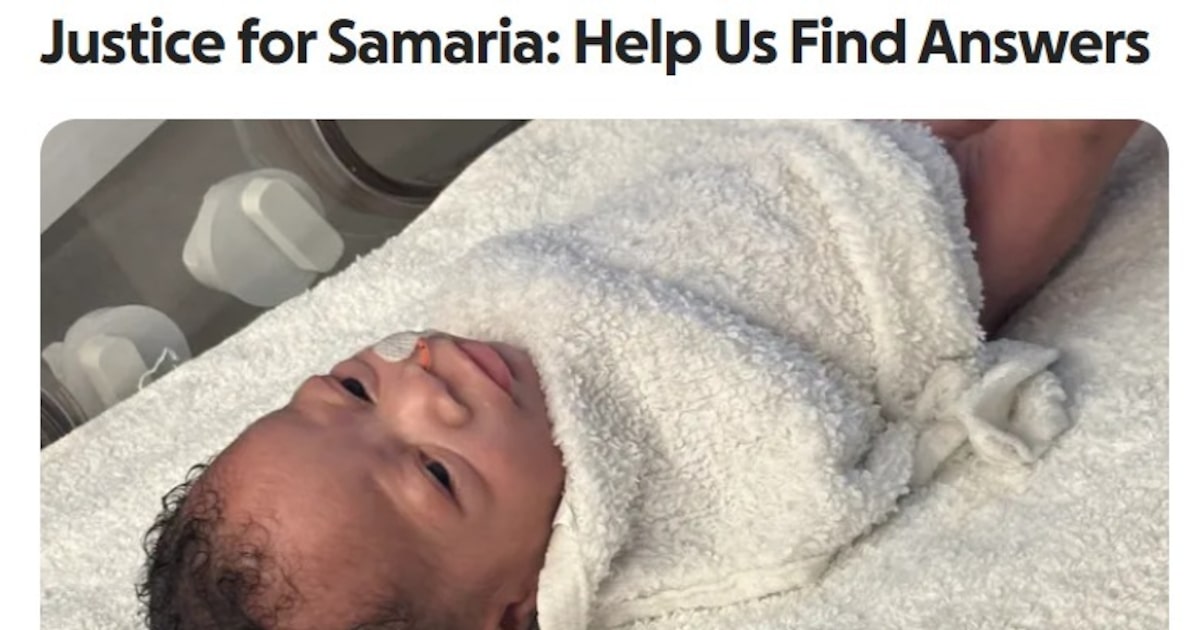
In December, a Fort Worth family took to social media seeking answers from a local hospital after they say their recently deceased baby arrived at the funeral home without internal organs.
The situation — and the family’s distress — have raised questions about standard autopsy procedures, and about how health officials communicate those standards to families.
Samaria Bates gave birth to twin baby girls in mid-October, with fiance Kenneth Sauls. The girls, who were born prematurely, stayed in the NICU at Texas Health Harris Methodist Hospital in Fort Worth.
Then, on Dec. 5, one of the baby girls suddenly declined in health and died at the hospital, Sauls said. The family was told that the cause of death was necrotizing enterocolitis, a gastrointestinal illness seen in newborns, particularly premature newborns.
Business Briefing
At the hospital, Sauls said, the couple authorized an autopsy on the baby. A week later, the father said, he and his family were at the funeral home making funeral arrangements for the baby.
When one of the family members mentioned the possibility of getting a second-opinion autopsy, Sauls said, the funeral director informed them the baby had been sent to the home without internal organs.
Spokespeople at the hospital where the baby died, Texas Health Harris Methodist Hospital in Fort Worth, did not comment directly on the situation.
Autopsy process
Dr. Reade Quinton, the 2025 president of the National Association of Medical Examiners, detailed standard autopsy procedures in an email to The Dallas Morning News.
Quinton wrote that a complete autopsy does typically involve the removal and dissection of internal organs.
He also clarified that there are two types of autopsies: forensic and hospital. The former are typically connected to legal or law enforcement investigations, while the latter are not. The Sauls’ family’s situation was a hospital autopsy.
Hospital autopsies, Quinton wrote, require consent from the family, and typically allow the family to determine the extent of the investigation, and what is done with internal organs.
While forensic autopsies typically include the release of all organs with the body, Quinton wrote, hospital autopsies may vary depending on the consent form that the family signed. Some hospitals may retain organs — such as the heart or the brain — for further study.
“Whatever the general practice in that hospital,” Quinton wrote, “organs are not retained if the family does not consent for retention of organs.”
While there are some less-invasive options for families who want answers without dissection, Quinton wrote that autopsies are “still the gold standard in answering questions about the cause of death.”
For this family
It’s not clear what happened in the case of the autopsy of Sauls’ newborn baby.
The hospital itself has not shed any additional light on the situation or on its standard practices. In a statement sent by Texas Health spokesperson Kimberly Walton, the hospital expressed sympathy for the family, but did not provide any concrete information.
“Our thoughts go out to the family during this difficult time,” the statement said. “It is always our first priority to provide our patients with the highest level of compassionate, safe, quality care.”
It added: “Due to patient privacy laws, we will not be able to share any information.”
Hospital spokespeople did not respond to follow-up questions about the situation.
According to Sauls, for a week after the family was told that the baby’s internal organs were not with her body, the hospital did not give the family answers on what had happened.
Then, on the morning of Dec. 19, a hospital executive called Sauls and told him that the baby’s organs were at Texas Health Fort Worth.
The executive “called, stating that they have the organs, asking do we want them to proceed with the autopsy,” Sauls said. “And we were like, ‘What do you mean?’”
Sauls said the death of their baby — combined with poor communication from the hospital and then the shock of discovering the baby’s organs were missing — has traumatized him and his fiancee.
“I’m just trying to hold it together,” Sauls said, “but this has ruined my family.”