
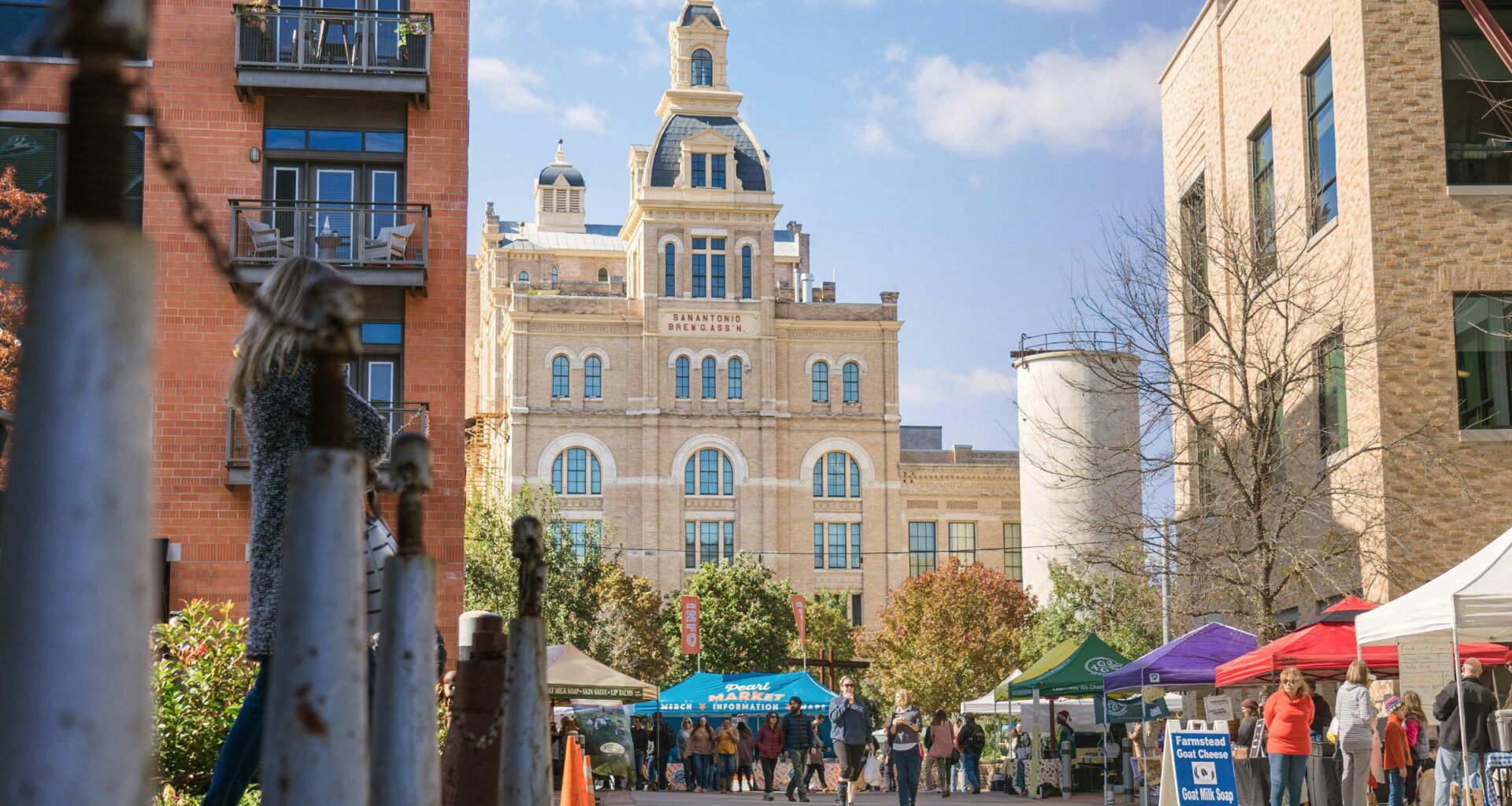
A week after announcing that his restaurant, Cured, would close for good, Steve McHugh was already dismantling the place. He was taking mirrors off the walls and selling tables and chairs that were once filled nightly with diners ordering charcuterie plates piled with bresaola and duck ham. “It’s actually kind of therapeutic,” McHugh said. After more than twelve years, the work of unmaking the restaurant had begun.
On its own, Cured’s closure would have been notable enough. McHugh is a six-time James Beard Award finalist, and Cured was one of the anchor restaurants that helped transform the remains of San Antonio’s historic Pearl Brewing from an inner-city industrial dead zone into one of the most admired food destinations in Texas. But the timing gave the news extra charge. Cured’s exit came on the heels of other recent restaurant closures at Pearl, including those of Carriqui, Full Goods Diner, and Botika, and amid a leadership transition at the top of the organization.
In a notoriously gossipy industry, theories traveled fast. Was Pearl being taken over wholesale by a giant corporate restaurant group or a predatory billionaire, or had it abandoned everyday San Antonians in favor of luxury travelers? On TikTok, the speculation was blunt and unsparing. “Pearl has become the new River Walk,” one commenter wrote. “It used to be the antithesis to the River Walk, but now it’s replaced it as a tourist trap.” Others zeroed in on the economics: The rent had become too expensive for the restaurateurs, or the parking had become too expensive for diners.
The swirl of speculation contains kernels of truth, but the full story is both more mundane and more layered.
To hear McHugh tell it, his decision to close Cured was personal—and practical. “We’re just at a different stage of life than we were twelve years ago,” he said. What had once felt exhilarating now felt relentless. Running Cured required his and his wife’s constant presence seven days a week, and they spent an increasing amount of time not cooking but fixing things—dealing with maintenance issues, staffing gaps, and the everyday triage of keeping a restaurant functioning. “We wanted to run a restaurant, not have it run us,” he said.
Then there’s the underlying economic reality. The restaurant business everywhere is under pressure: food costs are up, the price of labor is up, and diners are more selective about where—and how often—they spend money. “That’s not a Pearl problem,” McHugh said. “That’s a nationwide problem.” Its effect on Cured created a relentless struggle to find the right balance between raising prices, shaving costs, and drawing in foot traffic.
Pearl has undergone its own economic shift, shaped by its success. The property began developing into its modern incarnation more than twenty years ago, when San Antonio billionaire Kit Goldsbury (he made his money selling Pace Foods, of Pace Picante fame, to the Campbell Soup Company in 1994) bought it and reimagined it as a wildly ambitious urban renewal project, a kind of gift to the city he loved. It wasn’t exactly a philanthropic project, but he also wasn’t in it for a quick buck. It would take decades for Pearl to reach its full potential as a for-profit business, and Goldsbury knew he’d likely never recoup the full investment in his lifetime.
By the time Cured opened, in 2012, Pearl was still somewhat of a risky bet for a restaurateur. By then, a handful of pioneering stores and eateries had colonized the area, such as chef Johnny Hernandez’s La Gloria, Andrew Weissman’s Il Sogno Osteria (since closed), and the Twig Book Shop. But the surrounding blocks were construction sites. “These weren’t prime spaces,” McHugh said. “There was drug trafficking and prostitution on the corners.”
In those early years, Goldsbury made a deliberate bet on emerging chefs and merchants, often structuring deals to lower the up-front burden of opening a business in exchange for helping build a culinary ecosystem. McHugh, a first-time proprietor, says that Silver Ventures, Goldsbury’s investment firm spearheading the Pearl development, gave him a full-time project manager when he was building Cured. “It was amazing and saved me so much headache,” he said. The rents at Pearl back then were also a good deal compared to those on the River Walk or in Alamo Heights. “The leases were very favorable for a new operator,” said Michael Joergensen, Silver Ventures’ current chief marketing officer.
But success begets growth and change. When Hotel Emma opened in 2015 in the former Pearl brew house and instantly became a global smash—its countless accolades included being ranked the nineteenth-best hotel in the world and the third-best in the U.S. by Condé Nast Traveler—the district began to transition from a bet on the future into a proven high-end destination. As the area filled in with apartment buildings and office towers, the crowds grew—and so did the cost of doing business at Pearl.
Multiple sources describe today’s Pearl rents as at the very top of the San Antonio market. When leases come up for renewal—as Cured’s did right before it closed—the math can change abruptly. For restaurants that opened when Pearl was still an experiment, those increases can be existential.
McHugh is careful not to frame his own decision as a dispute over rent. “I understand why rents are higher now,” he said. “Pearl is established. It’s successful.” But he also acknowledged the cumulative pressure: higher costs, a changing clientele, and the reality that a restaurant built for one moment in Pearl’s evolution might not fit as neatly in another.
Another force reshaping the landscape is the rise of larger, better-capitalized operators—most notably Austin’s Emmer & Rye Hospitality Group, which made its name with such hot spots in that city as its namesake Emmer & Rye, Hestia, and Canje. Starting in 2022, the group extended its influence 75 miles down Interstate 35 with a string of dining concepts at Pearl, first with the Mediterranean grill Ladino and then with multiple other spots inside Pullman Market, a 40,000-square-foot gourmet emporium inside a former glass factory at the edge of the neighborhood.
Around the same time, Silver Ventures spun up its own restaurant-development company, Potluck Hospitality, to launch concepts by itself or with other groups. Potluck partnered with Emmer & Rye on its restaurants and worked with the chef who operated a ramen stall in Pearl’s food hall, Jennifer Hwa Dobbertin, to open Asian American fusion restaurant Best Quality Daughter.
On one hand, Pearl’s move toward taking ownership stakes in the restaurants on its property can look like a money grab. But to independent restaurateurs, it can be a lifesaver too. With the backing of a group like Potluck, a restaurant can outsource basic functions such as maintenance and accounting, and even command better prices on ingredients. “If they had offered me that twelve years ago, I would have done it,” McHugh said. “Instead, I had to become an expert on rewiring outlets and snaking plumbing myself so I could afford to stay in business.” For Dobbertin, the arrangement has proved successful, and she recently opened a new cocktail bar at Pearl, Jue Let.
That’s not to say the new strategy is a fail-safe. Carriqui, an extraordinarily expensive project by Potluck (solo, without a partner) that involved moving and reconstructing an iconic San Antonio building, announced it was closing its doors this past October, just three years after its launch. When the South Texas–themed restaurant opened in 2022 after eight years of painstaking renovation, then–Potluck CEO Elizabeth Fauerso predicted it would become “the highest-grossing restaurant in the state of Texas.”
Joergensen blames Carriqui’s failure to take hold on what he calls an “identity crisis.” The restaurant tried to merge various regional culinary traditions and confused diners in the process. But more important, he said, the company learned it’s harder to operate an establishment alone than in partnership with someone else. “It was our first foray into running a restaurant on our own, and we chose a beautiful one but also a really big one.” Potluck won’t be doing that again, he said.
Another Potluck concept, Full Goods Diner, which opened in partnership with the team behind the popular Austin breakfast spot Paperboy, announced its closure just about a week before Cured did. Ryan Harms, owner of the restaurants’ parent group, Daybreak Hospitality, declined to comment on why Full Goods closed after three years in business, but one factor might have to do with Pearl’s ever-evolving mix of tenants. Back when Full Goods opened, also in 2022, Potluck was planning to open a nearby entertainment venue in the vein of Punch Bowl Social (think pinball machines, bocce courts, bowling). Such a neighbor would have, in theory, created a lot of spillover business for Full Goods, but the concept ultimately never materialized. That corner of the district will now evolve to emphasize shopping, Joergensen said.
It’s tempting to read the recent closures as a verdict on Pearl’s direction. But the truth is that start-ups often grow in fits and starts, especially ones as sprawling as Pearl. Some aspects work, and some don’t. Or some work for a while and then don’t. Pearl has succeeded in becoming one of San Antonio’s top tourist attractions, and the crowd it draws today is not the same as the one it did a decade ago. In a major metro area with one of the highest poverty rates in the nation, Pearl has skewed increasingly toward attracting a luxury clientele—though executives are quick to point out the slate of free programming, such as movie nights and yoga sessions, intended to draw locals in.
When the most convenient parking lot, under U.S. 281, started charging for parking at the end of 2022, it was the last straw for many locals—and the first gripe they bring up in online comments today. Mesha Millsap, then the CEO of Pearl Real Estate, acknowledged the criticism of Pearl’s parking policies to the San Antonio Express-News but said the parking revenue would fund unspecified new amenities for locals. By January of last year, Pearl had backed off from the strategy to a degree and made parking free on weekdays until 3 p.m.
Millsap’s departure from Pearl was announced just days after Cured and Full Goods announced their closures; the company offered no specific reason but said a search for a replacement is underway.
Meanwhile, Goldsbury, the visionary founder and the deep pockets behind Pearl, is now 83 years old. He was 60 when he started the development, and sources say he has since stepped back from day-to-day involvement. And although Goldsbury is one of the wealthiest people in San Antonio, even his money has limits. Much like Silicon Valley companies often use large amounts of venture capital to grow to a certain dominance before pivoting to profitability, it was inevitable that Pearl would eventually begin to operate more like a bottom line–focused business than an incubator. The question will be whether it can resist the temptation of bringing in national brands that can pay the high rents. So far, even as it has changed, it has avoided that fate. There will be six new openings in 2026, according to Joergensen, and at least three of them will be from local chefs or restaurant groups.
For the chefs who helped build Pearl, the current moment can feel abrupt, even personal. For diners, it can be disorienting to watch institutions disappear or see newer places struggle to take hold. But Pearl has never been a static place.
The chefs who pass through it change along with it. Some grow alongside Pearl for years; others move in different directions as circumstances shift. The team behind Full Goods is already planning its next chapter, with a Paperboy outpost set to open in Denver this spring. When longtime staple Botika announced its closure in 2024, after eight years in business, chef Geronimo Lopez told his followers, “Stay tuned—this is not goodbye, but see you later.”
Cured’s McHugh hasn’t figured out what comes next, other than taking a long-deferred break. But like many chefs Pearl has helped elevate, he leaves better positioned for whatever follows. “I didn’t come here with a name,” he said, before getting back to dismantling his restaurant’s dining room, “but I’m leaving with one.”
Read Next