
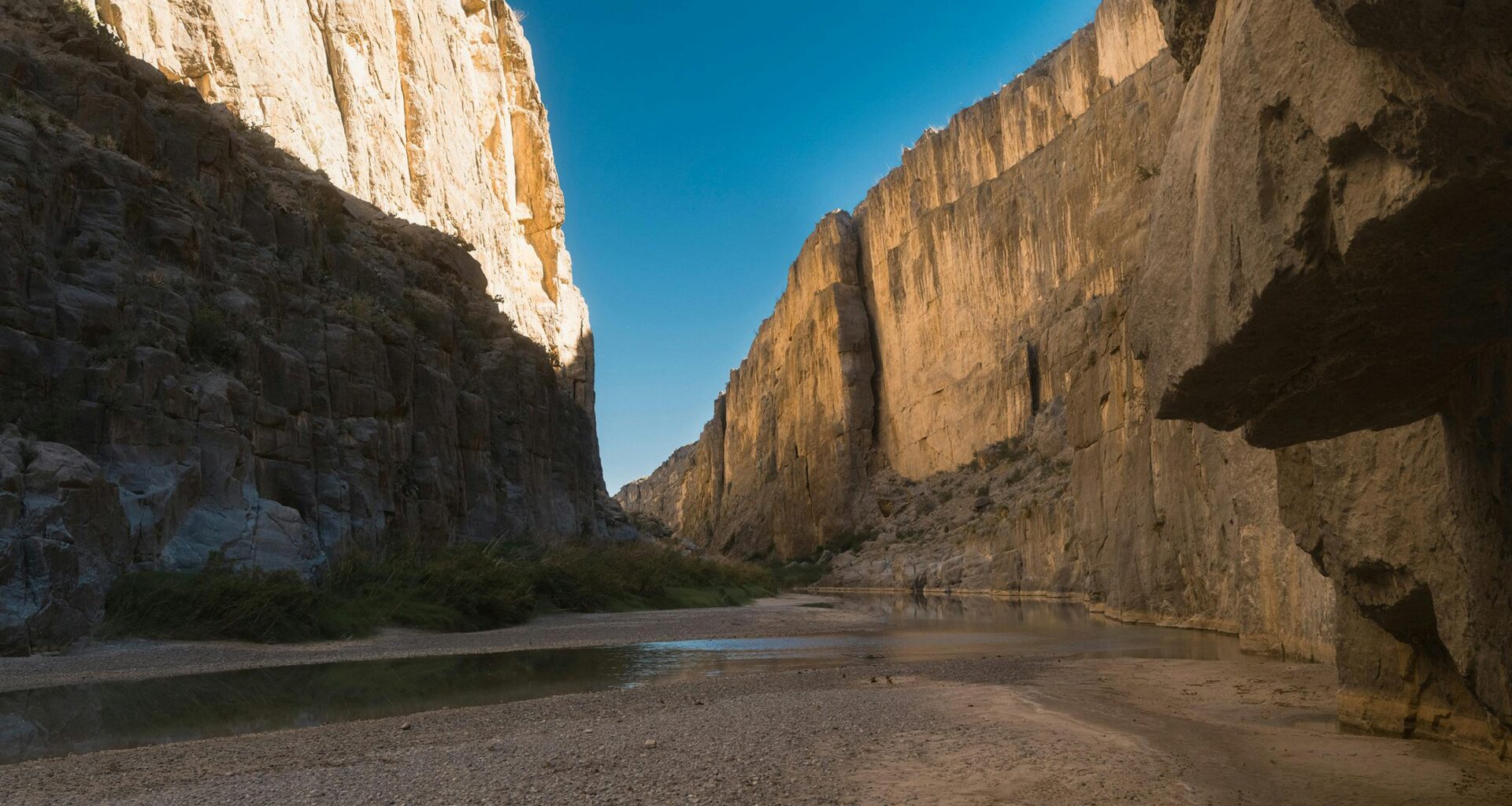
There’s a scenic overlook off the highway above the deep ravine of the Cañón del Pegüis in Chihuahua, Mexico, not far from the Texas border and Big Bend National Park. At the edge of this dramatic canyon stands a simple concrete monument, three concrete slabs arranged in a sort of X, the surface of which is pockmarked with craterous bullet holes—a local told me it’s where narcos go to blow off steam. On an early December day, I stood in the shade of this X, reading President Donald Trump’s Truth Social posts. “Mexico continues to violate our comprehensive Water Treaty, and this violation is seriously hurting our BEAUTIFUL TEXAS CROPS AND LIVESTOCK,” he posted on December 8. He said he was ready to raise a punishing 5 percent tariff on Mexico if the country didn’t immediately start sending water north. Hundreds of feet below me, as the wind blew, I could see the water Trump wanted: the thin, green line of the Río Conchos.
TM Audio subscribers can listen to this article.
Subscribe today for audio stories, bonus podcast episodes, and much more. Already a subscriber? Log in.
Listen to the story behind the story. For access, subscribe to TM Audio.
Most Texans have never heard of the Río Conchos, but it’s a waterway that’s vital to our state, even though its entire length—from the alpine reaches of the Sierra Madre through hostile deserts of Chihuahua—runs through Mexico, before finally joining the Rio Grande on the border with Texas. These are the stakes: Without water from the Río Conchos, South Texas could shrivel and die. In the midst of drought and overuse on the American side, cities like Laredo, McAllen, and Brownsville risk running out of drinking water within years if reservoirs aren’t replenished with water from the Conchos. In the farmland of the Rio Grande Valley, the lack of new water from the Mexican river has already helped destroy the Texas sugar industry, and it threatens to bring down citrus and cotton next.
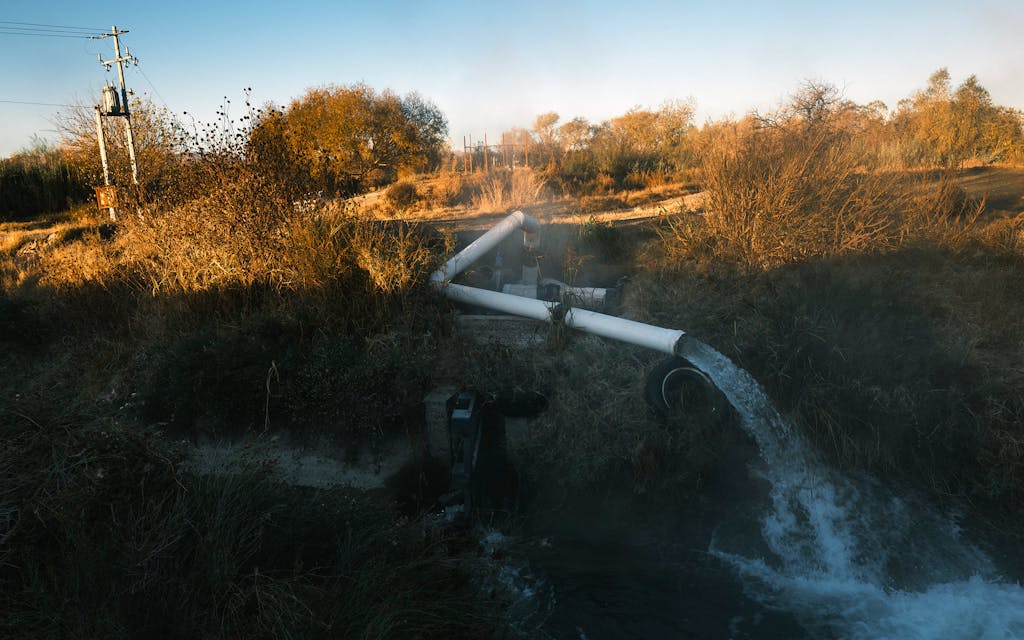 Water is pumped from the Río Conchos to a canal system in Julimes, Chihuahua, Mexico, on December 7, 2025.Photograph by Jordan Vonderhaar
The geography of North America makes the Río Conchos a thorn in the side of U.S.–Mexico relations, because without the Conchos, the Rio Grande—Texas’s great border river—would no longer make it to the Gulf. If you look at a map of the Rio Grande, the water appears to start high in the mountains of Colorado, descend through the desert of New Mexico, and then sweep along the entire 1,254 miles of Texas’s border with Mexico. But by 2000, that had stopped being the reality on the ground. Today, when the river gets south of El Paso, so many dams and canals have pulled out water for farmland upstream that the river is reduced to an algae-clogged trickle—and often the trickle stalls entirely. For much of the year, the river runs dry through the Forgotten Reach, some two hundred miles of dust and weeds between Fort Quitman and Presidio. Just outside Presidio, the Río Conchos meets the Rio Grande and recharges it. That means that today, Mexico controls the spigot on a river that Texas increasingly depends on. Laredo, for instance, relies on the Rio Grande for 100 percent of its drinking water. If the Conchos is held back, and the Rio Grande stops flowing, a Texas city of nearly 300,000 people runs out of water.
In December, in response to Trump’s threats of tariffs (which could cripple the Mexican economy), President Claudia Sheinbaum appeared to relent, agreeing that Mexico would send more than 65 billion gallons of water north by the end of the month. That huge amount of water—more than enough to supply the entire city of Dallas for a year—is only about a quarter of the debt Mexico owes under a major 1944 treaty that governs water use across the border. Yet the Trump administration victoriously proclaimed that they’d reached an “understanding” with Mexico for the country to meet its debt—on January 31, both countries will supposedly outline a “plan” for Mexico to address the shortage. Sheinbaum was more circumspect; at her daily morning press conference, she told reporters that Mexico couldn’t send water it didn’t have. When a reporter asked why Mexico had incurred a water debt, Sheinbaum replied, “There was a drought—because there wasn’t water. It’s simple as that.”
A week later, Mexico threw open the gates of reservoirs, and water started flowing north. But it wasn’t coming from the Río Conchos.
Another significant river flows north from Mexico into the Rio Grande. To the east, the Río San Juan curls around Monterrey, Mexico’s financial powerhouse, and joins with the Rio Grande, near Mission, Texas. Since December, Mexico has released water from El Cuchillo (“The Knife”), the large reservoir that feeds Monterrey. This is the water the country is using to meet its debt. (Some water has also been released from the Conchos basin, but it is not a significant amount.)
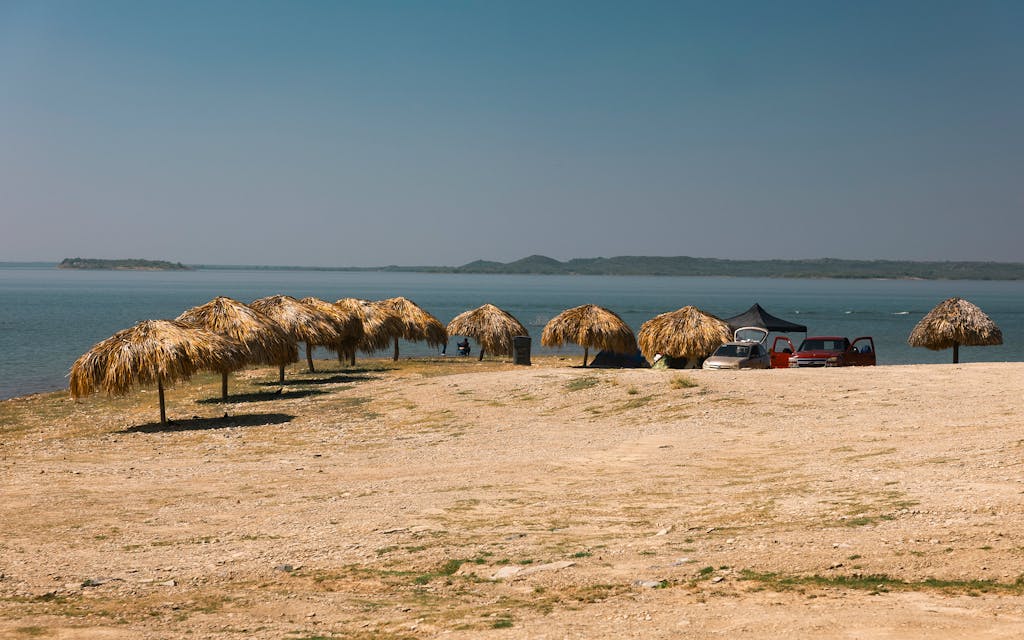 A recreational beach on the shores of El Cuchillo reservoir east of Monterrey, Nuevo Leon, Mexico, on October 28, 2025.Photograph by Jordan Vonderhaar
The sad reality here: This isn’t the water Texas farmers and officials want. San Juan water is perilously salty, and it enters the Rio Grande downstream of cities like Laredo and all borderland reservoirs. That means that Texas can’t bank the water to send to cities if the drought intensifies next year, and farmers might not be able to use all the water for their crops. But Texas will take what it can get. “Is that water good? No,” Dante Galeazzi, the president and CEO of the Texas International Produce Association, told me. “But it’s water that’s wet. Not theoretical water. It’s water we can actually do something with.” In recent years, farmers have managed San Juan water by mixing it with fresher water or treating it with sulfur; but for two months last summer, the water quality got so bad that Texas told Mexico to stop sending it entirely. It was useless.
Yet to send this subpar water north, Sheinbaum is creating a serious risk for her own citizens. Monterrey has already run out of water once.
In 2020, Mexico temporarily relinquished its rights to water held in international reservoirs in order to satisfy its water debt to the U.S. This meant that Mexican farmers and residents downstream, in particular in the border state of Tamaulipas, wouldn’t get the Rio Grande water they also relied on. To make up for this missing water, the Mexican government began taking large amounts of water out of reservoirs in the San Juan basin and sending it east toward Tamaulipas. In 2022, in the midst of historic drought, Monterrey—one of the richest cities in Latin America—ran out of water. For months, entire neighborhoods had empty taps. Bottled water was cleared off all shelves. When I traveled through the city last fall, residents told me that, during the worst of the crisis, scalpers had hawked plastic buckets, selling them at many times their value to residents desperate to haul water.
Why would Sheinbaum ever put Mexico’s industrial capital in jeopardy—especially with a stampede of World Cup tourists set to arrive this summer—all to send Texas water that it doesn’t really want? Why not send the coveted water from the much larger Río Conchos instead?
To put a complex problem in its simplest terms: sending water out of Chihuahua could be a battle Sheinbaum might not win. Even before the years in which Pancho Villa led his cavalry through Chihuahua, the Mexican central government has struggled to control its largest, most rugged state. In 2020, Sheinbaum’s predecessor and mentor, President Andrés Manuel López Obrador, learned this lesson the hard way when he opened the gates of La Boquilla, Chihuahua’s largest reservoir, to send Conchos water north. Large growers and campesinos—peasant farmers—all rose up in protests so massive that AMLO sent in the military. At the height of the drama, two farmers were shot, and one died. After that, AMLO didn’t try to send water from the Río Conchos basin again. Instead, he gave the Americans water directly out of the large cross-border reservoirs that both countries rely on (what diplomats call a “paper transfer). In 2022, Monterrey ran out of water.
Today, Sheinbaum seems unwilling to test whether chihuahuenses would rise up again. Even before Trump’s latest round of pressure, rural Mexico was already a powder keg: Seeking to fight back against unregulated and extralegal water use, Sheinbaum’s administration passed a new national water law, affirming that all water rights ultimately belong to the government and limiting private land owners’ ability to sell or transfer their water concessions. It will also attempt to create a new national registry of water users to try to crack down on unlicensed water users (a serious problem in states like Chihuahua). While I was in Chihuahua in December, farmers drove their tractors onto freeways and even the international bridge across from El Paso to protest the new law. Texas’s water demands have been front-page news in Chihuahua in the last month, but so far the protests haven’t boiled over, because officials have only released water from one small reservoir close to the Texas border in Chihuahua. Instead, the vast majority of the water the Sheinbaum government is currently sending north is coming out of the San Juan system.
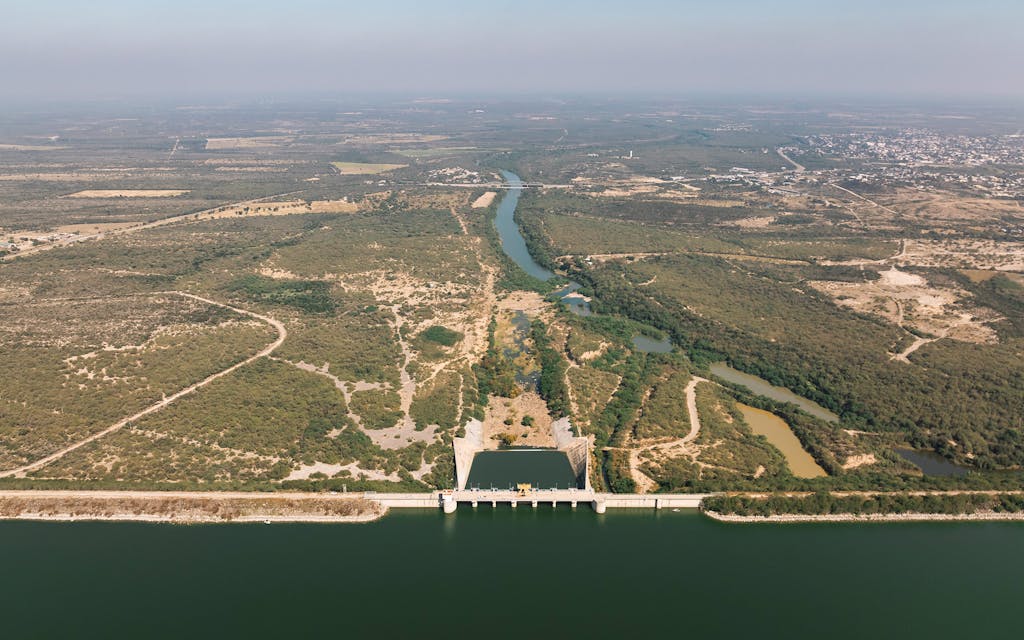 An aerial view of El Cuchillo reservoir east of Monterrey, Nuevo Leon, Mexico, on October 28, 2025.Photograph by Jordan Vonderhaar
While the 1944 treaty gives the two countries vague latitude to adjust water deliveries in times of drought, Trump administration officials are clear they expect Mexico to pay the full debt, and they’re willing to use whatever leverage they have to get it. Since mid-December, Mexico has emptied about 16 percent of El Cuchillo, which is enough to cover three-to-four months of water use in Monterrey.
It won’t be enough.
“These are just bandaids. They’re just buying time—for what, I don’t know,” Rosario Sanchez, a senior research scientist at the Texas Water Resources Institute, told me. Sanchez explained that, even if the Sheinbaum administration emptied the reservoir and doomed Monterrey, it wouldn’t be enough to satisfy Mexico’s water debt and future treaty obligations. There’s simply not enough water in the San Juan basin.
“We are seeing the limits of the treaty,” Sanchez said. “Mexico is not able to fulfill that amount of water.”
The farmers I’ve met in South Texas are sympathetic to the fact that Mexico is indeed in drought. But they are entirely unsympathetic to any excuse that doesn’t acknowledge Mexican overuse. For instance, in the last thirty years, the pecan industry has exploded in Chihuahua, more than doubling its already vast acreage. (Pecan growth has grown markedly along the Rio Grande in West Texas and New Mexico over that same span—a large reason why so little water makes it south of El Paso.) Tree nuts are some of the most water-thirsty crops, and farmers in Texas are furious that Chihuahua has planted more and more trees as the state falls further and further behind in its water debt.
“What Chihuahua is doing is they are farming in the desert,” Galeazzi, the president of the produce association, said. “Imagine, instead of the city of Las Vegas being in the middle of a desert in Nevada, you put a bunch of pecan groves. That’s going to take four or five times the amount of water you need because of the arid environment.”
While Galeazzi, as a voice for the South Texas produce industry, is resolute that Chihuahua needs to send more water to Texas, he agrees with experts like Sanchez on a sobering reality: “Getting water from Mexico is not a silver bullet,” he said. Even if Mexico sent every last drop of its treaty obligations from the Conchos, that water would still only meet about one-third of the RGV’s needs. “It is a looming disaster,” Galeazzi said. While he applauds officials in Texas and Washington, D.C., for putting pressure on Mexico to send the water farmers are owed, he worries that focusing on Mexico lets our leaders ignore problems here at home: Without major investment in water infrastructure and tough decisions about water use, the RGV will run out of water, no matter what Mexico chooses to do.
In January, Trump turned up the heat on Sheinbaum and her administration. The morning after the stunning kidnap-arrest of President Nicolás Maduro of Venezuela, Trump called into Fox & Friends, and one of the hosts asked if the operation was an attempt to send “a message” to Sheinbaum and Mexico. Trump initially said it wasn’t but went on to claim that Sheinbaum wasn’t in control of her own country—the cartels were. He again weighed military strikes within the country. “Something is going to have to be done with Mexico,” he said.
Read Next